

The foam roller market has evolved dramatically from simple cylindrical tubes to sophisticated recovery devices. Today’s athletes and fitness enthusiasts face a choice between smart foam rollers with integrated technology and vibrating foam rollers that add percussion therapy to traditional rolling. This comprehensive comparison examines both options to help you make an informed decision for your recovery routine.
Understanding the Technology
Smart Foam Rollers: Connected Recovery
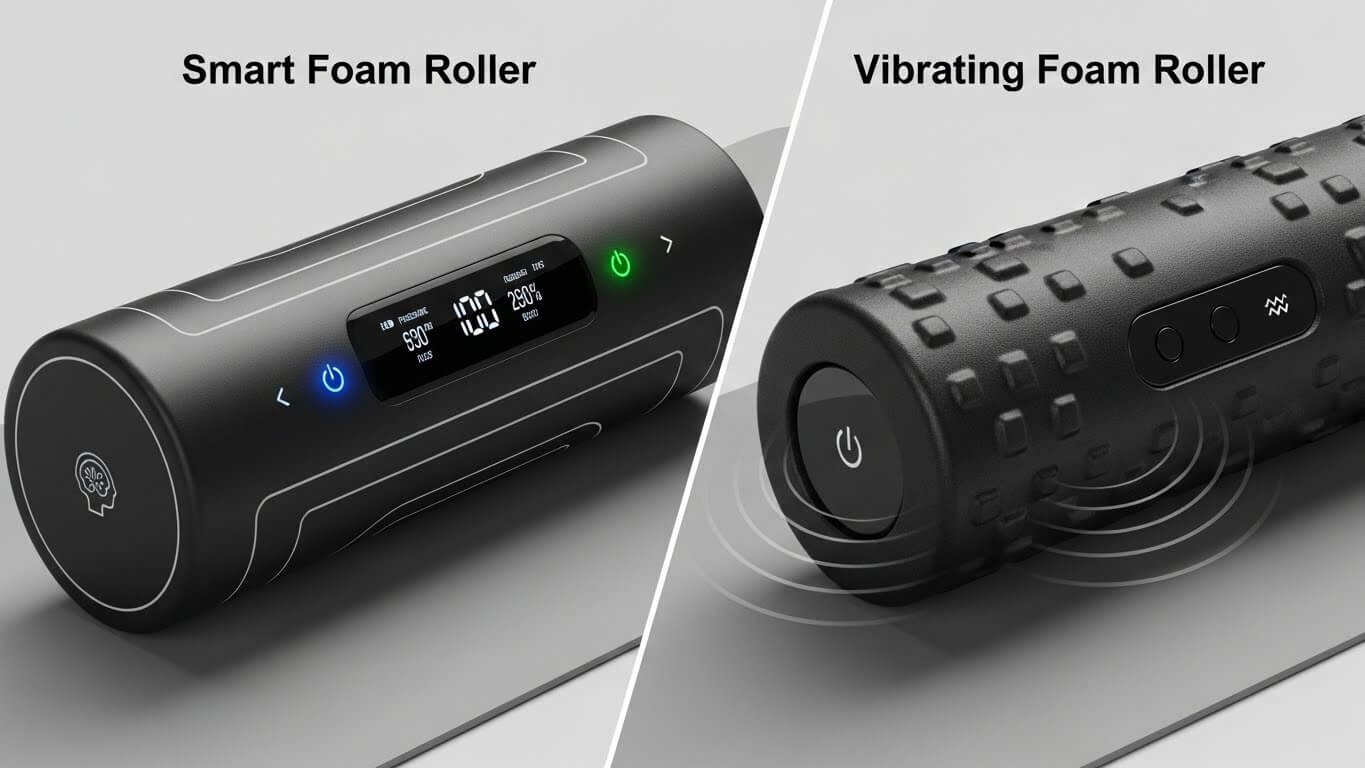
Smart foam rollers represent the cutting edge of self-myofascial release technology. These devices integrate sensors, Bluetooth connectivity, and companion apps to transform a simple recovery tool into a comprehensive training platform.
The technology typically includes pressure sensors embedded throughout the roller’s surface that detect how much force you’re applying during each session. This data transmits wirelessly to your smartphone or tablet, where sophisticated algorithms analyze your rolling patterns, identify problem areas, and track your progress over time.
Most smart rollers feature guided workout programs with visual feedback showing exactly where to position the roller and how much pressure to apply. The apps often include instructional videos, progress tracking dashboards, and personalized recommendations based on your activity level and recovery needs. Some advanced models even incorporate haptic feedback that vibrates to guide you through exercises or alert you when you’re applying too much pressure.
Vibrating Foam Rollers: Mechanical Muscle Relief
Vibrating foam rollers add motorized percussion to traditional foam rolling mechanics. An internal motor generates rapid vibrations, typically ranging from 1,500 to 4,000 pulses per minute, that penetrate deeper into muscle tissue than static pressure alone.
The technology is relatively straightforward compared to smart rollers. Most vibrating rollers offer multiple intensity settings controlled by simple buttons on the device itself. The vibrations work by stimulating mechanoreceptors in your muscles and fascia, which can reduce pain perception while increasing blood flow to the treated area.
Unlike smart rollers that focus on data and guidance, vibrating rollers prioritize immediate physical sensation and therapeutic effect. The oscillating motion helps break up adhesions in fascial tissue more aggressively than static rolling, making them particularly effective for stubborn knots and trigger points.
Recovery Effectiveness: What the Research Shows
Smart Foam Rollers and Performance Optimization
The primary advantage of smart foam rollers lies in their ability to optimize your recovery routine through data-driven insights. By tracking which areas receive the most attention and monitoring pressure consistency, these devices help ensure you’re not neglecting problem areas or overworking certain muscle groups.
Research on feedback-enhanced exercise suggests that real-time guidance can improve technique and consistency. Smart rollers apply this principle to myofascial release, helping users maintain appropriate pressure and duration for maximum benefit. The structured programs ensure comprehensive full-body coverage rather than the haphazard approach many people take with traditional rollers.
However, the recovery benefits ultimately depend on proper use of traditional foam rolling principles. The technology enhances the experience and adherence but doesn’t fundamentally change the physiological effects of myofascial release. Studies on foam rolling generally show modest improvements in range of motion and perceived muscle soreness, regardless of whether the roller includes smart features.
Vibrating Foam Rollers and Enhanced Muscle Recovery
Vibrating foam rollers demonstrate more direct physiological effects compared to their smart counterparts. Multiple studies have examined vibration therapy combined with foam rolling, with promising results.
A 2014 study published in the Journal of Clinical and Diagnostic Research found that vibration therapy significantly reduced delayed onset muscle soreness and improved range of motion more effectively than static stretching. When this vibration is combined with the mechanical pressure of foam rolling, users often experience faster relief from muscle tension.
The vibrations create a neurological effect known as vibration analgesia, temporarily reducing pain signals and making the rolling process more comfortable. This allows users to apply greater pressure and work deeper into tissue than they might tolerate with a traditional roller. The increased blood flow from vibration also accelerates the removal of metabolic waste products that contribute to muscle soreness.
Research specifically on vibrating foam rollers shows they can improve flexibility and reduce muscle soreness more quickly than non-vibrating alternatives. A study in the International Journal of Sports Physical Therapy found that vibrating rollers improved hamstring flexibility significantly more than traditional foam rolling after just five minutes of use.
Price Analysis: Investment and Value
Smart Foam Roller Costs
Smart foam rollers represent a significant financial investment, with prices typically ranging from $150 to $300 for quality devices. Premium models like the Vyper 3 and Hyperice Vyper Go can exceed this range when including subscription costs for advanced app features.
The initial purchase price is just one consideration. Many smart rollers require ongoing app subscriptions for full functionality, adding $5 to $15 monthly or $50 to $100 annually to the total cost of ownership. These subscriptions provide access to expanding workout libraries, detailed analytics, and personalized programming.
Battery life and replacement costs also factor into long-term value. Most smart rollers use rechargeable lithium-ion batteries that eventually degrade, potentially requiring expensive replacements or limiting the device’s useful lifespan to three to five years.
However, for serious athletes or those who value data-driven training, the investment can pay dividends through improved recovery consistency and injury prevention. The guided programs may also reduce the need for professional massage therapy sessions that cost $60 to $120 each.
Vibrating Foam Roller Costs
Vibrating foam rollers offer a more accessible entry point, with quality options available from $60 to $180. Budget-friendly models from established brands like TriggerPoint and RENPHO provide effective vibration therapy without breaking the bank.
These devices have no subscription fees or ongoing costs beyond occasional battery replacement or charging. Most use standard rechargeable batteries that last two to three years with regular use, and replacement batteries are typically inexpensive and easy to install.
The simpler technology generally means fewer points of failure and longer device longevity. Many users report their vibrating rollers lasting five years or more with regular use, making them a cost-effective long-term investment.
Premium vibrating rollers with more powerful motors, longer battery life, and durable construction fall in the $120 to $180 range but still cost significantly less than comparable smart rollers.
Head-to-Head Comparison
Ease of Use and Learning Curve
Smart foam rollers excel at guiding beginners through proper technique. The app-based instruction removes guesswork and ensures users target the right muscle groups with appropriate pressure and duration. The learning curve is minimal since the technology essentially coaches you through each session.
Vibrating foam rollers are even simpler to operate. Turn them on, select your preferred intensity, and roll. There’s no app to download, no account to create, and no pairing process. The straightforward operation appeals to users who want immediate results without technological complexity.
For travel and portability, both have limitations. Smart rollers require your phone nearby with adequate battery life and Bluetooth enabled. Vibrating rollers need charging but work independently. Neither is as convenient as a traditional foam roller for quick post-workout sessions at the gym.
Immediate Physical Sensation
Vibrating foam rollers provide undeniably more intense immediate sensation. The percussion penetrates deeper and often feels more therapeutic, especially for severe muscle tension. Users consistently report that vibrating rollers feel more like professional massage therapy.
Smart rollers offer traditional foam rolling sensation with the added benefit of knowing you’re applying optimal pressure. The feedback can prevent you from rolling too aggressively or too gently, but the physical experience is essentially standard myofascial release.
For pain tolerance, vibration can be both helpful and challenging. The oscillation may make rolling more comfortable by reducing pain perception, or it might intensify discomfort depending on individual sensitivity and muscle condition.
Long-Term Adherence and Motivation
Smart foam rollers shine in promoting consistency. The gamification elements, progress tracking, and structured programs keep many users engaged with their recovery routine. Seeing improvements in flexibility metrics or completing achievement milestones provides motivation that simple rolling lacks.
The social features in some apps, including challenges and leaderboards, create accountability. For individuals who struggle with recovery discipline, this technological encouragement can be transformative.
Vibrating foam rollers rely on the immediate gratification of muscle relief to maintain adherence. While this works well for many users, it lacks the long-term engagement strategies that smart technology provides. Once the novelty wears off, some users revert to inconsistent recovery habits.
Battery Life and Maintenance
Smart foam rollers typically offer 2 to 4 hours of active use per charge, which translates to several weeks of regular rolling sessions. However, maintaining Bluetooth connectivity and running the companion app drains smartphone battery, which can be inconvenient.
Vibrating foam rollers generally provide longer runtime, often 3 to 6 hours per charge, since they’re not streaming data or maintaining wireless connections. The simpler electronics also mean fewer potential technical issues.
Both require occasional cleaning and inspection for wear, but vibrating rollers with fewer electronic components are generally more durable and easier to maintain long-term.
Customization and Adaptability
Smart foam rollers offer superior customization through app-based programming. You can create targeted routines for specific sports, address particular problem areas, or follow programs designed by physical therapists and athletic trainers. The technology adapts to your progress and adjusts recommendations accordingly.
Vibrating foam rollers provide limited customization, typically just intensity adjustment. While some models offer multiple vibration patterns or speeds, the customization is far less sophisticated than smart roller capabilities.
For users with specific recovery needs or those training for particular sports, smart rollers provide more tailored solutions. Vibrating rollers work well for general muscle recovery but lack sport-specific programming.
Product Recommendations
Best Smart Foam Roller: Hyperice Vyper 3
The Hyperice Vyper 3 represents the gold standard in smart foam rolling technology. It combines powerful vibration (which provides immediate benefits even without using smart features) with comprehensive app integration that tracks your sessions and provides guided routines.
The three intensity settings offer versatility, while the rechargeable battery provides adequate runtime for regular users. The Hyperice app includes extensive exercise libraries organized by muscle group, sport type, and recovery goal.
At approximately $199, it represents a significant investment but delivers professional-grade recovery technology. The build quality ensures longevity, and the brand’s reputation provides confidence in ongoing app support and updates.
Best Value Smart Option: RollRecovery R4+
For budget-conscious buyers seeking smart features, the RollRecovery R4+ provides excellent value. Priced around $150, it offers tracking capabilities and app integration without the premium price tag of market leaders.
The unique four-roller design provides comprehensive muscle coverage, and the app includes solid instructional content. While the analytics aren’t as sophisticated as premium options, they’re sufficient for most users’ needs.
Best Vibrating Foam Roller: TriggerPoint GRID Vibe Plus
The TriggerPoint GRID Vibe Plus delivers exceptional value in the vibrating roller category. Priced at approximately $100, it provides reliable vibration therapy with the trusted GRID surface pattern that many therapists recommend.
The rechargeable battery offers impressive runtime, and the four vibration intensity settings accommodate everyone from beginners to advanced athletes. The durable construction ensures this roller will serve you well for years.
Best Budget Vibrating Option: RENPHO Vibrating Foam Roller
For those seeking effective vibration therapy without premium pricing, the RENPHO vibrating roller provides remarkable value at around $60. It delivers five intensity levels and includes a protective carrying case.
While the motor isn’t as powerful as premium alternatives and battery life is shorter, it provides legitimate vibration benefits at an accessible price point. It’s an excellent choice for trying vibration therapy before committing to a more expensive model.
Best for Targeted Therapy: Hyperice Hypersphere Mini
For addressing specific problem areas rather than full-body rolling, the Hyperice Hypersphere Mini combines smart technology with vibration in a compact sphere design. It’s perfect for feet, calves, and precise trigger point work.
The three vibration settings and Bluetooth app connectivity provide the smart roller experience in a specialized format. At approximately $149, it’s a premium investment for targeted recovery needs.
Frequently Asked Questions
Can I get both vibration and smart features in one device?
Yes, several products combine vibration with smart technology. The Hyperice Vyper 3 and Vyper Go both offer vibration therapy alongside app connectivity and guided programs. These hybrid devices typically cost more than vibration-only rollers but less than pure smart rollers with advanced sensors. They represent an excellent middle ground for users who want both immediate physical relief and data-driven guidance.
How loud are vibrating foam rollers?
Noise levels vary significantly by brand and model. Premium vibrating rollers like those from Hyperice and TriggerPoint operate relatively quietly at around 50 to 60 decibels, similar to normal conversation. Budget models can be noticeably louder, sometimes reaching 70 to 75 decibels, comparable to a vacuum cleaner. If noise concerns you, read reviews specifically mentioning sound levels or choose established brands known for quieter motors.
Do smart foam rollers work without the app?
Most smart foam rollers function as standard foam rollers without app connectivity, though you lose the primary benefits that justify their higher cost. Some models include basic vibration features that work independently, but the tracking, guidance, and feedback require the companion app. If you’re not committed to using the app regularly, a smart roller probably isn’t worth the investment.
How long do the batteries last in these devices?
Per-charge battery life typically ranges from 2 to 6 hours of active use, depending on intensity settings and features used. Smart rollers with Bluetooth connectivity generally drain faster than simple vibrating models. In terms of overall battery lifespan, expect 2 to 4 years before rechargeable batteries begin losing capacity. Most devices use standard lithium-ion batteries that can be replaced, though some require professional service for battery replacement.
Can vibrating foam rollers replace professional massage?
While vibrating foam rollers provide significant muscle relief and can reduce the frequency of professional massage appointments, they cannot fully replace hands-on therapy. Massage therapists can assess muscle condition, adjust pressure dynamically, and reach areas you cannot effectively treat yourself. Vibrating rollers excel at maintenance between professional sessions and can extend the time between appointments, potentially saving money while maintaining muscle health.
Are smart foam rollers worth it for beginners?
Smart foam rollers offer exceptional value for beginners who lack knowledge about proper technique, muscle anatomy, or recovery protocols. The guided instruction prevents bad habits and ensures effective treatment from the start. However, beginners should honestly assess their commitment to regular use. If you’re uncertain about maintaining a recovery routine, start with a traditional or vibrating roller before investing in smart technology. You can always upgrade once you’ve established the habit.
Which option is better for IT band issues?
For stubborn IT band syndrome, vibrating foam rollers generally provide more immediate relief due to deeper tissue penetration. The vibrations help reduce pain perception, making it easier to apply the sustained pressure needed for IT band treatment. However, smart rollers can ensure you’re positioning correctly and applying consistent pressure along the entire IT band. If you have chronic IT band problems, consider a vibrating roller for immediate relief or a hybrid device that combines vibration with guidance features.
How do I clean and maintain these electronic foam rollers?
Both smart and vibrating foam rollers require minimal maintenance. Wipe down the surface after each use with a damp cloth and mild soap to remove sweat and oils. Avoid submerging electronic rollers in water or using harsh chemicals that might damage the surface material. Store in a cool, dry place away from direct sunlight. For vibrating models, occasionally check that the vibration mechanism remains secure and that the battery charges properly. Smart rollers benefit from keeping the companion app updated to the latest version. Most quality rollers will last 3 to 5 years with basic care, and some exceed 7 years with gentle use.
Conclusion
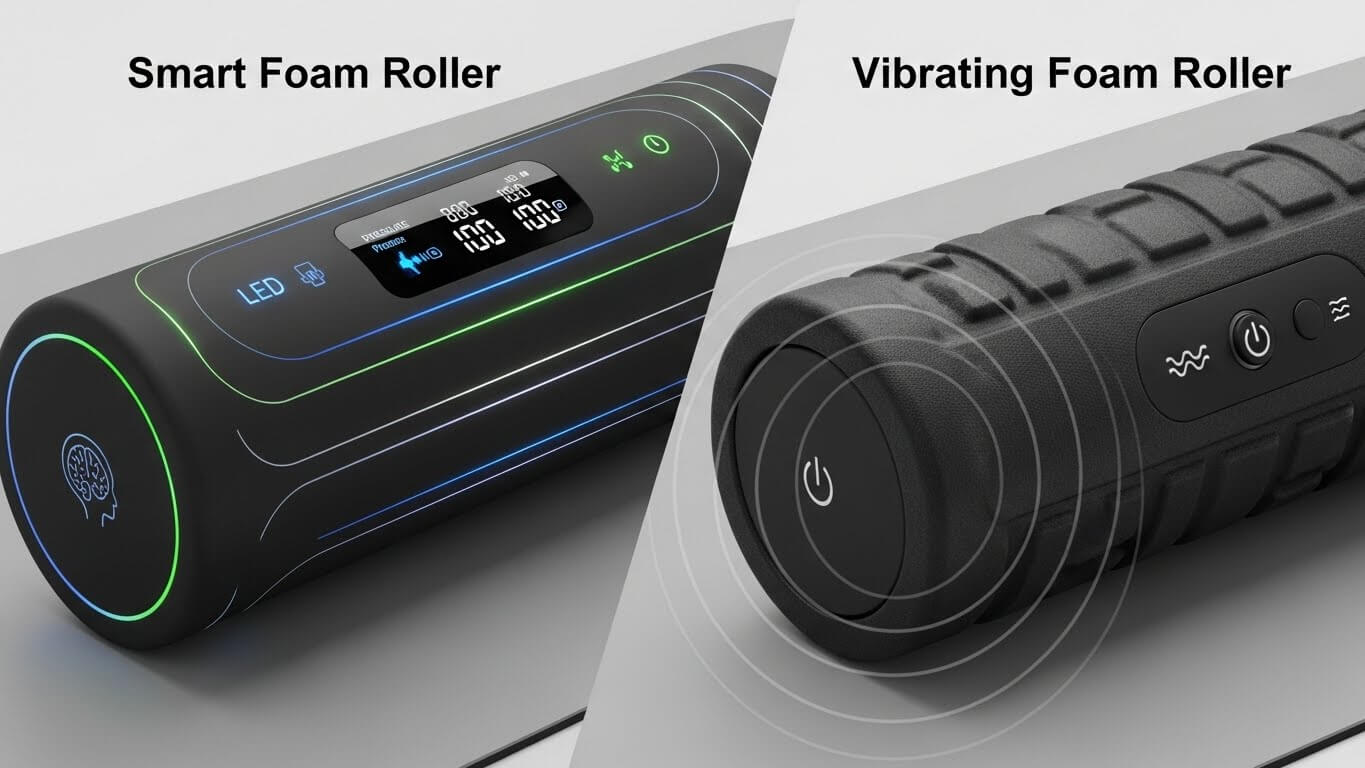
Your choice between smart and vibrating foam rollers ultimately depends on your recovery priorities and personal preferences.
Choose a smart foam roller if you value data-driven insights, need guidance on proper technique, struggle with consistency in your recovery routine, or enjoy technological integration with your fitness regimen. Smart rollers excel at building sustainable recovery habits through structure and accountability. They’re ideal for tech-savvy users, those new to foam rolling who want comprehensive instruction, or athletes who want to optimize every aspect of their training and recovery.
Choose a vibrating foam roller if you prioritize immediate muscle relief, prefer straightforward operation without apps, want deeper tissue penetration for chronic tension, or seek maximum value for your investment. Vibrating rollers deliver more intense physical therapy and work exceptionally well for stubborn muscle soreness. They’re perfect for experienced rollers who understand proper technique, users who want no-nonsense recovery tools, or anyone dealing with significant muscle tightness that requires aggressive treatment.
Consider your budget carefully. If $150 to $300 is a reasonable investment for optimized recovery with ongoing guidance, smart rollers justify their cost. If you prefer a one-time purchase under $150 with no subscriptions, vibrating rollers provide better value.
Think about your technical comfort level. If you enjoy fitness apps and tracking your progress across multiple metrics, you’ll appreciate what smart rollers offer. If technology sometimes feels like a barrier to just getting things done, the simplicity of vibrating rollers will serve you better.