

Back pain, muscle tension, and chronic stress affect millions of people worldwide, driving the search for effective, affordable at-home relief solutions. While professional massage therapy and chiropractic care provide powerful benefits, the cost and scheduling challenges make regular treatment impractical for many.
Two popular home therapy options have emerged to fill this gap: acupressure mats featuring thousands of plastic spikes that create intense stimulation through body weight, and massage chair pads offering automated massage through motors, rollers, and vibration. Both promise pain relief, relaxation, and improved well-being from the comfort of home, yet they work in fundamentally different ways and cater to different preferences and needs. Which approach delivers better results? Is the ancient wisdom of acupressure more effective than modern massage technology, or do automated chair pads justify their higher price through superior convenience and features?
In this comprehensive guide, we’ll examine how each therapy works, compare their effectiveness across various applications, evaluate value propositions, and help you determine which solution best addresses your specific pain, recovery goals, lifestyle, and budget.
Understanding Back Pain and Muscle Tension
Back pain and muscle tension stem from various sources affecting people differently. Poor posture during prolonged sitting, especially with inadequate lumbar support or forward head position, strains muscles and compresses spinal structures. Muscle imbalances occur when certain muscles become tight while opposing muscles weaken, creating dysfunction and discomfort.
Stress and anxiety cause unconscious muscle tension, particularly in the neck, shoulders, and back. Overuse from repetitive motions without adequate rest leads to chronic tightness and pain. Sedentary lifestyle results in weak core muscles that fail to support the spine properly. Previous injuries create compensatory patterns and residual tightness. Age-related changes include disc degeneration, reduced flexibility, and decreased muscle mass.
Inadequate sleep prevents complete muscle recovery and repair. Poor lifting technique or sudden movements can strain muscles acutely. These factors often combine, creating complex pain patterns requiring multifaceted approaches to relief.
Both acupressure and massage therapy address pain through various mechanisms. Pain modulation occurs through the gate control theory, which involves stimulating sensory nerves to “close the gate” to pain signals travelling to the brain, providing immediate relief. Increased circulation from stimulation delivers oxygen and nutrients while removing metabolic waste products, supporting healing and reducing inflammation.
Muscle relaxation happens as sustained pressure or rhythmic stimulation triggers reflexes that signal muscles to release tension. Endorphin release results from the body producing natural pain-relieving chemicals in response to stimulation. Stress reduction activates the parasympathetic nervous system, promoting relaxation that extends beyond just the treated area.
Improved sleep often results from effective pain relief and relaxation. Enhanced mood and reduced anxiety contribute to overall well-being. These benefits explain why various massage and pressure therapies remain popular despite limited large-scale scientific research supporting some specific claims.
Acupressure Mats: Details
What Are Acupressure Mats?
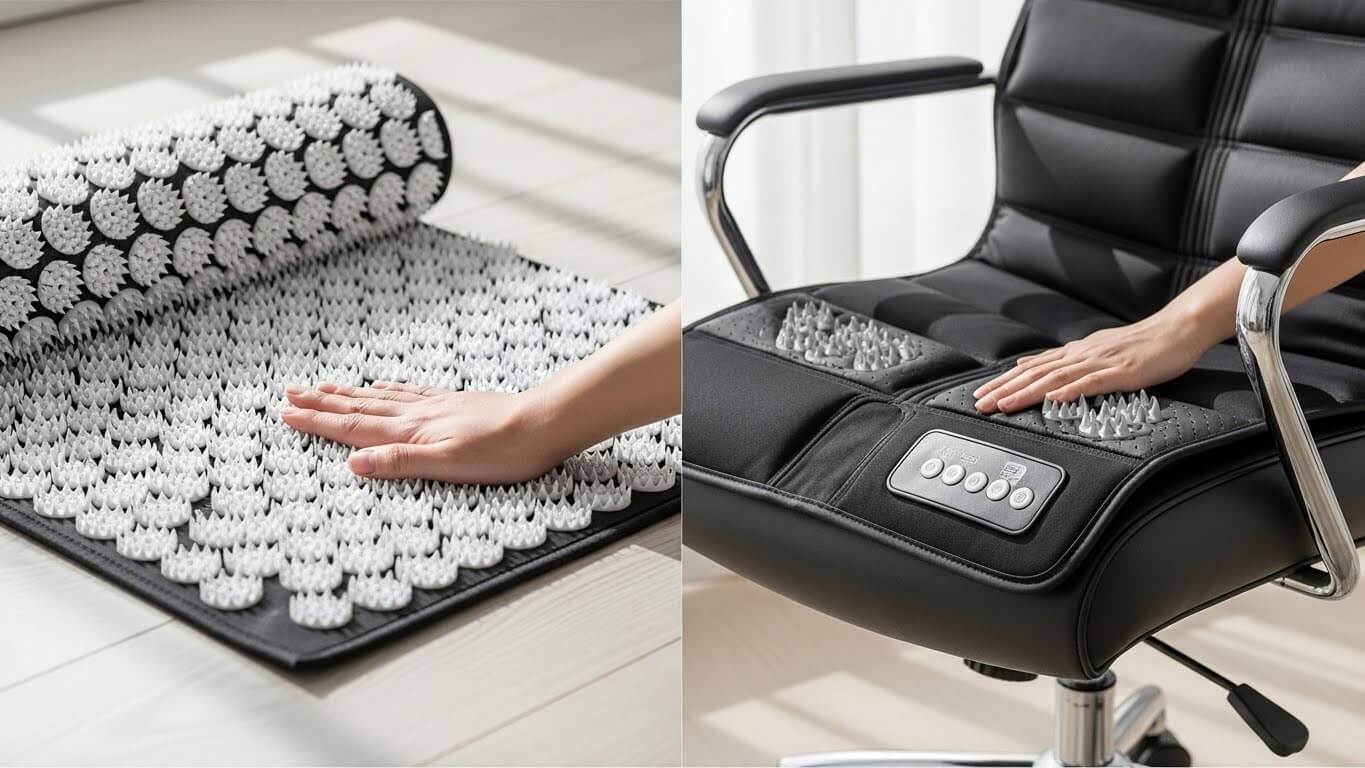
Acupressure mats are foam pads covered with thousands of small plastic spikes designed to stimulate pressure points across your back. Inspired by the Indian “bed of nails” tradition and acupressure principles, modern mats make the concept accessible and comfortable for home use.
Most mats measure approximately 26″ x 16″ to accommodate the back, with matching pillow options for neck and head. They feature 6,000-8,000 individual plastic points creating intense but generally safe stimulation. Materials include high-density foam bases covered with fabric, typically cotton or linen, with ABS plastic spikes arranged in disc formations called “flowers.”
Prices range from $20 for basic budget models to $80 for premium versions with higher-quality materials, better foam, and accessories like pillows or carrying bags. Most effective mats cost $30-$50.
How Acupressure Mats Work
The mechanism is simultaneously simple and complex. You lie on the mat, and your body weight presses into thousands of plastic spikes. The initial sensation is intensely prickly, uncomfortable but not typically painful. After 30-60 seconds, the discomfort usually transforms into warmth and tingling as your body adapts.
The proposed mechanisms include acupressure point stimulation similar to acupuncture but using pressure instead of needles, triggering the body’s healing response. Endorphin release occurs as the intense stimulation prompts the nervous system to produce natural pain relievers. Improved circulation results from skin stimulation, increasing blood flow to the area. Muscle relaxation follows as the parasympathetic nervous system activates in response to the treatment.
The gate control theory suggests that intense sensory input from thousands of pressure points may block pain signals, providing relief. Users typically report feeling relaxed, energised, or sometimes both; a seemingly paradoxical but common response.
Types and Variations
Basic acupressure mats ($20-$35) offer standard spike configurations with simple foam padding and basic fabric covers. Mid-range options ($35-$60) feature higher-quality materials, including thicker, more comfortable foam, durable fabric covers, additional neck pillows, and carrying bags.
Premium sets ($60-$80+) include multiple pieces like full-length mats plus separate neck pillows, sometimes foot mats, organic or eco-friendly materials, and superior construction. Speciality variations include extra-long mats for taller users, travel-sized compact versions, and therapeutic mats with specific spike patterns claiming targeted benefits.
The quality differences affect comfort and durability more than effectiveness—even budget mats provide the core acupressure experience.
Effectiveness and Benefits
Research on acupressure mats specifically is limited, but user experiences and related research on acupressure suggest several benefits. Pain relief is the most commonly reported benefit, with many users experiencing reduced back pain, neck tension, and general muscle soreness. Studies on acupressure generally show pain-reducing effects for various conditions.
Relaxation and stress reduction occur consistently, with users reporting deep relaxation during and after sessions. Improved sleep quality is frequently mentioned, particularly when mats are used in the evening. Energy boost paradoxically accompanies relaxation for many users—the endorphin release may explain this energised yet relaxed state.
Improved circulation is evidenced by skin warming, redness, and tingling during use. Some users report reduced headache frequency, improved mood, and an overall sense of well-being. The dramatic price-to-benefit ratio is exceptional; $30-$50 for unlimited use provides outstanding value if it works for you.
Limitations and Considerations
Acupressure mats aren’t for everyone. Initial discomfort can be intense, even painful, during the first minute. Some users never adapt to the sensation and find it unbearable. The experience is completely passive; you simply lie there, which some find boring or unstimulating.
Limited targeting makes it difficult to focus on specific problem areas; the mat treats wherever your body contacts it uniformly. The sensation is intense but lacks the deep pressure of massage. Results vary dramatically between individuals; some experience profound benefits, while others feel minimal effects.
Contraindications include open wounds, skin conditions in contact areas, pregnancy (consult doctors first), blood clotting disorders or blood thinner use, and acute injuries or inflammation. The mats work only on areas you can lie on: back, neck, and sometimes feet; not shoulders, arms, or legs effectively.
Massage Chair Pads: Details
What Are Massage Chair Pads?
Massage chair pads are portable devices featuring motors, rollers, and vibration mechanisms that drape over regular chairs, transforming them into massage chairs. They offer automated massage without the $2,000-$8,000+ cost of full massage chairs.
These pads typically measure 40-50″ long to cover from head to lower back. They feature multiple motors creating various massage modalities, rollers moving up and down the spine, vibration nodes targeting specific areas, and sometimes heat therapy. Most include remote controls for operation and adjustment.
Prices range from $50 for basic vibration-only models to $400+ for sophisticated pads with advanced features. Most effective models cost $100-$250.
How Massage Chair Pads Work
The mechanism involves several technologies. Shiatsu massage uses rotating nodes that press and knead muscles, mimicking the circular motions of Japanese massage. The rolling massage features nodes travelling up and down the spine, working along vertebrae and paraspinal muscles.
Vibration massage provides gentle oscillation, promoting relaxation and circulation. Spot massage targets specific areas with concentrated attention. Heat therapy on some models warms muscles, enhancing relaxation and increasing blood flow.
Users sit against the pad in regular chairs, secure it with straps, and select the desired massage program, intensity, and features via remote control, then relax for 15-30 minutes while the device works. The automated nature means completely hands-free operation with consistent, reliable stimulation.
Types and Price Ranges
Budget massage chair pads ($50-$100) offer basic vibration with limited features, few massage modes, and simple controls. These provide entry-level massage experience with limited durability. Mid-range pads ($100-$250) feature multiple massage types, including shiatsu and rolling, heat therapy, spot massage capabilities, better motors and construction, and longer warranties.
Premium pads ($250-$400+) deliver advanced features like customizable programs, superior roller quality providing deeper massage, full-body coverage from neck to thighs, quiet operation with powerful motors, and premium materials. Professional-grade pads ($400+) approach full massage chair quality in a portable format with sophisticated programming and durability for daily intensive use.
The sweet spot for most users is the $120-$200 range, balancing features, quality, and value.
Effectiveness and Benefits
Massage chair pads provide substantial benefits. Automated deep massage reaches muscle layers that passive acupressure can’t access effectively. The kneading and rolling motions release muscle knots and tension through mechanical work.
Customizable intensity allows adjustment from gentle to strong based on preference and needs. Targeted treatment focuses on specific areas: upper back, lower back, or full spine. The convenience factor is major; sit, press start, and relax while the device works, allowing multitasking like watching TV or reading.
Heat therapy, when included, enhances muscle relaxation and pain relief significantly. Consistent, reliable performance delivers the same quality massage each session without variation. Users report significant pain reduction, improved mobility, and deep relaxation comparable to professional massage for many types of muscle tension.
Limitations and Drawbacks
Chair pads have notable limitations. High cost compared to acupressure mats typically 3-10 times more expensive; creates a significant barrier. They require electricity, becoming useless during power outages. The devices are bulky with limited portability compared to simple mats.
Mechanical components can break or malfunction, requiring repair or replacement. The massage quality, while good, doesn’t match professional massage therapists who adjust technique responsively. Noise from motors, though reduced in quality models, can detract from relaxation.
The pads work only in seated positions, limiting treatment to back areas accessible while sitting. They don’t effectively treat legs, arms, or other body parts. Some users find the automated massage too intense or not intense enough without sufficient adjustability. The one-size-fits-all approach may not suit all body types or chair configurations.
Head-to-Head Comparison
Pain Relief Effectiveness
Winner: Massage Chair Pads (for most users)
For mechanical pain relief through muscle work, massage chair pads generally outperform acupressure mats. The active kneading, rolling, and deep pressure release muscle knots and tension more effectively than passive spike pressure. Users with chronic muscle tension, knots, or mechanical back pain typically experience superior relief from automated massage.
However, acupressure mats work surprisingly well for some individuals, particularly for general tension and pain related to stress or circulation issues. The dramatic individual variation means some people achieve better results with mats; this minority experiences profound benefits from the unique stimulation.
For the majority of users seeking mechanical muscle relief, chair pads deliver more consistent, significant results.
Relaxation and Stress Reduction
Winner: Tie (different experiences)
Both approaches effectively promote relaxation through different mechanisms. Acupressure mats trigger intense endorphin release, creating a unique, relaxed-yet-energized state many find addictive. The experience is meditative for those who adapt to the sensation.
Massage chair pads provide familiar, comfortable relaxation through gentle massage without the initial discomfort challenge. The soothing kneading and heat create spa-like relaxation accessible to everyone.
Personal preference determines which feels more relaxing. Try both if possible to discover your response.
Ease of Use and Convenience
Winner: Massage Chair Pads
Chair pads offer superior convenience; sit down, press start, and relax while the device works. Remote control operation allows adjusting settings without getting up. Using it while working, watching TV, or reading enhances multitasking.
Acupressure mats require lying down, dedicating 10-30 minutes to the activity without multitasking effectively. The initial discomfort demands mental adjustment. While not difficult, mats require more commitment to the experience.
For pure convenience, automated massage wins clearly.
Portability and Storage
Winner: Acupressure Mats
Acupressure mats roll up compactly, fitting in closets, under beds, or in travel bags easily. They weigh just 1-3 pounds and require no setup; just unroll and use. Perfect for travel, office use, or small living spaces.
Massage chair pads are bulkier, heavier (5-15 pounds), require storage space, and are less practical for frequent travel. While reasonably portable compared to full massage chairs, they’re significantly less convenient than mats.
For minimalists, travelers, or those with limited space, mats win decisively.
Cost and Value
Winner: Acupressure Mats (significantly)
At $30-$50 versus $100-$250 for effective models, acupressure mats cost 1/3 to 1/5 as much. For users who adapt well to the sensation and achieve good results, the value is extraordinary; unlimited use for years at minimal investment.
Massage chair pads cost more but potentially deliver more consistent benefits for a broader user base. The higher price may be justified if results significantly exceed the mat effectiveness for your specific needs.
For budget-conscious users or those uncertain about committing substantial money to back pain relief, mats provide a low-risk entry.
Versatility and Body Coverage
Winner: Acupressure Mats (slightly)
Mats work on the back, neck, feet, and theoretically other body parts you can press against spikes. They function while lying down, sitting on them, or even standing on them (for feet). Different positions provide varied experiences.
Chair pads work primarily for the back and neck while seated. They don’t effectively treat other body areas. However, within their intended scope, they offer more targeted, adjustable treatment.
For whole-body potential, mats have an edge. For focused back treatment, both work well.
Durability and Longevity
Winner: Acupressure Mats
Simple mats with no moving parts last for years often 5-10+ years, with minimal degradation. The only wear is foam compression and fabric fading. Replacement cost is minimal.
Massage chair pads contain motors and electronics that eventually fail, typically lasting 2-5 years with regular use. Repair is often impractical; replacement becomes necessary at $100-$250.
Over a decade, you might spend $30-$60 on mat replacement versus $200-$500 replacing chair pads multiple times.
Who Should Choose Each Option
Choose Acupressure Mats If…
Acupressure mats suit specific user profiles excellently. Budget-conscious individuals with $30-$50 to spend get effective therapy at minimal cost. Minimalists wanting simple, low-tech solutions appreciate the no-electricity, no-maintenance approach.
People open to intense sensations who don’t mind the initial prickly discomfort benefit most. Those seeking endorphin-based pain relief rather than mechanical muscle work may respond better to mats’ unique stimulation. Users wanting portable solutions for travel, office, or small spaces need the compact, lightweight option.
Individuals experiencing general tension, stress-related pain, or circulation issues often achieve good results. Those wanting to experiment with acupressure therapy at minimal financial risk should start with mats. People who enjoy lying down for relaxation find the format natural.
Users interested in energy medicine, alternative therapies, or Eastern healing traditions often gravitate toward mats philosophically.
Choose Massage Chair Pads If…
Chair pads serve different needs excellently. People with chronic muscle knots, tension, or mechanical back pain need active massage to work muscles directly. Those seeking maximum convenience want an automated massage while sitting in their favourite chair.
Users uncomfortable with intense initial sensations prefer gentle, gradually adjustable massage. Individuals willing to invest $100-$250 for superior features and capabilities prioritize quality and effectiveness over budget. People wanting heat therapy and varied massage modes benefit from chair pad features.
Those who sit extensively for work or relaxation appreciate treating back pain without lying down. Users seeking spa-like experiences at home want the familiar comfort of automated massage. Individuals with mobility issues who find lying down difficult or uncomfortable need seated treatment options.
People who’ve tried acupressure mats without adequate results often discover automated massage provides the missing therapeutic element.
Some back pain sufferers strategically use both. Acupressure mats handle morning awakening sessions for energy and circulation, quick afternoon tension relief, and evening pre-sleep relaxation. Massage chair pads provide deep evening muscle work after long workdays, targeted relief for specific problem areas, and weekend extended relaxation sessions.
This combination maximises benefits—the unique stimulation of mats plus deep muscle work of chair pads, while providing options for different moods and needs. Starting with an affordable mat and adding a chair pad later if needed minimizes risk while maximizing flexibility.
Cost-Benefit Analysis
Initial Investment
Acupressure mats cost $30-$50 for quality models, with budget options at $20 and premium sets reaching $80. Budget massage chair pads cost $50-$100, mid-range models run $100-$250, and premium pads cost $250-$400+.
The investment gap ranges from 2x to 10x more for chair pads versus mats.
Long-Term Value
Over five years, an acupressure mat costs a total $30-$100, including occasional replacement. Massage chair pads cost $100-$500, including likely replacement after 3-4 years as motors fail.
Cost per use heavily favours mats for equivalent usage frequency. A $40 mat used 200 times per year for 5 years costs $0.04 per session. A $150 chair pad used similarly costs $0.15 per session—still reasonable but nearly 4x more expensive.
Comparing to Professional Treatment
Professional massage costs $60-$120 per session. Weekly sessions total $3,120-$6,240 annually. Either home solution pays for itself in one professional session, providing exceptional value.
Chiropractic adjustments cost $40-$100 per visit. Physical therapy runs $100-$200 per session. Home therapies dramatically reduce but don’t eliminate the need for professional care; they complement rather than replace appropriate medical treatment.
Both options offer outstanding value versus ongoing professional costs, with mats providing superior financial value if they work for you.
When to Seek Professional Help
Warning Signs Requiring Medical Evaluation
Seek professional care for severe pain not improving with home treatment, pain radiating down legs or arms suggesting nerve involvement, numbness, tingling, or weakness indicating neurological issues, and sudden onset of pain following trauma. Pain accompanied by fever, unexplained weight loss, or night sweats suggests serious conditions.
Bowel or bladder dysfunction with back pain is a medical emergency. Pain progressively worsening despite treatment requires evaluation. New pain after age 50 or with a history of cancer needs assessment.
When Home Therapy Isn’t Enough
Home therapies work well for mechanical tension, stress-related pain, muscle soreness, and general stiffness. They’re less effective for disc herniations, nerve compression, spinal stenosis, arthritis, and structural problems.
If chronic pain significantly limits daily activities, a professional evaluation identifies underlying issues and creates comprehensive treatment plans. Physical therapy, chiropractic care, or medical intervention may be necessary alongside home treatments.
Frequently Asked Questions
Are acupressure mats scientifically proven to work?
Research specifically on acupressure mats is limited. However, studies on acupressure generally show benefits for pain relief and relaxation. The mechanisms—endorphin release, gate control theory, and improved circulation- have scientific support. User experiences strongly suggest benefits for many people, though individual responses vary dramatically.
Can I use these therapies every day?
Yes, daily use is generally safe when done properly. Limit sessions to recommended durations—20-30 minutes for mats, 15-30 minutes for chair pads—to avoid overstimulation. Listen to your body and reduce frequency if you feel overly sore or fatigued.
Which is better for sciatica?
Neither directly treats sciatica’s root cause, nerve compression or irritation. However, if muscle tension contributes to symptoms, both may provide relief. Massage chair pads potentially offer more targeted back work that might help. Consult healthcare providers for a proper sciatica diagnosis and treatment.
Do massage chair pads work as well as full massage chairs?
Quality chair pads provide similar benefits for back massage, though full massage chairs offer more comprehensive features, wider coverage including legs and arms, more powerful motors, and more sophisticated programming. For focused back relief, good pads work well at a fraction of the full chair cost.
Can pregnant women use these devices?
Acupressure mats and massage chair pads both require caution during pregnancy. Consult healthcare providers before use. Some acupressure points may stimulate contractions, and intense massage might not be advisable. Medical guidance ensures safety for both mother and baby.
How long before I see results?
Individual responses vary. Some people feel immediate relief after the first use. Others require consistent use for 1-2 weeks before noticing cumulative benefits. Acupressure mats often provide immediate relaxation, while massage chair pads may show progressive improvement in chronic tension with regular use.
Conclusion
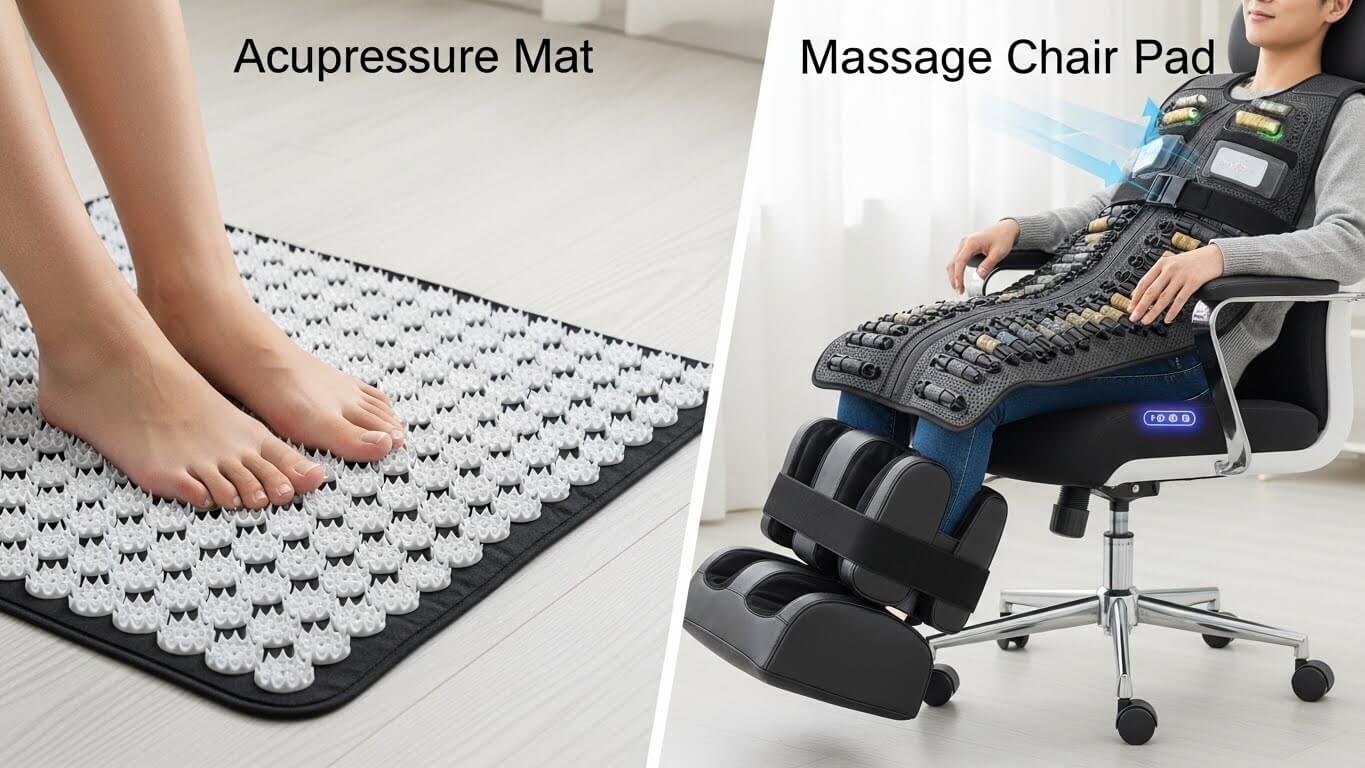
Acupressure mats and massage chair pads both offer valuable at-home back pain and tension relief, but they serve different needs through fundamentally different mechanisms. Acupressure mats provide unique, intense stimulation triggering endorphin release and deep relaxation at minimal cost ($30-$50). They’re perfect for budget-conscious users, minimalists, travelers, and those who adapt well to the distinctive sensation and seek the energized-yet-relaxed state mats uniquely produce.
Massage chair pads deliver automated, adjustable massage, providing mechanical muscle work that releases knots, reduces chronic tension, and offers familiar, comfortable relaxation at a higher cost ($100-$250). They suit users wanting maximum convenience, superior features, heat therapy, and targeted muscle relief without the initial discomfort challenge of mats.
For most budget-conscious users or those uncertain about investing significantly in back pain relief, acupressure mats offer exceptional value and low-risk experimentation. Many people discover that the unique stimulation provides surprising benefits at minimal financial commitment. Start here unless you know you need the specific features of automated massage.
For those willing to invest more for convenience, familiar massage experiences, or superior mechanical muscle work, massage chair pads justify their higher cost through consistent, reliable automated therapy. Users with chronic muscle tension often find the investment worthwhile through regular use, replacing occasional professional massage.
Many dedicated back pain sufferers ultimately maintain both options, using mats for quick sessions, energy, and unique stimulation while relying on chair pads for deep evening muscle work and extended relaxation. This combined approach maximizes therapeutic options while accommodating different moods, needs, and situations. Whether you choose simple spikes or sophisticated motors, both paths lead to the same destination: reduced pain, improved relaxation, and better quality of life through accessible, affordable at-home therapy.