

Dealing with excessive earwax is one of those uncomfortable problems nobody likes to talk about, yet millions of people experience it regularly. Whether it’s muffled hearing, that annoying feeling of fullness in your ears, or actual discomfort, earwax buildup can significantly impact your daily life. The market now offers numerous at-home solutions, from traditional earwax removal kits to high-tech electronic ear cleaners with cameras. But which approach is safer, more effective, and worth your money? In this comprehensive guide, we’ll compare traditional at-home earwax removal kits with modern electronic ear cleaners to help you make an informed decision about caring for your ears safely and effectively.
Understanding Earwax and When to Remove It
What is Earwax and Why Do We Have It?
Earwax, medically known as cerumen, is a natural substance produced by glands in your ear canal. It’s not actually wax but a combination of secretions, dead skin cells, and debris. Far from being just a nuisance, earwax serves important protective functions, including trapping dust, bacteria, and foreign particles before they reach your eardrum, lubricating and protecting the delicate skin of your ear canal, and providing natural antibacterial and antifungal properties.
Most people produce just the right amount of earwax, and it naturally migrates out of the ear canal through jaw movements while eating and talking. However, some people overproduce earwax, while others have ear canal shapes that prevent natural migration, leading to buildup and potential blockage.
Signs You Need Earwax Removal
Common symptoms of earwax buildup include a feeling of fullness or blockage in the ear, muffled or decreased hearing, ear pain or discomfort, ringing in the ears (tinnitus), dizziness, or itching in the ear canal. If you experience these symptoms, earwax may be the culprit, though some conditions require medical attention rather than at-home treatment.
When to See a Doctor Instead
Not all ear problems should be treated at home. Seek professional medical care if you experience severe pain, discharge or bleeding from the ear, sudden or significant hearing loss, symptoms lasting more than a week despite treatment, or if you have a perforated eardrum or ear tubes. Additionally, if you’re uncertain about what’s causing your symptoms, a healthcare provider can safely examine your ears and recommend appropriate treatment.
Traditional At-Home Earwax Removal Kits
What’s Included in Standard Kits
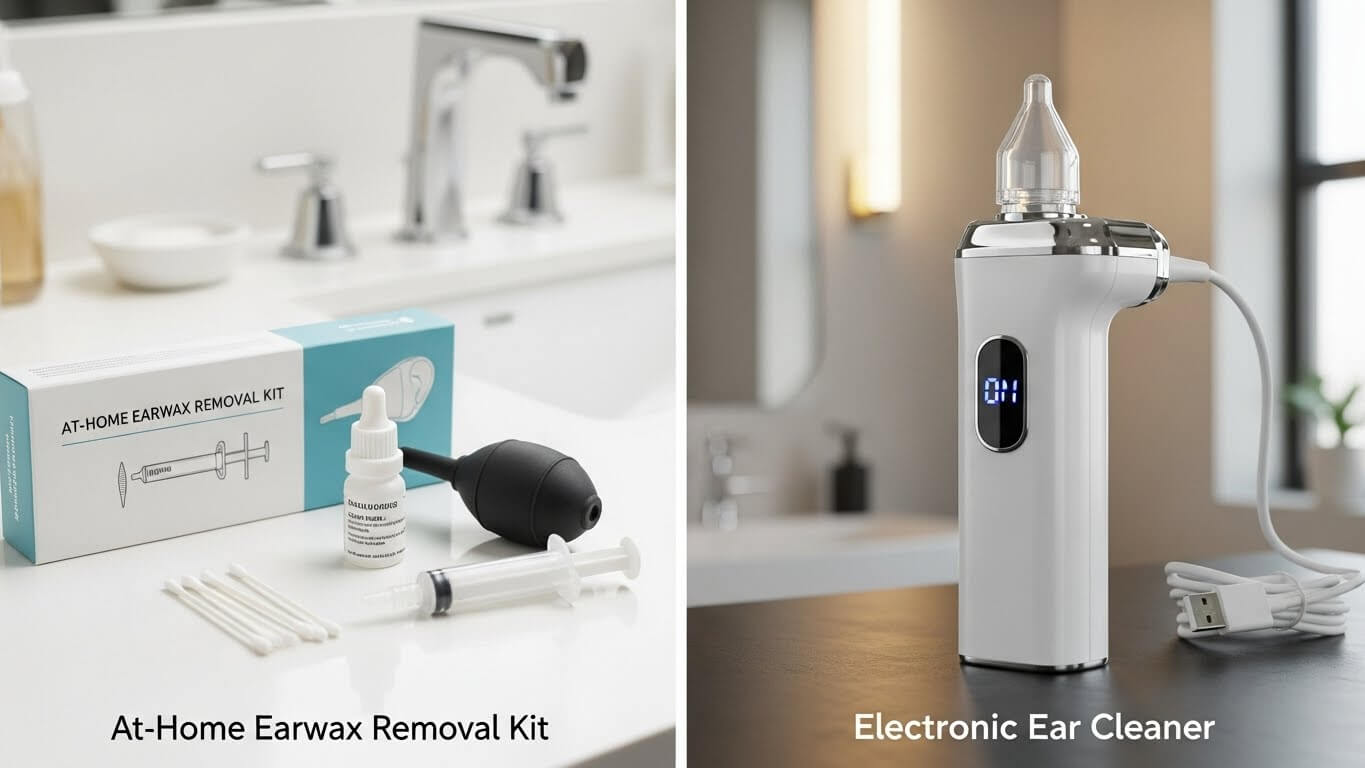
Traditional earwax removal kits typically include carbamide peroxide drops or a similar softening solution, a rubber bulb syringe or squeeze bottle for irrigation, sometimes a basin or collection device, and detailed instructions. Popular brands like Debrox, Murine, and Similasan follow this basic formula, with prices ranging from $5 to $20.
The process involves applying drops to soften the earwax over several days, then using warm water irrigation to flush out the loosened wax. The carbamide peroxide solution breaks down earwax through a foaming action, making it easier to remove.
How They Work
The removal process typically takes 3-5 days. You begin by applying the softening drops twice daily for several days, allowing the solution to sit in your ear for 5-10 minutes per application. The drops fizz and foam as they work, which feels strange but is normal. After sufficient softening, you use the bulb syringe filled with body-temperature water to gently irrigate your ear canal, directing the water stream toward the ear canal wall rather than straight at the eardrum.
The loosened wax flushes out with the water into your basin or sink. You may need to repeat the irrigation several times over one or two sessions to fully clear the wax. The entire process requires patience and can be messy, but it’s generally safe when done correctly.
Pros of Traditional Kits
Traditional kits offer several advantages. They’re inexpensive, typically costing under $20, and are widely available at pharmacies and online without prescription. The method has been used safely for decades with established safety records. Chemical softening is gentle and effective for most types of earwax buildup, and there are no electronic components to malfunction or require charging.
These kits work well for people with moderate earwax buildup and are particularly effective when the wax is soft or partially impacted. The simplicity of the approach means less can go wrong compared to more complex devices.
Cons of Traditional Kits
The downsides include the time-consuming multi-day process before irrigation, the messy nature of the irrigation procedure, and the fact that you’re working blind without seeing inside your ear canal. Results can be inconsistent, and it’s sometimes difficult to know if you’ve completely removed the wax. Some people experience temporary increased blockage as drops cause wax to swell before softening.
The irrigation process can feel uncomfortable, and improper technique may push wax deeper or cause injury. People with certain ear conditions or previous ear surgeries should avoid irrigation methods entirely.
Electronic Ear Cleaners
Types of Electronic Ear Cleaners
The electronic ear cleaner category includes several distinct technologies. Camera-equipped ear cleaners feature a tiny camera on a thin wand, connecting to your smartphone via app to show real-time video of your ear canal. Vacuum-based ear cleaners use gentle suction to remove wax without liquid, often with various tip sizes. Spiral tip devices rotate soft silicone tips to catch and extract earwax. Some advanced models combine features like cameras with irrigation or suction capabilities.
Prices range dramatically from $20 for basic devices to $200+ for high-end camera systems with professional-grade features.
How Electronic Cleaners Work
Camera-equipped devices connect wirelessly to your smartphone or tablet, displaying live video of your ear canal on screen. This allows you to see exactly what you’re doing as you gently manoeuvre the tool to capture wax. The visual feedback theoretically makes the process safer and more thorough.
Vacuum devices create gentle suction to pull softened wax out without water. Some use disposable tips to maintain hygiene. Spiral tip cleaners feature soft, flexible silicone spirals that rotate slowly to catch wax as you carefully insert and withdraw the tool.
Most electronic cleaners work best on soft or medium-consistency wax. Hardened or deeply impacted wax often requires softening drops first or professional removal.
Pros of Electronic Cleaners
Electronic ear cleaners offer several compelling advantages. The immediate visual feedback from camera models eliminates guesswork, allowing you to see exactly what you’re removing. There’s no messy liquid irrigation involved with most models, and you can use them as needed without multi-day preparation. The process typically takes just minutes rather than days.
For people who regularly deal with earwax buildup, the reusable nature means long-term value despite higher upfront costs. Many users find the technology fascinating and feel more confident seeing inside their ear canal. The devices can also be useful for examining ears for other issues, like foreign objects in children’s ears.
Cons of Electronic Cleaners
The disadvantages are significant. Higher cost represents a barrier, with quality devices starting around $50 and premium models exceeding $150. The technology creates a false sense of security, as seeing your ear canal doesn’t necessarily mean you’re using the tool safely. In fact, studies show people often push wax deeper or cause injuries because they overestimate their ability to navigate the ear canal while watching a screen.
The learning curve is steep, and hand-eye coordination while watching a screen proves challenging for many users. Cheaper models often have poor camera quality, making them nearly useless. Battery life and charging requirements add inconvenience. Some devices are difficult to sanitize properly between uses, creating hygiene concerns.
Most concerning, ear, nose, and throat specialists frequently treat injuries caused by these devices, from minor abrasions to perforated eardrums. The American Academy of Otolaryngology warns against using such devices without proper training.
Head-to-Head Comparison
Safety and Risk of Injury
Winner: Traditional Kits (with proper use)
While both methods carry risks if used improperly, traditional kits using softening drops and gentle irrigation have decades of safe use when instructions are followed. The chemical softening approach is gentle, and irrigation avoids inserting anything into the ear canal.
Electronic cleaners require inserting tools into your ear canal, increasing injury risk regardless of camera assistance. The false confidence from visual feedback can lead to aggressive use or pushing wax deeper. ENT specialists report regularly treating injuries from these devices.
That said, improper irrigation with traditional kits can cause problems including perforated eardrums if water pressure is too high. The key with either method is following instructions carefully and stopping if you experience pain.
Effectiveness
Winner: Tie (depends on wax type)
For soft to medium earwax, both methods can be effective. Traditional kits excel at softening and removing various wax types through chemical action combined with irrigation. The multi-day softening ensures even stubborn wax breaks down.
Electronic cleaners work quickly for visible, accessible wax but struggle with deep or hardened impactions. You can only remove what you can reach and see clearly. Some wax is too hard for suction or spiral tools to extract.
Neither method is highly effective for severely impacted wax, which typically requires professional removal. For routine maintenance and mild buildup, both can work, though traditional methods are more thorough for complete cleaning.
Ease of Use
Winner: Traditional Kits
Despite the multi-day process, traditional kits are straightforward. Apply drops, wait, irrigate. The instructions are simple, and the technique is intuitive. Most people achieve satisfactory results on the first attempt.
Electronic cleaners require practice and coordination. Watching your ear canal on screen while manipulating a tool proves disorienting for many users. Camera quality affects usability significantly, and cheaper models can be nearly impossible to use effectively. The learning curve discourages some users from persisting.
Cost and Value
Winner: Traditional Kits
At $5-$20 per kit with multiple uses possible, traditional methods offer exceptional value. Even buying a kit every few months costs less than a single quality electronic cleaner.
Electronic devices range from $30-$200+, with cheaper models often disappointing users and premium models requiring significant investment. While reusable, the upfront cost is substantial, and cheaper devices may break or perform poorly, wasting money.
For occasional earwax removal, traditional kits make financial sense. For people needing frequent cleaning, electronic devices might eventually pay off, though the questionable safety profile complicates the value proposition.
Convenience
Winner: Electronic Cleaners (in theory)
Electronic cleaners offer immediate results without multi-day preparation, no messy liquid, and can be used whenever needed. For quick maintenance or curiosity about your ear canal, they’re undeniably convenient.
However, the convenience is offset by charging requirements, learning curve, and setup with apps or connections. Traditional kits require more time and preparation but deliver thorough cleaning without technical complications.
Expert Recommendations and Medical Perspective
What ENT Doctors Say
The American Academy of Otolaryngology and most ear, nose, and throat specialists express significant concerns about at-home ear cleaning in general. They emphasize that earwax is normal and healthy, with most people never needing removal. The ears are self-cleaning organs, and interference often causes more problems than it solves.
When removal is necessary, ENT doctors overwhelmingly prefer softening drops with gentle irrigation over any tool insertion method. They frequently treat injuries from cotton swabs, bobby pins, and yes, electronic ear cleaners. The combination of delicate ear structures and limited user training makes injury common.
Many ENT specialists specifically warn against camera ear cleaners despite the appealing technology, noting that visualization doesn’t prevent injury when users lack anatomical knowledge and proper technique. They emphasize that professional removal remains the safest option for problematic earwax.
Safest Home Removal Methods
If you must remove earwax at home, medical professionals recommend starting with over-the-counter softening drops used according to package directions. After several days of softening, you can try gentle irrigation with body-temperature water, directing the stream at the ear canal wall, not straight at the eardrum. Never use cold or hot water, which can cause dizziness.
Stop immediately if you experience pain, and never insert anything into your ear canal, including cotton swabs, regardless of how gentle you think you’re being. The old saying bears repeating: don’t put anything smaller than your elbow in your ear.
For persistent problems or uncertainty, see a healthcare provider. Professional removal is quick, safe, and often covered by insurance. It’s not worth risking your hearing or causing injury to save a modest medical bill.
Pros and Cons Summary
At-Home Earwax Removal Kits
Pros:
- Inexpensive ($5-$20)
- Proven safe with proper use
- Effective for various wax types
- No learning curve required
- Chemical softening is gentle
- Widely available
- No electronics to maintain
Cons:
- Multi-day process before irrigation
- Messy liquid irrigation
- Working without visual feedback
- Can be uncomfortable
- Temporary increased blockage possible
- Not suitable for perforated eardrums
- Results sometimes inconsistent
Electronic Ear Cleaners
Pros:
- Visual feedback with camera models
- Quick process (minutes not days)
- No messy liquids with most models
- Reusable for long-term value
- Satisfies curiosity about ear canal
- Can identify other issues
- Modern, tech-forward approach
Cons:
- Expensive ($30-$200+)
- Higher injury risk with improper use
- Steep learning curve
- Poor camera quality on cheap models
- False sense of security
- Requires charging/batteries
- ENT doctors express concerns
- May push wax deeper
Making Your Decision
Choose Traditional Kits If…
You should opt for traditional at-home earwax removal kits if you have occasional earwax buildup that doesn’t require frequent attention, want the safest proven method with decades of safe use, prefer a budget-friendly option under $20, don’t mind a multi-day process and messy irrigation, or want the approach most consistent with medical recommendations.
Traditional kits work well for people with soft to medium earwax who follow instructions carefully and want thorough, complete removal. They’re also ideal if you’re risk-averse and want to minimize injury potential.
Choose Electronic Cleaners If…
Consider electronic ear cleaners if you frequently need earwax maintenance and will use the device regularly, are comfortable with technology and have good hand-eye coordination, want immediate results without multi-day preparation, prefer a dry method without liquid irrigation, or are genuinely curious about examining your ear canal.
However, invest in quality models ($80+) rather than cheap devices with poor cameras. Understand that even with visualization, you can cause injury. Use the gentlest technique possible, never force anything, and stop at the first sign of discomfort.
Some people successfully combine methods by using softening drops for several days, then using an electronic cleaner to remove the loosened wax. This provides the thorough softening of traditional methods with the visual feedback of electronic devices. If attempting this, be extremely gentle and cautious.
Frequently Asked Questions
Are electronic ear cleaners safe?
They can be used safely with proper technique and caution, but ENT doctors report regularly treating injuries from these devices. The technology doesn’t eliminate risk and may create false confidence. Traditional methods have better safety records.
How often should I clean my ears?
Most people never need to clean their ears as they’re self-cleaning organs. Only remove earwax if you experience symptoms of buildup. Over-cleaning can strip protective wax and cause dryness or irritation.
Can I use these methods if I have ear tubes?
No. Anyone with ear tubes, perforated eardrums, or previous ear surgery should only have earwax removed by a healthcare professional. At-home methods can cause serious complications in these situations.
Why do doctors warn against cotton swabs?
Cotton swabs push wax deeper into the ear canal rather than removing it, potentially causing impaction. They can also abrade ear canal skin or puncture the eardrum. They’re designed for external ear cleaning only.
How much do professional ear cleaning services cost?
Professional earwax removal typically costs $50-$150 without insurance, though many insurance plans cover it as a medical necessity. The cost often includes examination to ensure no underlying problems exist.
Do ear candles work?
No. Ear candling is ineffective and dangerous. Studies show they don’t remove earwax and can cause burns, ear canal obstruction from candle wax, or perforated eardrums. Medical professionals universally recommend against them.
Conclusion
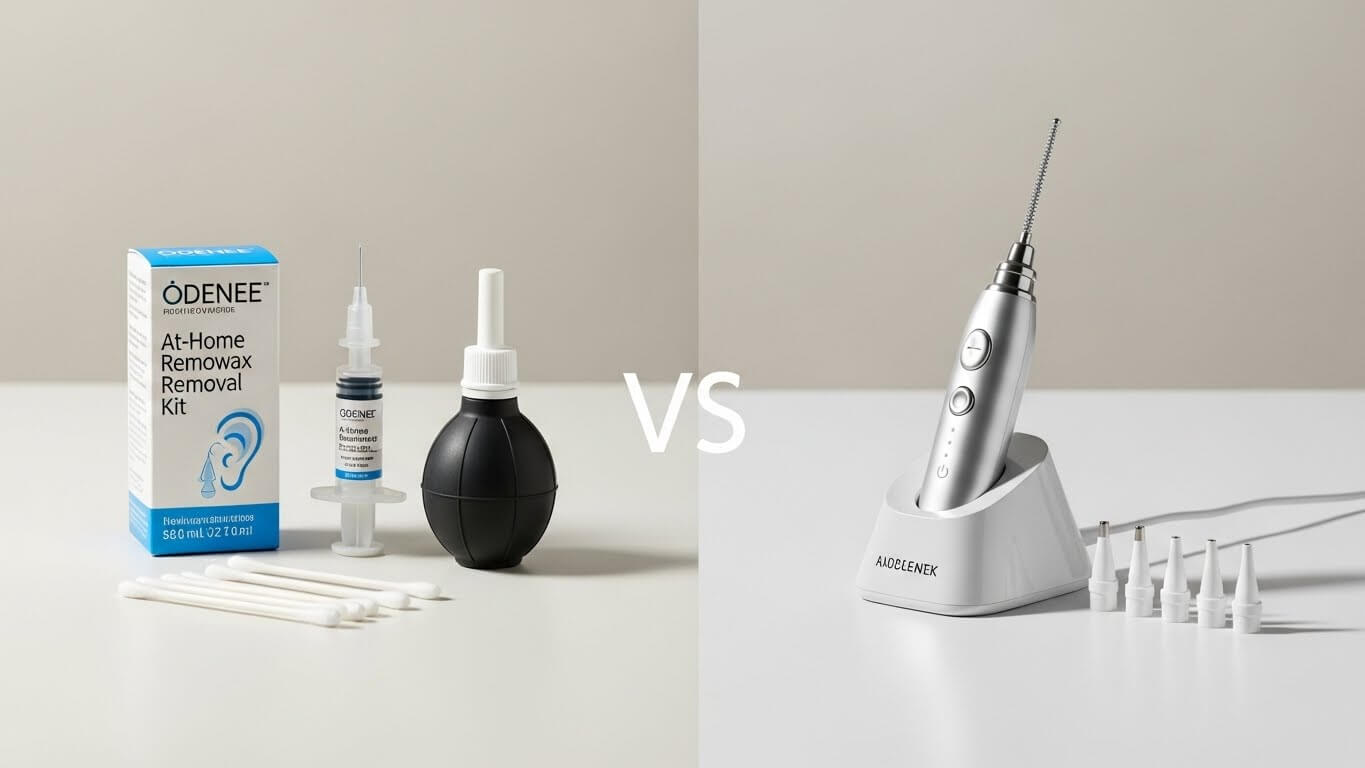
Choosing between at-home earwax removal kits and electronic ear cleaners ultimately comes down to weighing safety, effectiveness, cost, and convenience. Traditional kits offer proven safety, effectiveness, and affordability, making them the smarter choice for most people who occasionally need earwax removal. They align with medical recommendations and minimize injury risk when used properly.
Electronic ear cleaners appeal with their modern technology and convenience, but the higher cost, increased injury risk, and concerns from medical professionals make them a questionable investment for most users. If you choose an electronic cleaner, invest in quality, understand the risks, and use extreme caution.
Remember that healthy ears typically don’t need cleaning. If you experience persistent earwax problems, consider seeing a healthcare provider rather than repeatedly attempting home removal. Professional cleaning is quick, safe, and ensures no underlying problems are missed. Your hearing is precious—protect it by choosing safe, proven methods and knowing when professional care is the better option.