

Not all blue light glasses block the same amount of light, and the difference between a 50% and a 99% filter is more than a number. It determines what you can see, when you should wear them, and whether the glasses actually solve your problem.
What Is Blue Light and Why Does It Matter?
Blue light is high-energy visible light in the 415 to 455 nanometer range. It is emitted in large quantities by LED screens, smartphones, tablets, and fluorescent lighting. Unlike infrared or ultraviolet light, blue light is fully visible and is part of the normal daytime spectrum that helps regulate alertness and the circadian rhythm.
The concern with blue light is twofold. First, prolonged exposure, particularly from screens at close range, is associated with digital eye strain, which manifests as dry eyes, blurred vision, headaches, and difficulty focusing. Second, blue light exposure in the evening suppresses melatonin production and disrupts the sleep-wake cycle, making it harder to fall asleep and reducing sleep quality.
Blue light blocking glasses address both concerns by filtering out a portion of the blue light spectrum before it reaches the eye. The critical variable is how much they filter and in which wavelength range.
The Technology Behind Blue Light Filters
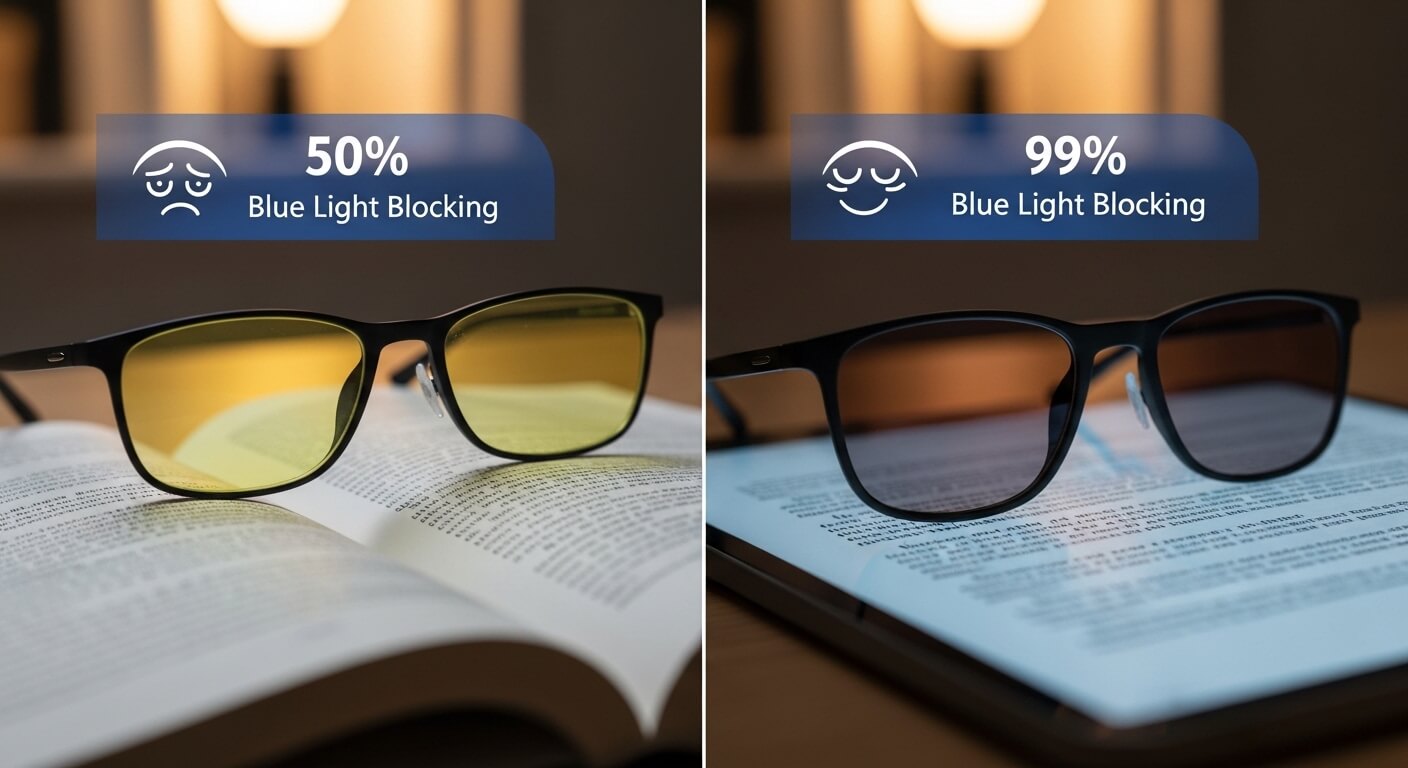
Blue light lenses work through one of two mechanisms: a surface coating that reflects blue wavelengths away from the lens, or a chromatic pigment embedded in the lens material that absorbs selected wavelengths. Coated lenses typically achieve 20 to 50% filtering across the blue spectrum and have a mild blue or violet sheen visible on the lens surface. Pigmented lenses, which are tinted yellow or amber, absorb blue wavelengths at higher rates and can achieve 90 to 99% filtering but introduce visible color distortion to the wearer.
Key technical distinction: Filtering percentage is measured at peak blue-light wavelength, typically 455 nm. A lens rated at 99% blue light blocking blocks 99% of light at that specific wavelength peak. Always ask for the spectral transmission curve, not just the headline number, for accurate comparison.
50% Filter Glasses: Daytime Use and Color Accuracy
50% filter lenses use a clear or very lightly tinted coating that removes approximately half of the peak blue light wavelength while preserving color accuracy. To the wearer, the world looks essentially normal. Colors are not shifted, screens do not appear warm or yellow, and the lenses are socially acceptable in any setting from an office meeting to a video call.
The tradeoff is that 50% filtering provides modest benefit for the circadian and sleep-related concerns. Reducing blue light by half before bed still allows enough blue wavelength transmission to partially suppress melatonin. For daytime eye strain, however, 50% filtering is often sufficient. Most digital eye strain research attributes fatigue to a combination of screen glare, reduced blink rate, and blue light exposure. A 50% filter addresses the blue light component while leaving the other variables untouched.
Users who need accurate color representation for graphic design, photo editing, video production, or any color-sensitive work should use 50% or lower filter lenses during working hours, as amber-tinted lenses fundamentally alter perceived color values.
99% Filter Glasses: Evening Use and Sleep Optimization
99% filter lenses use deep amber, orange, or red pigmentation to absorb virtually all blue wavelengths at and around the 455 nm peak. Studies examining the effect of blue light on melatonin production show that near-complete blockage in the 2 to 3 hours before sleep produces measurable improvements in melatonin onset, sleep latency, and sleep quality scores.
The visible consequence is pronounced color shift. Under 99% amber lenses, the world appears warm yellow to orange. Screens become sepia-toned. Discerning red from green can become difficult, and any color-critical work is effectively impossible. These lenses are engineered for a specific use window: the 2 to 3 hours before bed when blue light suppression of melatonin is the primary goal, not daytime productivity.
Head-to-Head Comparison: Key Performance Factors
| Factor | 50% Filter | 99% Filter |
| Color accuracy | Excellent | Significantly distorted |
| Daytime eye strain relief | Good | Overkill for daytime use |
| Melatonin protection (evening) | Partial | Near complete |
| Sleep quality improvement | Modest | Significant (clinical studies) |
| Suitable for screen work | Yes, all day | No, not for color work |
| Suitable for evening use | Helpful | Optimal |
| Appearance and discretion | Near-invisible tint | Visible amber tint |
| Prescription compatibility | Easy | Available, less common |
| Typical price range | $20 to $200 | $15 to $100 |
What the Research Actually Shows
The evidence base for blue light glasses is mixed and depends heavily on the outcome being measured. For eye strain specifically, a 2021 Cochrane systematic review found that blue light filtering spectacle lenses did not reduce eye strain compared to standard lenses over a two-week period, concluding that the discomfort of digital eye strain is more attributable to screen proximity, reduced blinking, and accommodation fatigue than to blue light per se.
For sleep and circadian outcomes, the evidence is considerably stronger. Multiple randomized controlled trials, including a well-cited study published in the Journal of Adolescent Health, found that amber lens use in the 2 to 3 hours before bed produced significant improvements in sleep onset, total sleep time, and sleep quality scores versus no-filter controls. The 99% filter lens category is where the clinical evidence is most compelling and most directly tied to the filtering mechanism.
User Experiences: Who Benefits From Each Filter Level
Survey data and user feedback across both filter categories consistently reveals use-case stratification:
- Office workers and developers who use screens for 6 to 10 hours daily report the most satisfaction with 50% clear-lens filters worn consistently throughout the workday, citing reduced end-of-day headaches and less evening eye fatigue without any workflow disruption.
- Shift workers, insomniacs, and individuals with diagnosed circadian rhythm disruption report the most dramatic benefit from 99% amber lenses worn in the 2 hours before target sleep time, with several studies and user cohorts noting 10 to 30 minute reductions in sleep onset time after adopting the evening routine.
- Graphic designers, photographers, and video editors consistently reject tinted lenses during working hours but several adopt 99% amber lenses as a strict post-work sleep hygiene tool, treating them as a separate evening accessory.
- Parents seeking blue light solutions for children overwhelmingly prefer 50% clear lenses for homework and screen time, and consider 99% amber lenses for devices used within 1 to 2 hours of the child’s bedtime.
Price Analysis: What Filter Level Costs
| Tier | Filter Level | Construction | Best For | Price Range |
| Entry | 20 to 40% | Basic AR coating | Casual screen users | $15 to $40 |
| Mid-range clear | 40 to 55% | Quality AR coating | Daily office, all-day work | $40 to $120 |
| Premium clear | 50 to 60% | Optical-grade, prescription option | Professionals, prescription wearers | $100 to $300 |
| Budget amber | 90 to 99% | Pigmented tint, basic frame | Evening sleep hygiene | $15 to $40 |
| Premium amber | 95 to 99% | Precision tint, comfort frame | Dedicated sleep optimization | $50 to $150 |
Product Recommendations
Best 50% Filter for All-Day Use: Felix Gray Faraday
At $95, Felix Gray’s clear-tinted lenses filter 50% of blue light in the peak range with no visible tint. The lenses also include an anti-reflective coating that addresses screen glare independently of blue light filtering. Prescription versions are available and optometrist-approved. Recommended for office professionals, developers, and students who need all-day comfort without color distortion.
Best 99% Amber Filter for Sleep: Swanwick Classic Night Swannies
At $69, Swanwick’s amber-tinted frames deliver verified 99% peak blue light filtering with a comfortable fit for extended evening use. Their optically clear amber lens avoids the visual distortion and glare that cheaper amber lenses introduce. Recommended for anyone pursuing clinically supported sleep optimization through pre-bed blue light reduction.
Best Budget 50% Option: GUNNAR Intercept
GUNNAR’s Intercept at $49 uses a proprietary lens tint that filters approximately 35 to 65% of blue light with a very mild amber warmth that is barely perceptible in normal use. Widely used in gaming and extended screen environments. Recommended for budget-conscious users who want reliable daytime protection.
Best Prescription-Compatible Clear Filter: Warby Parker Blue-Light Lenses
Warby Parker offers blue light filtering as a $50 add-on to any of their prescription or non-prescription frames, using a lens coating that filters in the 40 to 50% range. For prescription wearers, this is the most accessible and optically reliable way to add daytime blue light filtering without purchasing a second pair of glasses.
Best Budget Amber for Evening Use: THL Amber Blue Blockers
At $16 to $22, THL’s amber wraparound frames achieve 99% filtering at a price point that removes any barrier to adopting the evening use habit. The wrap-around style also prevents peripheral blue light from reaching the eye, which matters for consistent melatonin suppression. Recommended as a starting point for anyone new to the evening routine.
Frequently Asked Questions
Do blue light glasses actually work for eye strain?
The clinical evidence for eye strain relief is weaker than for sleep benefits. The Cochrane review (2021) found no significant difference over two weeks. However, many users report subjective relief, which may reflect benefits from anti-reflective coating, reduced glare, or placebo response. For documented benefits, target sleep and melatonin outcomes with 99% amber lenses rather than relying on blue light filtering alone for eye strain.
Can I wear 99% amber lenses all day?
You can, but it is not recommended for most users. Blue light is part of the natural daytime alertness signal. Blocking it completely during the day can reduce alertness, cause mild mood changes in some users, and significantly impair color-critical tasks. Use 99% amber lenses specifically in the 2 to 3 hours before your target bedtime for maximum benefit with minimum daytime interference.
How do I verify a lens is actually filtering what the manufacturer claims?
Request the spectral transmittance report for the lens. Reputable brands publish wavelength-by-wavelength transmission curves. A credible 50% filter should show approximately 50% transmission at 455 nm. A 99% filter should show less than 1% transmission at that wavelength. Headline numbers without spectral data are unverifiable and frequently misleading in budget products.
Are blue light glasses safe for children?
Clear-tinted 50% filter lenses are considered safe for children by optometrists in the context of daytime screen use. For children, amber 99% lenses used close to bedtime carry no known safety concern and have been studied in adolescent populations with positive sleep outcomes. Standard advice is to prioritize screen-free time in the hour before sleep over optical solutions where possible.
What is the difference between blue light glasses and computer glasses?
Computer glasses is a broader term that may include blue light filtering, anti-reflective coating, mild magnification for close-up screen work, or some combination of all three. Blue light glasses specifically target wavelength filtering. Comparing them requires checking which specific features each lens includes rather than relying on the product category name.
The Verdict

For daytime eye strain and all-day wear, a 50% clear-tinted lens provides sufficient blue light reduction without compromising color accuracy or comfort. For sleep optimization and melatonin protection in the evening, 99% amber lenses are the category where clinical evidence is strongest and the filtering mechanism is directly matched to the therapeutic goal.
The most effective approach is two pairs: a clear-tinted lens worn during the workday and an amber lens reserved for the 2 hours before bed. Used together, they address both the comfort and the circadian dimensions of blue light exposure without either compromising the other.