

Elite athletes have used cold water immersion for decades to manage post-training soreness, accelerate perceived recovery, and prepare for back-to-back competition. But as ice baths have migrated from professional locker rooms into mainstream wellness routines, driven in part by accessible consumer coolers purpose-built for immersion, a critical question has come into sharper focus: how much cold exposure is actually necessary, and does more time in the water mean better results meaningfully?
The 10-minute ice bath has long been the default recommendation in sports training circles, passed down through coaching tradition as much as clinical evidence. The 3-minute protocol, championed by researchers who studied the physiological response curve of cold exposure, challenges this tradition with the argument that the most significant tissue and nervous system responses occur in the first few minutes and that extending exposure adds discomfort without proportional benefit for most recovery goals.
This article examines the science behind both durations, compares their effectiveness across specific recovery outcomes, addresses the role of water temperature, and provides practical guidance for athletes and recreational users navigating the cold exposure landscape.
The Physiology: What Happens Minute by Minute
Understanding why duration matters requires mapping the body’s physiological response to cold immersion across time. Cold water immersion triggers a cascade of reactions that unfold in distinct phases, and the therapeutic benefits of each phase are not uniformly distributed across a 10-minute exposure.
Minutes 0–1 (Cold Shock Phase): Entry into cold water (50–59°F / 10–15°C) immediately activates cutaneous cold receptors, triggering an involuntary gasp reflex, rapid heart rate elevation, hyperventilation, and peripheral vasoconstriction. Blood is shunted away from extremities toward core organs. This phase is primarily a stress response and provides no direct recovery benefit; it is the physiological cost of admission that precedes therapeutic effects.
Minutes 1–3 (Active Inflammatory Response): As the initial shock response subsides, cold begins suppressing local tissue inflammation in earnest. Vasoconstriction reduces blood flow to peripheral muscles, limiting prostaglandin and cytokine delivery to damaged tissue sites. Tissue temperature in superficial muscles begins dropping measurably. Neural conduction velocity slows, reducing afferent pain signal transmission. This is where the primary analgesic and anti-inflammatory benefit of cold immersion is generated, and the 3-minute protocol targets precisely this window.
Minutes 3–6 (Thermal Penetration): Cold penetration continues moving from superficial tissue into deeper muscle compartments. Studies using intramuscular thermometry show that muscle temperature at 3 cm depth continues falling for several minutes beyond immersion initiation. For athletes whose training load produces deep muscular damage, this phase matters, but its benefits plateau as thermal equilibrium between tissue and water approaches.
Minutes 6–10 (Diminishing Returns): Beyond 6 minutes, the marginal physiological benefit of continued immersion decreases substantially for most recovery goals. Core body temperature begins to fall more measurably, increasing metabolic demand for rewarming post-immersion. Some research suggests that extended cold exposure at this phase may begin to blunt the acute inflammatory response to a degree that interferes with long-term training adaptation, a finding with significant implications for athletes training for hypertrophy or strength gains.
Head-to-Head: 3-Minute vs. 10-Minute Protocol Across Recovery Factors
| Recovery Factor | 3-Minute Protocol | 10-Minute Protocol | Evidence Advantage |
| Perceived Muscle Soreness (DOMS) | Significant reduction vs. control | Greater reduction in most studies | 10-min (moderate evidence) |
| Immediate Pain Relief | Comparable—peak analgesia by min 3 | Marginal improvement beyond 3 min | 3-min (equivalent benefit, less exposure) |
| Superficial Tissue Cooling | Effective—full superficial response | Deeper thermal penetration | 10-min for deep muscle involvement |
| Systemic Inflammation Markers | Meaningful reduction vs. control | Comparable reduction to 3-min | Tie—similar CRP and IL-6 outcomes |
| Post-Exercise Heart Rate Recovery | Accelerated vs. no treatment | Comparable to 3-min | Tie—both effective |
| Sleep Quality Post-Training | Modest improvement noted | Greater improvement in athletes | 10-min (limited evidence) |
| Neuromuscular Function Recovery | Partial recovery by 1-hour post | More complete recovery at 1-hour post | 10-min (moderate evidence) |
| Hypertrophy/Strength Adaptation | Minimal interference | May blunt adaptation with regular use | 3-min (safer for strength athletes) |
| Psychological Recovery/Mood | Significant—comparable to 10-min | Significant—comparable to 3-min | Tie—both protocols effective |
| Safety Profile | Low risk in healthy adults | Moderate risk—core temp drop concern | 3-min (lower risk) |
| Compliance / Repeatability | High-discomfort manageable | Moderate—difficult for many users | 3-min (behavioral advantage) |
| Time Efficiency | Excellent—total session ~5 min | Moderate—total session ~15 min | 3-min (practical advantage) |
Temperature Interaction: How Water Temperature Changes the Duration Equation
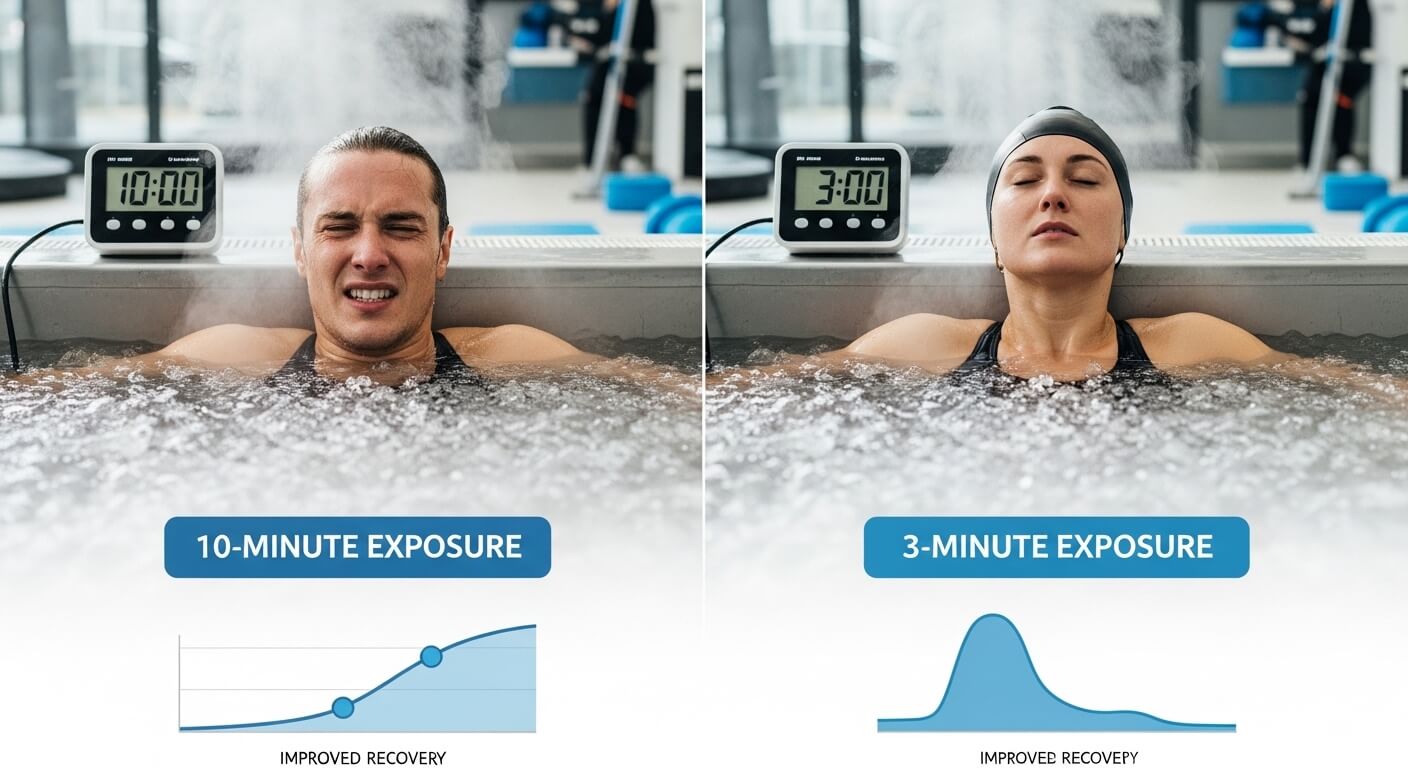
Duration cannot be evaluated independently of temperature, the two variables interact to determine total cold stimulus. A 3-minute immersion at 50°F (10°C) delivers a substantially different physiological dose than 3 minutes at 59°F (15°C), and understanding this relationship helps calibrate protocol recommendations to actual practice.
Most research supporting the 10-minute protocol was conducted at water temperatures between 50 and 59°F (10–15°C), the range that requires 6–8 minutes to achieve meaningful deep-tissue cooling. At colder temperatures (41–50°F / 5–10°C), which are achievable with heavy ice loading in purpose-built coolers, tissue cooling rates accelerate significantly. A 3-minute immersion at 46°F (8°C) may produce a similar depth of tissue temperature reduction to a 6-minute immersion at 57°F (14°C).
Practical implication: athletes using ice-loaded cooler baths at temperatures below 50°F should consider the 3-minute protocol or a modified 5-minute protocol, rather than defaulting to 10 minutes, as colder temperatures shorten the time needed to achieve equivalent tissue cooling and increase the risk of overcooling, particularly in the extremities.
| Water Temperature | Recommended Duration | Primary Use Case | Risk Level |
| 59–65°F (15–18°C) | 10–15 minutes | General recovery, beginners | Low |
| 50–59°F (10–15°C) | 6–10 minutes | Post-training soreness, standard protocol | Low-Moderate |
| 41–50°F (5–10°C) | 3–5 minutes | Acute injury, elite athlete recovery | Moderate |
| Below 41°F (<5°C) | 1–3 minutes maximum | Targeted acute intervention only | High-consult professional |
Effectiveness by Athlete Type and Recovery Goal
The research on cold immersion duration shows that the optimal protocol varies meaningfully by athlete type, training goal, and the specific recovery outcome being prioritized. A single universal recommendation fails to serve the diversity of users who now incorporate cold immersion into their routines.
Endurance athletes (runners, cyclists, triathletes): benefit most clearly from the 10-minute protocol. Training-induced muscle damage in endurance sport is distributed across large muscle groups, involves significant inflammatory response, and recovery timeline matters for multi-day event performance. The additional deep-tissue cooling and greater DOMS reduction of the longer protocol aligns with endurance recovery demands where hypertrophy is not a training goal.
Strength and power athletes (weightlifters, sprinters, rugby): present a more nuanced picture. The evidence that regular cold water immersion blunts anabolic signaling, specifically by attenuating satellite cell activation and reducing post-exercise insulin-like growth factor responses, is concerning for athletes whose primary goal is muscle development. For this group, the 3-minute protocol offers a pragmatic compromise: sufficient cold exposure to reduce soreness and improve recovery comfort without the adaptation-blunting effects associated with longer, more frequent immersion.
Recreational athletes and wellness users: for whom recovery speed matters less than consistency and the psychological benefits of the cold exposure practice itself, the 3-minute protocol offers a compelling entry point. The compliance advantage is substantial. Research on behavioral adherence to recovery protocols consistently shows that shorter, more manageable interventions are practiced more reliably than longer ones, and consistent moderate cold exposure outperforms irregular intensive exposure in long-term outcomes.
Injury recovery context: cold immersion for acute soft tissue injury (sprains, strains, bruising) is a distinct application from post-exercise recovery and follows different protocols. Acute injury typically calls for shorter, more frequent applications (10–20 minutes, 3–4 times daily) with the goal of limiting acute inflammatory cascade; not the sustained immersion protocols discussed here for exercise recovery.
Equipment Analysis: Cooler Setups for Each Protocol
The choice of cold immersion protocol also affects the cooler setup required to execute it consistently. Temperature maintenance is the central variable. A 10-minute protocol requires sustained cold temperature for twice as long as a 3-minute session, which directly impacts ice volume requirements and cooler insulation quality.
| Cooler / Setup Type | Temp Maintenance (10 min) | Ice Required Per Session | Best Protocol Fit | Approx. Cost |
| Budget Cooler (PP liner) | Struggles — temps rise 3–5°F | 20–25 lbs to compensate | 3-min only | $40–$80 |
| Mid-Range Rotomolded | Good — holds within 2°F | 15–20 lbs | Both protocols | $150–$200 |
| Premium Rotomolded (YETI/ORCA) | Excellent — holds within 1°F | 12–15 lbs | Both — optimal for 10-min | $300–$450 |
| Dedicated Cold Plunge Tub | Excellent with chiller | No ice needed (chiller) | Both — most consistent | $500–$5,000+ |
| DIY Chest Freezer Conversion | Excellent — thermostat-controlled | No ice needed | Both — best temp control | $200–$400 |
For athletes pursuing the 10-minute protocol with serious intent, premium rotomolded cooler construction becomes a meaningful performance variable — not just a comfort upgrade. A cooler that loses 4°F over 10 minutes due to poor insulation delivers an inconsistent thermal dose that undermines protocol reproducibility. HDPE rotomolded coolers with polyurethane foam insulation maintain target temperatures with substantially less ice loading, reducing the per-session cost of ice over time.
Protocol Recommendations by User Profile
Endurance Athletes: Modified 8-Minute Protocol at 52–57°F
For runners, cyclists, and triathletes managing accumulated training load, an 8-minute immersion at 52–57°F represents an evidence-supported middle ground that captures most of the deep-tissue cooling benefit of the 10-minute protocol while reducing the core temperature drop and rewarming demand. Enter gradually, maintain consistent submersion to the waist or chest, and plan 20–30 minutes of passive rewarming afterwards. Avoid rewarming with hot showers immediately post-immersion, which can cause problematic rapid vasodilation.
Strength and Power Athletes: 3-Minute Protocol at 50–55°F, Non-Training Days
For athletes prioritizing muscle development and strength adaptation, reserve cold immersion for rest days or the evening following a training session; not within 4 hours of a resistance training bout. Three minutes at 50–55°F provides analgesic and recovery comfort benefits while minimizing interference with the acute anabolic response. If using cold immersion daily during heavy training blocks, consider reducing to 2-minute sessions or elevating the temperature to 57–60°F to further protect adaptation signalling.
Recreational Users and Beginners: 3-Minute Progressive Protocol
Begin at 59–65°F for 2 minutes and add 30 seconds per session over 2–3 weeks until reaching 3 minutes at 50–55°F. This progressive approach allows the nervous system to adapt to the cold shock response, dramatically improving the subjective experience and reducing the hyperventilation and panic response that causes most beginners to exit before completing the target duration. Consistency at 3 minutes, 3–4 times per week, produces measurable benefits for general recovery and wellbeing.
Competition Recovery (Back-to-Back Events): 10-Minute Protocol at 55–59°F
When rapid recovery for next-day performance is the priority and adaptation concerns are temporarily secondary, the 10-minute protocol at 55–59°F is best supported by the evidence. Schedule immersion within 30–60 minutes post-event for maximum inflammatory response management. Pair with adequate nutrition (protein + carbohydrates within the same recovery window) and sleep prioritisation; cold immersion is a recovery tool, not a recovery system on its own.
General Wellness and Mental Health Use: 2–3 Minutes at 55–60°F
For users pursuing cold exposure primarily for mood, stress regulation, and the noradrenergic response associated with cold shock, shorter durations at slightly higher temperatures are both safer and equally effective for psychological outcomes. The catecholamine and endorphin responses that drive the mood-elevating effects of cold immersion are triggered within the first 1–2 minutes; extending the session does not meaningfully amplify these psychological benefits for most users.
Frequently Asked Questions
Q: Is a 3-minute ice bath actually cold enough to produce real physiological effects?
A: Yes, the primary analgesic, anti-inflammatory, and mood-related effects of cold water immersion are substantially triggered within the first 1–3 minutes of exposure at temperatures below 59°F (15°C). The physiological response to cold does not require extended duration to initiate; it requires sufficient temperature stimulus. A properly cold 3-minute immersion outperforms a lukewarm 10-minute one by every measurable metric.
Q: Can cold immersion after strength training interfere with muscle gains?
A: Research published in the Journal of Physiology and replicated in subsequent studies suggests that cold water immersion performed within 1 hour of resistance training can attenuate satellite cell activation and reduce post-exercise anabolic signalling, effects associated with blunted hypertrophy and strength adaptation with regular use. The interference appears dose-dependent, with longer immersion durations and lower temperatures producing greater attenuation. Athletes focused on building muscle should either avoid post-training cold immersion or restrict it to very short exposures on heavy training days.
Q: How much ice does a proper ice bath require, and how does cooler quality affect this?
A: A full-body immersion to chest depth typically requires 80–100 lbs of water at the target temperature. To bring that volume from ambient temperature to 50–55°F using ice, approximately 15–25 lbs of ice is required, depending on starting water temperature and ambient conditions. Premium rotomolded coolers with superior insulation maintain target temperatures for 10+ minutes with this initial ice load. Budget coolers require 25–40% more ice to compensate for heat ingress through thin walls, a meaningful ongoing cost for frequent users.
Q: What is the correct way to rewarm after a cold immersion session?
A: Passive rewarming; toweling dry and allowing body temperature to recover naturally through movement and clothing, is preferred over immediate hot showers or baths. Rapid vasodilation from sudden heat application after cold immersion can cause dizziness, nausea, or fainting as blood rushes back to peripheral vessels. Allow 15–20 minutes of passive rewarming before exposure to significant heat. Light movement (walking, gentle stretching) accelerates rewarming safely by increasing metabolic heat production.
Q: Are the benefits of cold immersion supported by strong scientific evidence?
A: The evidence base is mixed by outcome. Reduction in perceived muscle soreness (DOMS) and improved subjective recovery are among the most consistently supported findings, with multiple meta-analyses confirming benefit over passive recovery. Psychological benefits (mood, stress) have growing support but involve smaller study populations. The performance benefits of cold immersion for endurance sport are well-supported. The evidence for strength sport is more equivocal, with legitimate concerns about adaptation interference. Cold immersion is a useful tool with real but specific evidence base; not a universal recovery solution.
Q: Is there a minimum water temperature below which ice baths become unsafe?
A: There is no single universal minimum; individual tolerance and cardiovascular health status create significant variation. As a general framework, temperatures below 50°F (10°C) should be approached with caution and limited to very short exposures even for experienced users. Below 41°F (5°C), the cold shock response risk increases substantially, and immersion should be limited to 1–2 minutes maximum in healthy adults. Cold water immersion is contraindicated for individuals with uncontrolled hypertension, a history of cardiac arrhythmia, Raynaud’s disease, cold urticaria, and several other conditions; consult a healthcare provider before establishing any cold immersion practice.
The Verdict
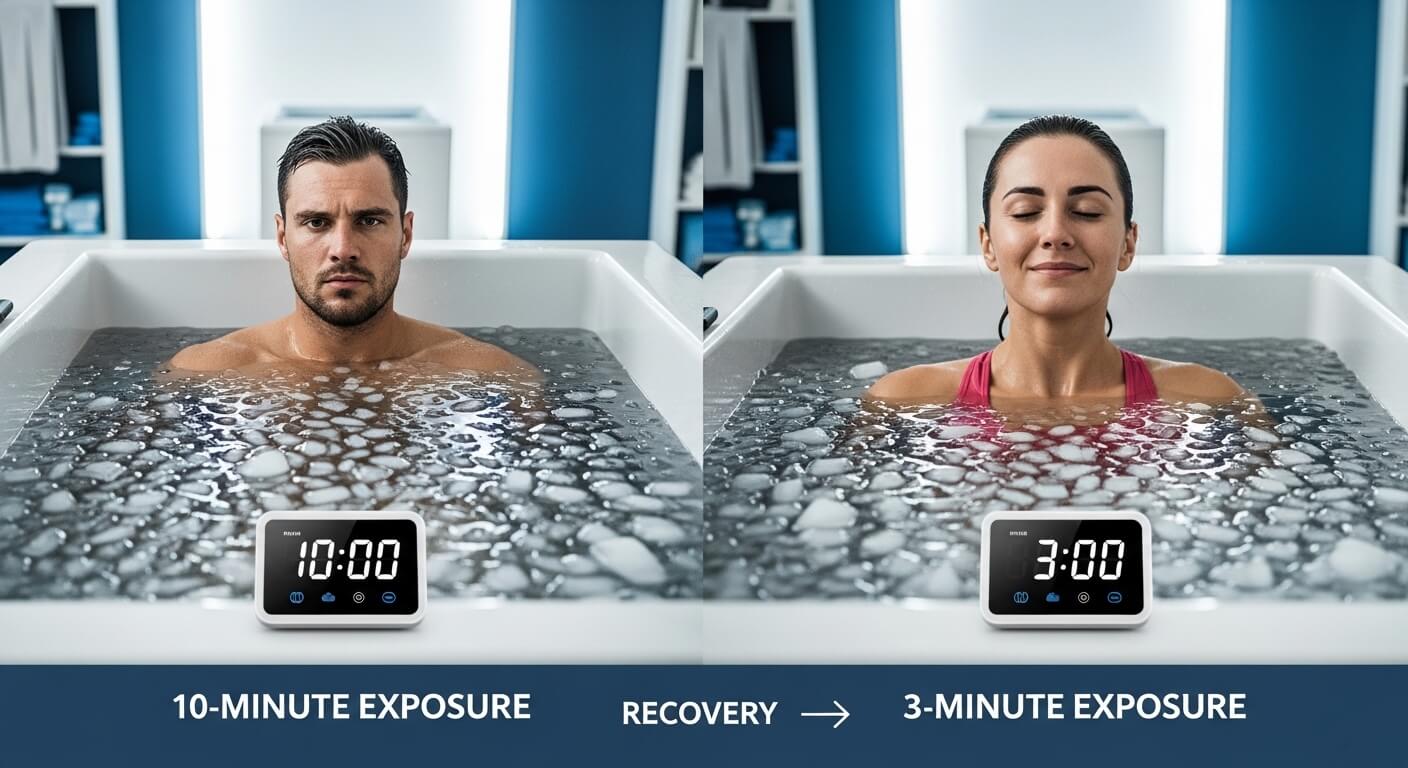
The 3-minute vs. 10-minute debate resolves differently depending on who is asking. For endurance athletes managing heavy training loads and back-to-back competition demands, the 10-minute protocol’s additional deep-tissue cooling and DOMS reduction are supported by evidence and worth the extended discomfort.
For strength and power athletes, the 3-minute protocol’s equivalent analgesic benefit with reduced risk of adaptation interference makes it the more strategically sound choice. For recreational and wellness users, the compliance advantage of a manageable 3-minute session is not a consolation prize; it is the decisive factor, because a protocol that gets done consistently at moderate dosage outperforms an intensive protocol that gets abandoned.
Temperature is ultimately the more important variable than duration. Get the temperature right; confirmed with a thermometer, not estimated from how cold it feels, and both protocols become substantially more effective. A well-insulated rotomolded cooler that holds 52°F for the full session duration without requiring mid-session ice additions is not a luxury; it is the equipment foundation that makes protocol precision possible.