

The concept of earthing, also called grounding, has gained significant attention in wellness circles, with proponents claiming that direct contact with the Earth’s electrical charge provides numerous health benefits, from reduced inflammation to improved sleep. The theory suggests that modern life, with its rubber-soled shoes and elevated living spaces, disconnects us from the Earth’s natural electrons, potentially contributing to various health issues. While walking barefoot on grass or sand provides the most direct earthing experience, practical reality means most people can’t spend hours daily with bare feet on natural surfaces.
Let’s introduce earthing products: mats you can use indoors and specially designed grounding shoes that allow earth connection while protecting your feet. Both promise to restore your body’s electrical connection to the Earth, but they work in fundamentally different ways and suit different lifestyles. Earthing mats plug into grounded electrical outlets, allowing grounding while working, sleeping, or relaxing indoors. Grounding shoes feature conductive materials in soles that theoretically transfer Earth’s electrons while you walk on natural surfaces outdoors.
But do these products actually work? Is there scientific evidence supporting earthing claims, and if so, which approach delivers better results? In this comprehensive comparison, we’ll examine the earthing concept, evaluate both mats and shoes, compare their effectiveness and practicality, and help you determine whether investing in grounding products makes sense for your health goals, lifestyle, and budget.
Understanding Earthing and Grounding
The Earthing Theory
Earthing, or grounding, is based on the premise that the Earth maintains a negative electrical charge and that direct contact allows free electrons to flow into the body. Proponents suggest that these electrons act as antioxidants, neutralizing free radicals and reducing inflammation. The theory emerged from observations by Clint Ober and has been promoted through books, documentaries, and various products.
The proposed mechanism involves the Earth’s surface containing free electrons that, when contacted through conductive materials, transfer to the human body. These electrons theoretically neutralize positively charged free radicals, reducing oxidative stress and inflammation throughout the body. The electromagnetic fields we encounter from electronics and power lines may create electrical imbalances that grounding helps correct.
Advocates claim benefits including reduced inflammation and pain, improved sleep quality, decreased stress and cortisol levels, enhanced circulation, accelerated wound healing, and improved immune function. The earthing movement has gained followers despite mainstream medical skepticism.
The Role of Modern Lifestyle
Regardless of earthing theory validity, modern life does disconnect us from direct Earth contact more than historical human existence. Rubber-soled shoes create electrical insulation between feet and ground. Elevated living in apartments and buildings prevents ground contact during daily life. Indoor environments with synthetic materials reduce natural grounding opportunities.
Whether this disconnection causes health problems as earthing advocates suggest remains debated. However, spending time barefoot outdoors, walking on natural surfaces, and connecting with nature provides benefits beyond potential electrical effects—stress reduction, sensory stimulation, and physical activity all contribute to wellbeing.
Earthing Mats: Indoor Grounding Solution
How Earthing Mats Work
Earthing mats are conductive surfaces that connect to the ground port of electrical outlets via cords, theoretically allowing electron flow from Earth through the electrical system to your body. The mats contain conductive materials; typically carbon or silver threads—woven into or layered onto fabric or rubber surfaces.
The setup involves placing the mat on the floor under your desk, on your bed as a half-sheet, or on surfaces where you rest hands or feet. A cord connects the mat to the grounding port (round hole) of a standard electrical outlet. When you touch the mat with bare skin, you theoretically complete the circuit, allowing electron transfer.
Different mat types include desk mats for placing feet on while working, bed sheets or pads for overnight grounding, mouse pads for hand contact, and floor mats for standing desks. Most measure 10×26 inches to full bedsheet size and cost $40-$150 depending on size and quality.
Claimed Benefits of Earthing Mats
Proponents claim indoor mats provide the same benefits as outdoor barefoot contact including reduced inflammation particularly beneficial for chronic pain conditions, improved sleep quality from overnight grounding during sleep, decreased stress and anxiety from cortisol regulation, and reduced exposure to electromagnetic fields by grounding the body.
The convenience factor is significant; grounding while working, sleeping, or relaxing without going outside. Year-round availability regardless of weather makes mats practical. Continuous contact during sleep provides extended grounding periods.
Practical Advantages
Earthing mats offer several practical benefits. Ease of use requires simply plugging in and placing skin contact; no technique required. Indoor convenience allows grounding during sedentary activities that dominate modern life. Weather independence enables grounding during winter, rain, or extreme temperatures. Continuous overnight grounding during 7-8 hours of sleep maximizes potential exposure.
Discrete use doesn’t require lifestyle changes or visible products; the mat simply exists where you already spend time. Affordability relative to grounding shoes makes mats accessible at $40-$150 for unlimited use.
Limitations and Concerns
Despite advantages, earthing mats have notable limitations and concerns. Electrical safety questions exist; though mats should only connect to ground, not live current, improper installation or faulty wiring could create risks. Testing your outlet and mat regularly is recommended.
Effectiveness depends entirely on proper electrical grounding in your home. Older buildings or improperly wired outlets may not provide actual ground connection. Dirty electricity or electromagnetic field exposure from electrical systems isn’t clearly addressed—some argue it may worsen exposure.
Limited mobility confines you to mat location—sitting or lying in specific positions. Requires bare skin contact with the mat, which may be impractical during some activities. Cleaning and maintenance necessary to preserve conductivity. The lack of outdoor benefits like fresh air, vitamin D, or nature exposure that come with outdoor grounding.
Grounding Shoes
How Grounding Shoes Work
Grounding shoes feature conductive plugs or patches in soles that theoretically allow electron transfer from Earth through the shoe to your feet. Unlike earthing mats that use electrical outlets, grounding shoes require actual outdoor contact with conductive surfaces—grass, soil, sand, or concrete.
The design typically includes a conductive copper or carbon plug embedded in the sole, often at the ball of the foot or heel. Some shoes use conductive threads throughout the sole. The conductive materials create a pathway from Earth to your skin, theoretically allowing electron flow.
Grounding shoes look like regular footwear; sneakers, sandals, casual shoes, or boots—but with conductive elements. Brands include Earth Runners, Groundals, Pluggz, and others. Prices range from $80-$200 depending on style and brand.
Claimed Benefits of Grounding Shoes
Proponents suggest that grounding shoes provide mobile grounding during normal daily activities like walking, hiking, or running. Connection with nature combines grounding with outdoor exposure, fresh air, and sunlight. Physical activity benefits stack with potential grounding effects. Natural surface contact on grass, soil, or sand provides “purer” grounding than electrical-based mats.
The lifestyle integration allows grounding during exercise, errands, or outdoor work without dedicated grounding time. Foot health benefits from more natural sole designs with zero-drop or minimal shoes promoting natural gait.
Practical Advantages
Grounding shoes offer distinct practical advantages. Mobility and freedom enable grounding anywhere you walk on conductive natural surfaces. Outdoor activity encouragement combines grounding attempts with proven beneficial outdoor time. Natural environment connection provides psychological and physical benefits beyond potential electrical effects.
Exercise compatibility makes them suitable for walking, hiking, or light running. No electrical dependency or outlet requirements mean they work anywhere with suitable ground surfaces. Social acceptability allows wearing in public without appearing unusual—they look like regular shoes.
Limitations and Concerns
Grounding shoes face significant limitations. Surface dependency means they only work on conductive natural surfaces—grass, soil, sand, concrete. They don’t function on asphalt, wood, rubber, or indoor floors. Weather limitations reduce use during rain, snow, or extreme temperatures. Geographic restrictions affect urban dwellers with limited access to natural surfaces.
Footwear quality varies widely—some grounding shoes prioritize conductivity over comfort, support, or durability. The shoes are expensive for footwear ($80-$200), comparable to premium athletic shoes. Effectiveness is questionable even among earthing proponents—some argue shoes can’t provide the same connection as direct barefoot contact.
Limited usage time compared to overnight mat use means you might ground 1-3 hours daily walking versus 7-8 hours sleeping on a mat. The requirement for specific surfaces and weather limits practical grounding opportunities for many people.
Head-to-Head Comparison

Effectiveness and Evidence
Winner: Uncertain (both lack strong evidence)
Neither earthing mats nor grounding shoes have robust scientific evidence definitively proving effectiveness. The limited earthing research typically uses mats or direct barefoot contact, not grounding shoes. No peer-reviewed studies specifically validate grounding shoes’ effectiveness.
For mats, some small studies suggest potential benefits, though methodological limitations undermine conclusions. For shoes, the theoretical conductivity exists, but whether it translates to physiological effects is unproven. User testimonials exist for both, but placebo effects, lifestyle changes, or confirmation bias could explain reported benefits.
Neither product has clear evidence of superiority—both rely on the same unproven earthing theory.
Convenience and Practicality
Winner: Earthing Mats
Mats provide far greater practical convenience. Use them indoors year-round regardless of weather. Ground during sedentary activities like working or sleeping without lifestyle changes. Continuous overnight contact maximizes grounding duration. No surface limitations—works anywhere with grounded electrical outlets.
Grounding shoes require outdoor access to specific surfaces, limit use to when you’re already walking or active, depend on favorable weather, and don’t work indoors or on many outdoor surfaces. For most modern lifestyles, mats offer dramatically more practical grounding opportunities.
Cost and Value
Winner: Earthing Mats
Quality earthing mats cost $40-$150 for unlimited use over several years. Grounding shoes cost $80-$200 but wear out like regular shoes, requiring replacement every 6-18 months. Over three years, you might spend $40-$150 for a mat versus $160-$600 replacing grounding shoes multiple times.
Mats provide better cost-per-use value, especially when considering overnight use accumulates 7-8 hours daily versus maybe 1-3 hours walking in grounding shoes.
Lifestyle Integration
Winner: Depends on Individual
For sedentary indoor workers, mats integrate seamlessly into existing routines. For active outdoor enthusiasts, grounding shoes fit naturally into their lifestyle. Urban apartment dwellers with limited outdoor access benefit more from mats. Suburban or rural residents with yards or nearby parks can utilize grounding shoes more easily.
Individual lifestyle determines which product integrates more naturally. Neither is universally superior for lifestyle fit.
Additional Health Benefits
Winner: Grounding Shoes
Beyond theoretical grounding, shoes encourage outdoor activity, fresh air, and nature exposure—all proven beneficial. Walking provides cardiovascular benefits, vitamin D from sunlight, and psychological wellbeing from nature contact.
Mats, while convenient, don’t inherently encourage any additional healthy behaviors. If grounding theory is questionable, the additional proven benefits of outdoor activity make shoes potentially more valuable overall.
Safety and Risks
Winner: Grounding Shoes (slightly)
Both products are generally safe. Mats carry small electrical safety risks if outlets are improperly wired or mats are defective. Testing and proper installation mitigates but doesn’t eliminate risk.
Grounding shoes have no electrical concerns. The main risk is purchasing poor-quality shoes lacking adequate support or durability. For pure safety, shoes edge ahead slightly.
Making an Informed Decision
Questions to Ask Yourself
Consider several questions before purchasing. What are your health goals—better sleep, pain relief, general wellness? Do you have access to outdoor natural surfaces regularly? How much time do you spend sitting versus active? What’s your budget—$40-$150 for mats or $80-$200 for shoes?
Are you skeptical or open-minded about earthing theory? Do you have grounded electrical outlets (test with outlet tester)? Would you actually use the product consistently? Are you making purchase based on scientific evidence or anecdotal reports?
Do you prefer indoor convenience or outdoor activity? Are you willing to try unconventional wellness approaches? Can you afford to experiment without guaranteed results?
Honest answers guide toward appropriate choices or recognition that earthing products may not suit your needs or values.
If You Choose Earthing Mats
Buy from reputable brands with good return policies like Earthing.com official products. Test your electrical outlets with a circuit tester before use. Start with a desk mat ($40-$80) rather than expensive bedsheets to minimize risk. Use consistently for 4-6 weeks before evaluating effectiveness.
Clean mats regularly to maintain conductivity. Combine with other sleep hygiene or wellness practices. Keep realistic expectations—view as an experiment rather than certain cure. Document experiences to assess whether you notice genuine changes.
If You Choose Grounding Shoes
Select brands with good reviews for comfort and durability, not just conductivity. Ensure you have regular access to appropriate grounding surfaces. Start with one pair rather than investing in multiple styles immediately. Wear during outdoor activities you already enjoy to maximize utility beyond grounding.
Maintain shoes properly to preserve conductive elements. Be realistic about surface limitations—they won’t work most places in urban environments. Consider them outdoor activity shoes that may provide grounding rather than grounding-specific products.
The Barefoot Alternative
The most cost-effective approach to earthing is simply spending time barefoot outdoors on natural surfaces—grass, soil, sand, or even concrete. This costs nothing, provides the most direct Earth contact, encourages outdoor time and nature exposure, and avoids reliance on products of questionable effectiveness.
If earthing theory is valid, barefoot contact should be most effective. If it’s placebo or lifestyle effects, outdoor barefoot time still provides proven benefits. This approach tests earthing interest without financial investment.
Frequently Asked Questions
Is earthing scientifically proven?
No. While some small studies suggest possible benefits, the evidence is insufficient for medical claims. Methodological limitations, small sample sizes, and lack of replication mean earthing remains unproven by rigorous scientific standards. Approach claims skeptically.
Can earthing mats be dangerous?
Generally safe when properly installed and used. Main risks involve faulty wiring or defective mats potentially creating electrical hazards. Test outlets, use mat testers, and buy from reputable sources to minimize risk. Consult electricians if uncertain about home wiring.
Do grounding shoes actually work?
Unknown. No scientific studies specifically validate grounding shoes. The conductivity exists, but whether it provides health benefits is unproven. User experiences are mixed and subjective. They may work as well as any shoes for outdoor walking; which provides proven benefits regardless of grounding.
How long before I see results?
Proponents suggest trying earthing consistently for 4-6 weeks before evaluating. However, if benefits are primarily placebo or lifestyle-related, you might notice changes immediately or never. No definitive timeline exists because effectiveness itself is unproven.
Can I use both mats and shoes?
Yes, they’re compatible. Some users combine overnight mat grounding with daytime shoe grounding. However, if one approach doesn’t provide noticeable benefits, adding another is unlikely to help. Start with one method before investing in both.
Are there any proven benefits to earthing?
The earthing theory itself lacks robust proof. However, related activities, spending time outdoors barefoot, walking in nature, reducing sedentary time; have well-established benefits independent of electron transfer. These proven benefits may explain some positive earthing experiences.
Conclusion
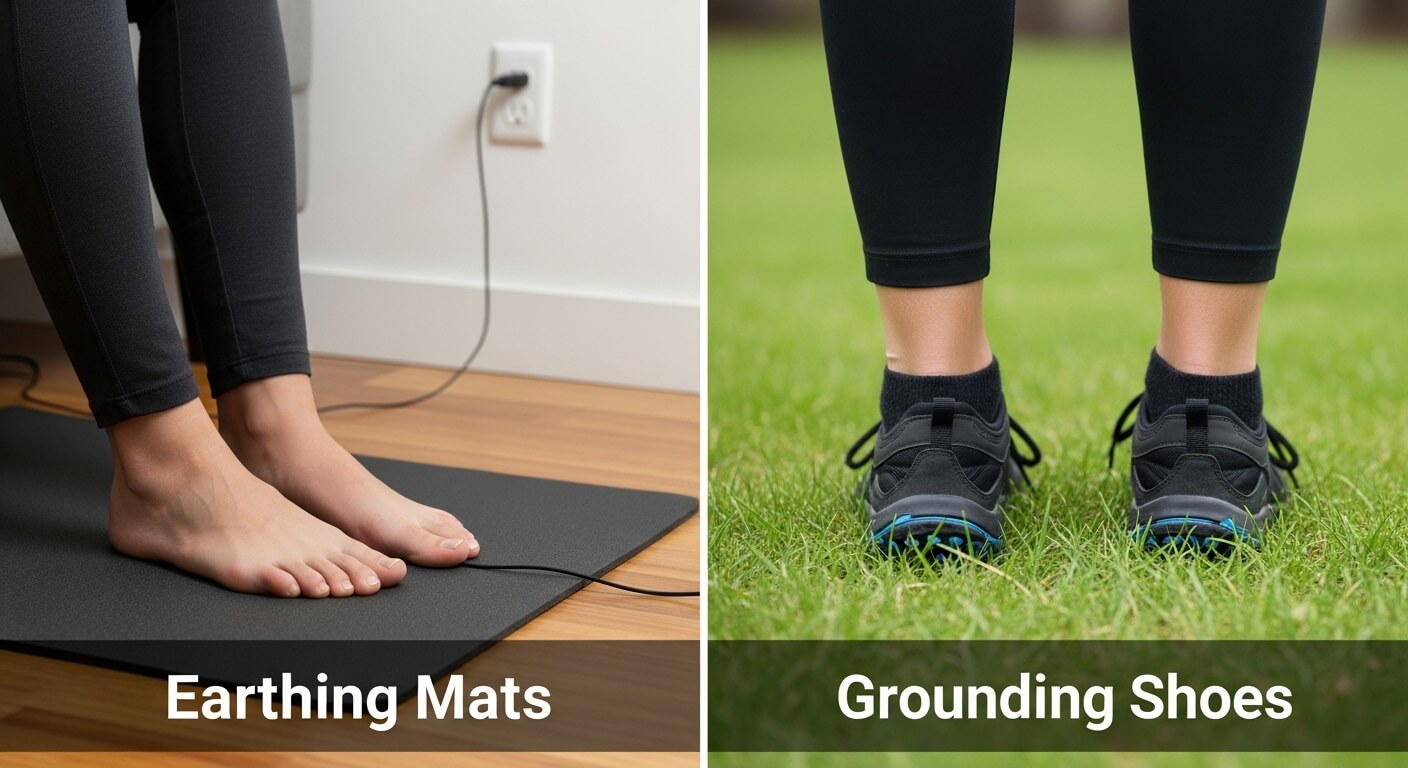
Earthing mats and grounding shoes both attempt to restore the Earth connection that modern life has reduced, but they approach the goal differently and suit different lifestyles. Earthing mats provide convenient indoor grounding through grounded electrical outlets at lower cost ($40-$150) with ease of use and continuous overnight contact. They suit sedentary indoor workers, people with limited outdoor access, those seeking overnight grounding during sleep, and users prioritizing convenience and affordability. Mats offer practical advantages for most modern lifestyles.
Grounding shoes provide mobile outdoor grounding on natural surfaces at higher cost ($80-$200) with the added benefit of encouraging outdoor activity. They suit active outdoor enthusiasts, people with regular access to parks or yards, those who prefer outdoor time over sedentary indoor grounding, and users valuing exercise and nature exposure beyond potential earthing effects. Shoes make sense primarily if you already spend significant time outdoors.
The fundamental question remains: does earthing actually work? Current scientific evidence is insufficient for confident conclusions. Some small studies suggest possible benefits, but methodological limitations prevent definitive claims. User experiences vary dramatically; from dramatic improvements to no effects; suggesting significant placebo potential or individual variation.
For most people interested in earthing, starting with free barefoot outdoor time makes more sense than purchasing products. This tests interest without investment and provides proven benefits regardless of earthing validity. If you insist on trying earthing products, mats offer better value, practicality, and cost-effectiveness for typical modern lifestyles.
Approach earthing with appropriate skepticism, realistic expectations, and recognition that proven health benefits come from exercise, outdoor time, stress reduction, and good sleep—all of which you can achieve without earthing products. If you do try grounding products, view them as experiments rather than certain solutions, use consistently for several weeks before evaluating, and maintain evidence-based wellness practices alongside any earthing attempts.
Whether electrons flow from Earth through mats or shoes remains scientifically unclear, but the pursuit of wellness through nature connection, reduced sedentary time, and outdoor activity provides genuine benefits worth pursuing regardless of grounding theory validity.