

Summer heat brings a familiar dilemma: stay cool and watch your electricity bill skyrocket, or suffer through sweltering temperatures to save money. With air conditioning accounting for nearly 12% of home energy expenditures nationally—and much more in hot climates—summer cooling costs represent a significant financial burden for many households. Climate change has intensified this challenge, with heat waves becoming more frequent, longer, and more severe across much of the country. But what if you could stay comfortable without breaking the bank?
Modern energy-saving gadgets promise to reduce cooling costs while maintaining comfort through smart technology, efficient designs, and innovative approaches to heat management. In this comprehensive guide, we’ll explore the most effective energy-saving devices for summer heat control, examine how much they actually save, evaluate their effectiveness, and help you determine which gadgets offer the best return on investment for your specific situation and climate.
Understanding Summer Cooling Costs
Air conditioning dominates summer energy consumption in most homes. Central AC systems typically use 3,000-5,000 watts when running, translating to substantial electricity consumption during hot months. A system running 8 hours daily at $0.13 per kWh costs roughly $100-$170 monthly. In hot climates with systems running 12+ hours daily, costs can exceed $300 monthly.
Window units are more efficient for cooling specific rooms, using 500-1,500 watts depending on size and efficiency rating. However, cooling an entire home with multiple window units often consumes comparable energy to central systems. Fans use significantly less energy—50-100 watts for ceiling fans and 20-75 watts for portable fans—but provide comfort through air circulation rather than actual cooling.
Other summer energy drains include refrigerators working harder in hot kitchens, water heaters operating less efficiently in hot environments, and increased use of other appliances and electronics. Poor insulation, air leaks, inefficient windows, and heat-generating appliances all contribute to higher cooling needs and costs.
Inefficient cooling practices waste enormous amounts of energy and money. Cooling empty rooms unnecessarily, setting thermostats too low (below 76°F), neglecting AC maintenance, causing reduced efficiency, air leaks around windows and doors, inadequate insulation allowing heat infiltration, and leaving heat-generating appliances running all compound cooling costs.
A poorly maintained AC system can use 20-30% more energy than a well-maintained one. Each degree you lower your thermostat below 78°F increases energy consumption by approximately 6-8%. These inefficiencies add up quickly, turning manageable summer bills into budget-breaking expenses.
Beyond personal finances, excessive cooling has environmental consequences. Air conditioning accounts for roughly 6% of all electricity produced in the United States, releasing approximately 117 million metric tons of carbon dioxide annually. Peak summer demand strains electrical grids, sometimes necessitating less-efficient power sources. Refrigerants in AC systems, if leaked, are potent greenhouse gases.
Reducing cooling energy consumption benefits both your wallet and the environment, making energy-saving gadgets a win-win investment.
How Smart Thermostats Work
Smart thermostats revolutionize home temperature management through learning algorithms, remote control capabilities, and optimization features. These devices learn your schedule and temperature preferences over time, automatically adjusting temperatures when you’re away or sleeping. They connect to Wi-Fi, allowing smartphone control from anywhere, and integrate with smart home systems for voice control through Alexa, Google Assistant, or Siri.
Advanced models include occupancy sensors detecting when rooms are empty, geofencing that adjusts temperatures based on your phone’s location, weather integration for proactive adjustments, and energy reports showing consumption patterns and savings opportunities.
Leading Smart Thermostat Options
The Google Nest Learning Thermostat ($180-$250) leads the market with sophisticated learning algorithms, an attractive design, and comprehensive features. It typically pays for itself in 1-2 years through energy savings. The Nest Thermostat (non-learning version) offers similar benefits at $130 for budget-conscious buyers.
The Ecobee SmartThermostat ($200-$250) includes a room sensor, excellent voice control integration, and detailed energy reports. Its multi-room sensor capability makes it ideal for homes with hot and cold spots. Amazon Smart Thermostat ($80) provides basic smart features at an entry-level price, working well with Alexa ecosystems.
Honeywell Home T9 ($150-$200) offers reliable performance with room sensors and good compatibility with existing HVAC systems. Installation ranges from DIY-friendly to requiring professional help, depending on your wiring setup.
Studies show smart thermostats typically save 10-23% on heating and cooling costs. For a household spending $2,000 annually on cooling, that translates to $200-$460 saved yearly. The devices typically pay for themselves within 1-3 years, depending on your usage patterns and local energy rates.
Maximum savings occur when you consistently allow the thermostat to optimize rather than constantly overriding it manually. Homes with irregular schedules benefit most, as the thermostat adjusts automatically rather than cooling empty homes all day.
Smart Fans and Air Circulators
Why Fans Matter for Cooling Efficiency
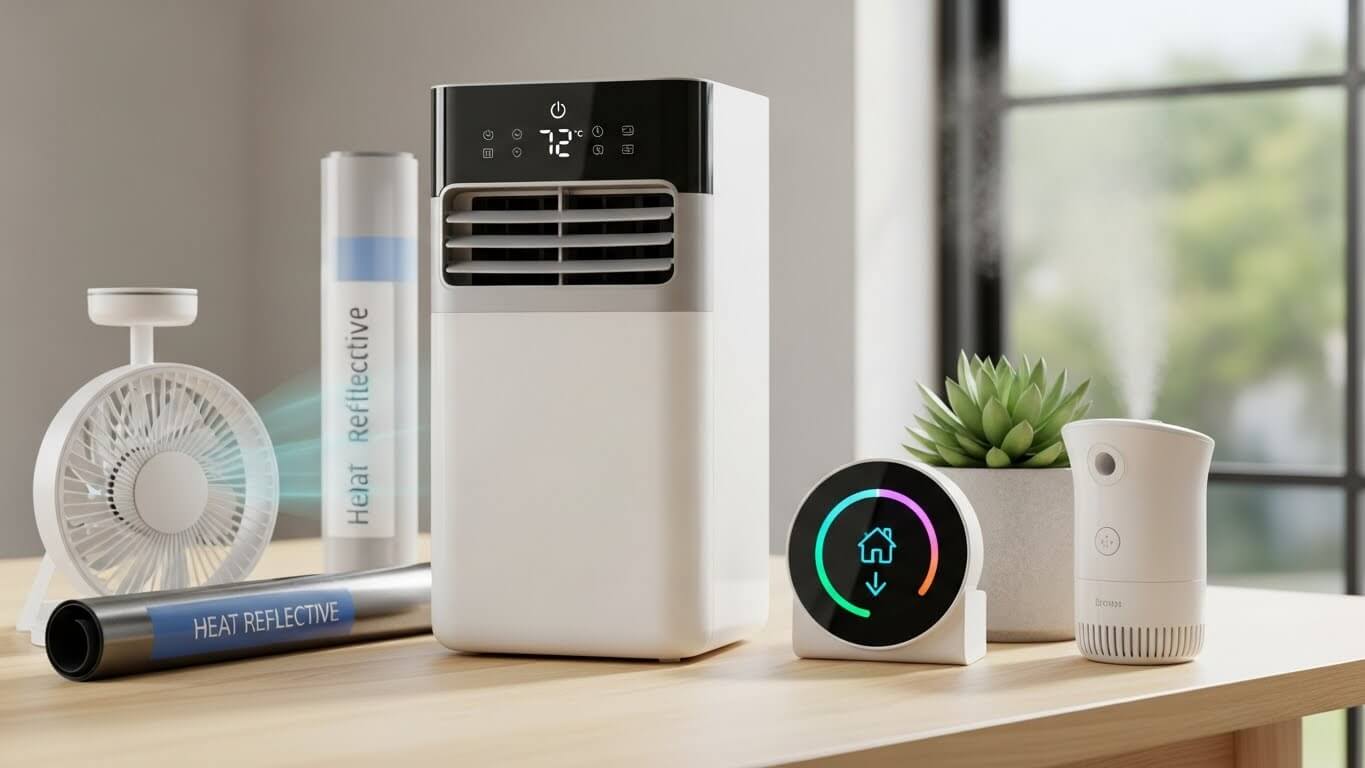
Fans don’t actually lower the room temperature, but create cooling sensations through air movement that helps sweat evaporate. This wind chill effect allows you to feel comfortable at higher thermostat settings. Each degree you raise your thermostat while using fans to maintain comfort saves approximately 3-5% on cooling costs.
Ceiling fans use just 15-90 watts compared to ACs’ 3,000+ watts, making them incredibly energy-efficient cooling supplements. Strategic fan use can reduce AC runtime significantly while maintaining comfort.
Smart Ceiling Fans
Modern smart ceiling fans connect to Wi-Fi or smart home systems, offering scheduled operation, voice control, integration with thermostats, and remote speed adjustment. Some include built-in temperature sensors that automatically adjust speed based on room temperature.
Hunter Signal ($200-$300) offers excellent smart features with quiet operation and energy-efficient motors. Big Ass Haiku ($500-$1,000+) represents premium options with extreme efficiency and whisper-quiet performance. Budget-friendly options include various models with smart switches or hubs added to existing fans for $30-$100.
DC motor fans use up to 70% less energy than traditional AC motor fans while providing comparable or better airflow. When replacing fans, prioritize DC motors for maximum efficiency.
Smart Air Circulators and Tower Fans
Portable smart fans offer flexible cooling solutions. The Vornado 660 AirCirculator ($100-$130) moves air efficiently throughout rooms without smart features but with exceptional performance. Smart versions from brands like Dreo ($80-$150) add app control, scheduling, and integration with smart home systems.
Tower fans with oscillation, multiple speed settings, and timers provide targeted cooling for specific areas. Smart models allow scheduling, remote control, and energy monitoring. Using portable fans strategically in occupied rooms while raising the overall AC temperature saves substantial energy.
Window and Portable AC Innovations
Energy-Efficient Window Units
Not all window AC units are created equal. Modern high-efficiency models use inverter technology that adjusts compressor speed rather than cycling on and off, reducing energy consumption by 30-50% compared to traditional units. Look for Energy Star ratings—these units use at least 10% less energy than standard models.
The Midea U-Shaped Inverter Window AC (8,000-12,000 BTU, $300-$450) leads efficiency ratings while being extremely quiet. Frigidaire’s FHWW series ($250-$400) offers excellent efficiency at more affordable prices. When selecting size, choose appropriate BTU ratings—oversized units waste energy and dehumidify poorly, while undersized units run constantly without adequately cooling.
Calculate required BTUs: roughly 20 BTU per square foot for rooms with average ceiling height, moderate sun exposure, and typical insulation. Adjust up or down based on sun exposure, ceiling height, insulation quality, and room position in the house.
Smart Portable AC Units
Portable AC units offer flexibility but generally use more energy than window units for equivalent cooling. However, smart portable units allow precise room-by-room cooling, potentially saving energy by cooling only occupied spaces.
The Midea Duo Smart Portable AC ($500-$700) uses an innovative dual-hose design for higher efficiency than traditional single-hose portables. It includes smart features like WiFi connectivity, scheduling, and voice control. Black+Decker BPACT14WT ($350-$450) provides good performance at a lower cost with basic smart features.
Key efficiency tip: portable ACs work best when exhaust heat is properly vented. Dual-hose designs are significantly more efficient than single-hose models, as they don’t create negative pressure that pulls hot air into your home.
Solar-Powered Cooling Solutions
Solar Attic Fans
Attics can reach 150°F on hot summer days, radiating heat into living spaces below and forcing AC systems to work harder. Solar attic fans exhaust hot air using free solar energy, reducing attic temperatures by 20-50°F and cutting cooling costs by 10-30%.
Quality solar attic fans ($300-$600 installed) include QuietCool Solar Attic Fans and Remington Solar Attic Fans. They require no electrical wiring, activate automatically with sunlight, and pay for themselves in 2-4 years through energy savings. Installation ranges from moderately difficult DIY to professional work, depending on roof type and comfort level.
Proper attic ventilation combined with adequate insulation provides maximum benefit. The fan removes heat, while insulation prevents it from entering living spaces.
Solar-Powered Fans and Ventilators
Solar window fans, greenhouse fans, and small ventilators offer supplemental cooling using free solar energy. While individual units provide modest cooling, strategic placement—like exhausting hot air from south-facing rooms—can meaningfully reduce AC load.
Small solar fans ($30-$100) are affordable experiments in solar cooling. Larger solar vent fans ($100-$300) can exhaust significant air volumes. The beauty of solar-powered devices is that they work hardest when you need them most—during peak sunshine, creating peak heat.
Smart Window Treatments and Films
Automated Smart Blinds and Shades
Windows are major heat gain sources, with up to 76% of sunlight entering through windows becoming heat. Smart blinds automatically close during peak sun hours, blocking heat before it enters your home, while opening to provide natural light when beneficial.
Motorized cellular shades ($150-$400 per window) provide excellent insulation when closed. IKEA Fyrtur smart blinds ($130-$200) offer an affordable entry into automated window treatments. Lutron Serena smart shades ($250-$500+) represent premium options with excellent reliability.
Smart systems schedule operations based on time and sun position, integrate with thermostats for coordinated efficiency, and allow voice control and smartphone management. While expensive for whole-house installation, prioritizing west- and south-facing windows provides maximum return.
Solar Control Window Films
Window films reject solar heat while allowing visible light transmission. Quality films block 50-80% of heat gain without significantly darkening rooms. Professional installation costs $7-$15 per square foot, with DIY options at $1-$3 per square foot plus labor.
Heat-control films typically pay for themselves within 3-7 years through reduced cooling costs. They also reduce UV damage to furniture and flooring while improving comfort near windows. Combined with smart thermostats, window films can reduce cooling costs by 15-25%.
Smart Plugs and Energy Monitors
Eliminating Phantom Loads
Many devices consume electricity even when “off,” collectively called phantom loads or vampire power. This includes electronics in standby mode, chargers plugged in without devices, cable boxes and DVRs, gaming consoles, and appliances with display clocks. Phantom loads account for 5-10% of residential electricity use.
Smart plugs allow remote power control, scheduled on/off times, energy monitoring showing device consumption, and voice control integration. Placing heat-generating devices like gaming consoles, entertainment systems, and chargers on smart plugs prevents both phantom loads and heat generation when not in use.
Energy Monitoring Systems
Whole-home energy monitors like Sense ($300) or Emporia Vue ($100) install in your electrical panel, providing real-time energy consumption data, device-level identification, and cost tracking. This visibility helps identify energy hogs and inefficient practices, often motivating behaviour changes that reduce consumption by 10-15%.
Smart plugs with energy monitoring ($15-$30 each) offer device-specific tracking for less investment. TP-Link Kasa, Wemo, and Amazon Smart Plug models provide reliable performance with energy reporting.
Dehumidifiers and Air Quality Devices
The Humidity Factor
Humidity significantly impacts comfort perception. At 70% humidity, 78°F feels like 82°F. Reducing humidity to 40-50% makes higher temperatures comfortable, allowing you to raise the thermostat while maintaining comfort. Each degree thermostat increase saves 3-5% on cooling costs.
Energy-efficient dehumidifiers ($200-$400) use 30-50% less energy than older models. Look for Energy Star ratings, built-in humidistats, and continuous drain options. Smart dehumidifiers include app control, scheduling, and integration with smart home systems.
Ideal placement is in basements or the most humid rooms. For whole-house control, whole-home dehumidifiers ($1,000-$2,500 installed) integrate with HVAC systems, providing superior efficiency compared to portable units.
Smart Air Purifiers with Cooling Benefits
While primarily for air quality, some smart air purifiers provide secondary cooling through high-volume air circulation. Models with HEPA filtration, activated carbon for odours, and smart features allow scheduled operation and air quality monitoring.
Dyson Pure Cool ($400-$600) combines purification with powerful air circulation, though premium-priced. Coway Airmega ($200-$400) offers excellent performance at a lower cost. Levoit smart purifiers ($150-$300) provide budget-friendly options with effective filtration.
These aren’t AC replacements but can supplement cooling while improving air quality—particularly valuable for allergy sufferers who keep windows closed.
Cost-Benefit Analysis and ROI
Initial Investment Breakdown
Creating an energy-efficient cooling setup requires various investments. A smart thermostat costs $80-$250 and saves 10-23% on cooling with a 1-3 year payback. Smart ceiling fans run $200-$500 per fan and save 3-5% per thermostat degree raised, with a 3-7 year payback depending on use.
Energy-efficient window AC units cost $250-$450 and save 30-50% versus old units, with a 2-5 year payback if replacing old units. Solar attic fans run $300-$600 and save 10-30% on cooling, with a 2-4 year payback. Window films cost $100-$500+, depending on the windows covered, and save 15-25% with a 3-7 year payback.
Smart plugs cost $15-$30 each and save 5-10% on phantom loads, with a 1-2 year payback. The total investment for comprehensive upgrades might range from $500-$2,000+, but phased implementation spreads costs while delivering immediate partial savings.
Calculating Your Savings
To estimate potential savings, start with your average summer electricity bill. Identify the percentage attributable to cooling (typically 40-70% in hot months). Apply estimated savings percentages from devices you’re considering. Factor in your electricity rate and climate severity.
Example: $300 monthly summer bill, 60% for cooling ($180), smart thermostat saving 15% ($27/month), ceiling fans saving an additional 8% ($14/month), total monthly savings of $41, annual summer savings (4 months) of $164, device costs of $230 (thermostat) plus $250 (fan) equals $480, payback period of 2.9 years.
Your actual results depend on existing efficiency, local climate, electricity rates, and consistent device use. Hot climates with high electricity rates see faster payback than moderate climates with low rates.
Long-Term Value
Quality energy-saving devices typically last 5-15 years. A smart thermostat lasting 10 years at $164 annual savings delivers $1,640 in savings after a $230 investment—a $1,410 net benefit. Multiply savings across multiple devices for a substantial cumulative impact.
Beyond direct savings, benefits include increased home comfort, reduced environmental impact, potentially higher home resale value, and protection against rising electricity rates. These intangible benefits add value beyond simple financial calculations.
Frequently Asked Questions
How much can I realistically save with these gadgets?
Total savings typically range from 15% to 40% on summer cooling costs, depending on which gadgets you implement, your starting efficiency level, local climate, and consistent usage. Homes starting with inefficient systems and practices see larger savings. Expect 1-5 years for complete payback on typical investments.
Do smart thermostats work with all AC systems?
Most smart thermostats work with standard central AC and heat pump systems. Compatibility issues can arise with older systems, some heat pump configurations, 120V baseboard systems, and complex multi-zone setups. Check compatibility before purchasing, and expect possible professional installation for complex systems.
Are portable AC units energy efficient?
Portable AC units are generally less efficient than window units for equivalent cooling capacity. However, smart use—cooling only occupied rooms rather than whole homes—can yield energy savings. Dual-hose portable units are significantly more efficient than single-hose models.
Will solar attic fans work in my climate?
Solar attic fans provide benefits in any climate with significant summer heat. They work best in sunny climates with hot summers and adequately sized units for your attic volume. Even moderate climates see meaningful attic temperature reductions and cooling cost savings.
Can I install these devices myself?
Many devices are DIY-friendly, including smart plugs, portable fans, window films, and some smart thermostats. Professional installation may be needed for hardwired ceiling fans, complex thermostat wiring, solar attic fans, and whole-home systems. Assess your skill level honestly—improper installation can waste money and create safety issues.
Do these gadgets require ongoing costs?
Most devices have minimal ongoing costs. Smart devices may require app subscriptions for premium features ($3-$10 monthly), though basic functions are typically free. Occasional filter replacements for air quality devices and maintenance for AC units represent the primary ongoing expenses, though these would exist regardless of smart features.
Conclusion
Energy-saving gadgets for summer heat control offer proven ways to reduce cooling costs while maintaining comfort during hot months. Smart thermostats form the foundation, delivering 10-23% savings through optimized temperature management. Supplementing with efficient fans, strategic window treatments, and targeted AC use can push total savings toward 30-40% for households starting with inefficient cooling practices.
The key to success lies in selecting appropriate devices for your specific situation, implementing them correctly and consistently, combining multiple strategies for cumulative benefits, and viewing them as long-term investments rather than quick fixes. Most quality energy-saving devices pay for themselves within 2-5 years while continuing to deliver savings for years afterwards.
Start with high-impact, relatively affordable upgrades like smart thermostats and improved fan use. Phase in additional gadgets as budget allows, prioritizing those addressing your home’s specific inefficiencies—whether that’s poor ventilation, excessive solar heat gain, or inefficient AC equipment. The combination of modern technology, strategic implementation, and consistent usage can transform your summer cooling from a budget-breaking necessity into a manageable expense while keeping your home comfortably cool throughout even the hottest months.