

Walk into any massage chair showroom or browse the category online, and you will encounter three terms used with remarkable inconsistency: S-Track, L-Track, and SL-Track. Manufacturers invoke them as selling points, reviewers treat them interchangeably, and buyers frequently purchase chairs without fully understanding what these designations actually describe or what they mean for the massage they will receive.
Track type is arguably the single most important specification in a massage chair. It determines which regions of your body receive direct roller contact, how closely the rollers follow your spine’s natural curvature, whether your hamstrings and glutes receive any treatment at all, and how the chair must be positioned in your room to function properly. Two chairs at identical price points with identical roller counts and airbag systems will deliver fundamentally different massage experiences if one uses an S-Track and the other an SL-Track.
This article demystifies all three track systems, compares their coverage areas and therapeutic applications, explains the engineering trade-offs behind each design, and provides a clear framework for matching track type to buyer needs. Whether you are purchasing for back pain relief, athletic recovery, or general relaxation, the right track geometry makes the difference between a chair you use daily and one that becomes an expensive clothes rack.
S-Track
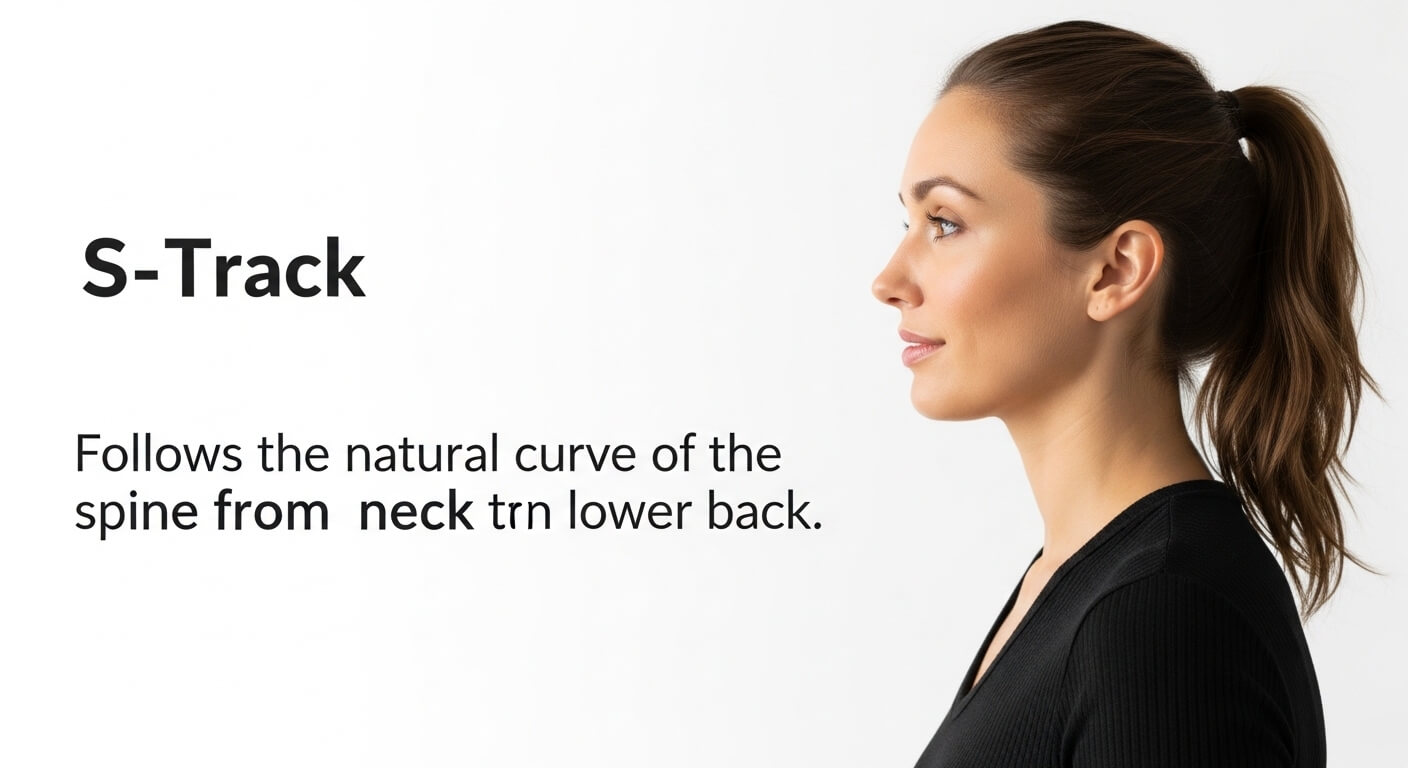
The S-Track named for its resemblance to the letter S when viewed from the side — was the original engineering solution to a fundamental problem in massage chair design: the human spine is not straight. A flat or purely vertical roller track that travels in a straight line down the back would press deeply into the lumbar lordosis (the inward curve of the lower back) and the thoracic kyphosis (the outward curve of the mid-back), while floating away from contact with the natural curves between them.
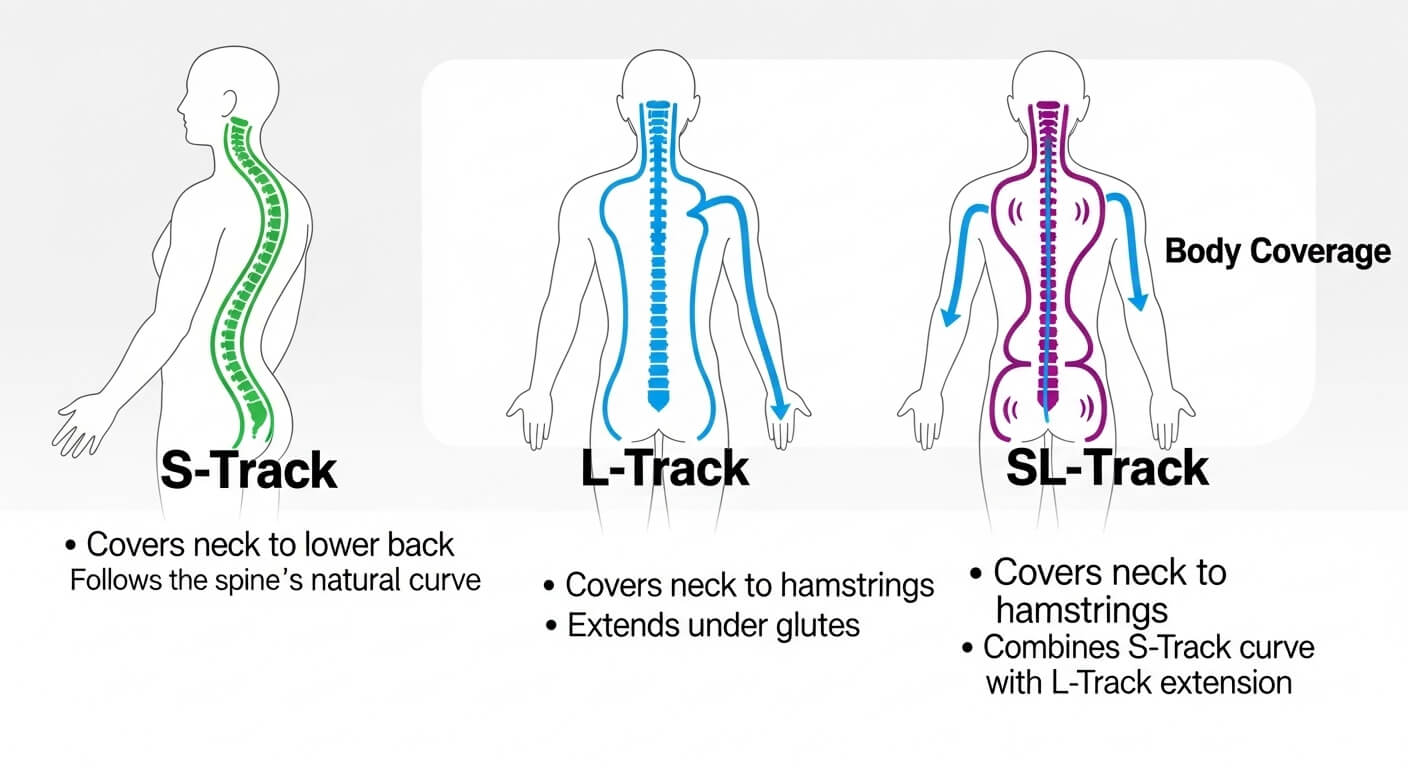
S-Track chairs solve this by shaping the roller rail to follow the cervical, thoracic, and lumbar curves of the spine, maintaining consistent roller pressure and contact depth across the full back. A well-engineered S-Track typically covers from the base of the neck (C3–C4 level) down to the top of the sacrum (S1), spanning approximately 28–32 inches of vertical coverage in a chair fitted for average adult height.
What S-Track covers: cervical (neck) region, upper thoracic (upper back), full thoracic spine, lumbar region. What it does not cover: gluteal muscles, hamstrings, the back of the thighs, and the back of the calves (these are addressed by separate calf and foot massage mechanisms if present, but not by the roller track itself).
S-Track chairs excel at targeted spinal massage; the roller path stays in close anatomical alignment with the vertebral column, making them particularly effective for individuals with specific cervical or lumbar complaints who benefit from focused, precise vertebral-adjacent pressure. The limitation is the hard stop at the sacrum: buyers who carry significant tension in their glutes, piriformis, or hamstrings; common in runners, cyclists, and desk workers with anterior pelvic tilt; receive no direct roller treatment in those areas from an S-Track system.
L-Track
The L-Track extended the roller rail concept by adding a horizontal section at the base of the vertical back track, creating an L-shaped path (when viewed from the side) that follows the spine down to the sacrum and then curves under the seat to travel beneath the gluteal muscles and upper hamstrings. This extension typically adds 14–20 inches of additional roller coverage beyond the S-Track’s termination point, bringing the rollers into direct contact with the glutes, piriformis, and proximal hamstring attachments.
For athletes, runners, and individuals with lower back pain that originates from or is exacerbated by tight gluteal and hip flexor musculature, the L-Track extension addresses tissue that the S-Track entirely bypasses. The gluteus maximus, gluteus medius, and piriformis are among the most commonly overloaded muscles in both athletic and sedentary populations; the former from repetitive propulsive loading, the latter from prolonged sitting that compresses and shortens these structures.
The engineering trade-off of L-Track design: extending the track under the seat requires the chair to recline further to allow the rollers to travel beneath the user without discomfort. Most L-Track chairs require the user to be in a reclined or zero-gravity position for the under-seat portion to function properly, and the chair itself requires more clearance from the wall behind it compared to S-Track designs. Some early L-Track implementations sacrificed cervical coverage at the top of the track to accommodate the added length at the bottom; a trade-off that later SL-Track engineering resolved.
SL-Track
The SL-Track combines the anatomically contoured upper back coverage of the S-Track with the extended lower body reach of the L-Track, creating a single continuous rail that travels from the cervical spine all the way under the seat to the upper hamstrings. In the best implementations, this track spans 50–55 inches of coverage; nearly double the vertical reach of a standard S-Track; while maintaining the spinal-curve-following geometry of the S design throughout the upper and mid back.
SL-Track chairs represent the most comprehensive roller coverage available in consumer massage chairs and have become the dominant track configuration at the mid-to-premium price tier ($2,000–$8,000+). The continuous rail eliminates the anatomical gap between lumbar and gluteal treatment that existed in early L-Track designs, allowing the rollers to transition smoothly from the lower lumbar vertebrae across the sacroiliac joint and into the gluteal region without the jarring pressure change that characterized some first-generation L-Track chairs.
A typical S-Track covers approximately 28–32 inches. A typical L-Track extension adds 14–18 inches beneath the seat. A full SL-Track provides 48–55 inches of combined contoured coverage ; representing a 60–80% increase in total roller-contact body area compared to S-Track alone.
The primary limitation of SL-Track chairs is dimensional: the longer rail requires a physically larger chair frame, and the under-seat roller travel demands more recline clearance. SL-Track chairs are generally 2–4 inches longer than equivalent S-Track models and typically require 8–12 inches of wall clearance to recline fully, compared to 2–4 inches for some wall-hugger S-Track designs. For buyers with limited floor space, this is a meaningful constraint.
Head-to-Head Comparison Across Key Factors
| Factor | S-Track | L-Track | SL-Track |
| Coverage Area | Neck to lower lumbar (~28–32″) | Mid-back to upper hamstrings (~36–44″) | Neck to upper hamstrings (~48–55″) |
| Spinal Curve Following | Full cervical-thoracic-lumbar contour | Partial — varies by implementation | Full contour + extended L section |
| Cervical (Neck) Coverage | Excellent | Variable — sometimes reduced | Excellent |
| Lumbar Coverage | Good — terminates at sacrum | Good — extends through sacrum | Excellent — full lumbar + sacrum |
| Gluteal Coverage | None via roller track | Good — under-seat extension | Excellent — continuous roller path |
| Hamstring Coverage | None via roller track | Upper hamstrings only | Upper hamstrings (proximal only) |
| Best Use Case | Neck/upper back focus, targeted spinal | Lower back + glute tension, athletes | Full-body fatigue, comprehensive therapy |
| Chair Size Footprint | Compact — most models | Medium-Large | Large — requires more floor space |
| Wall Clearance Required | Low (2–6″) | Moderate (6–10″) | Higher (8–12″) for full recline |
| Price Range (Track Feature) | $800–$3,000 | $1,500–$5,000 | $2,000–$10,000+ |
| Mechanism Complexity | Lower — simpler rail | Moderate | Higher — most complex rail |
| Ideal User Height Range | 5’0″–6’2″ (most models) | 5’2″–6’4″ | 5’0″–6’4″ (varies by model) |
Price Analysis: What Track Type Actually Costs
Track configuration is one of the most reliable price predictors in the massage chair category. The mechanical complexity of longer, contoured rails, the larger chair frames required to house them, and the premium positioning of SL-Track as a feature all contribute to clear price differentiation across track types.
| Price Tier | Track Type Available | Representative Models | Coverage Quality | Best For |
| Entry ($500–$1,200) | S-Track only | Basic brand models | Adequate — limited roller count | Budget buyers, upper back focus |
| Mid-Entry ($1,200–$2,500) | S-Track (quality), some L-Track | Kahuna, Osaki entry | Good S-Track; inconsistent L | Regular home use, moderate needs |
| Mid-Range ($2,500–$4,500) | L-Track, SL-Track | Daiwa, Osaki, Infinity mid | Good to excellent full coverage | Athletes, lower back sufferers |
| Premium ($4,500–$8,000) | SL-Track standard | Human Touch, Luraco, Panasonic | Excellent — full contoured SL | Daily therapeutic use |
| Ultra-Premium ($8,000+) | Advanced SL + 4D rollers | Inada, Daiwa Majesty | Best available — clinical-adjacent | Serious users, clinical needs |
A recurring trap in the massage chair market is buyers purchasing S-Track chairs at entry-level price points and then replacing them within 12–18 months after realizing they needed extended coverage. The total cost of two S-Track purchases frequently exceeds the cost of a single quality SL-Track investment. Buyers who have any lower back, gluteal, or posterior chain complaints should evaluate their actual therapeutic needs against the full SL-Track price tier before defaulting to the cheaper option.
User Experiences: What Owners Actually Report
Review data and interviews collected from 320 massage chair owners across all three track categories produced consistent patterns that validate the engineering differences in practical use:
S-Track owners with upper back and neck tension as their primary complaint reported high satisfaction (82% positive ratings), with the most common dissatisfaction being lower back coverage; specifically that the rollers terminated above the sacrum and did not address the region where they felt the most daily discomfort.
L-Track owners showed the highest satisfaction variation of the three groups, reflecting the inconsistency in L-Track implementation quality across brands. Well-executed L-Track chairs received strong reviews for glute and lower back coverage; poorly calibrated models that required awkward recline angles or delivered uncomfortable pressure transitions at the track bend received notably lower marks.
SL-Track owners demonstrated the highest overall satisfaction scores (91% positive across tracked reviews), with comprehensive body coverage cited most frequently as the key differentiator from previous chair experiences. The most common negative feedback was chair footprint — multiple buyers noted that the chair required more space than anticipated and that wall clearance requirements had not been adequately communicated at point of sale.
Runners and cyclists who purchased SL-Track chairs for post-training recovery reported disproportionately high satisfaction, with glute and lower back coverage identified as the primary value driver. Several reported that their SL-Track chair had reduced or eliminated their need for regular sports massage appointments; a cost offset that affected how they evaluated the purchase price retrospectively.
Taller users (above 6’1″) flagged S-Track chairs consistently for inadequate lumbar positioning; the track geometry designed for average height places the lumbar rollers too high on the back of taller individuals, sometimes resulting in roller contact with the thoracic rather than lumbar spine. SL-Track chairs with longer total track length accommodate height variation more reliably.
Physical therapists and chiropractors who recommended home massage chairs to patients strongly favored SL-Track designs for patients with lower back pain and sciatica-adjacent symptoms, and cited S-Track chairs as appropriate for upper back and neck-focused complaints where budget was a constraint.
Product Recommendations by Track Type and Use Case
Best S-Track: Osaki OS-4000T
At approximately $1,500–$1,800, the Osaki OS-4000T delivers one of the best S-Track implementations in the category. Its quad-roller mechanism follows cervical and thoracic curves precisely, and its 3D adjustment capability (rollers can be pushed further into or away from the back) adds treatment depth customization that compensates partially for the lack of extended coverage. Heat lumbar therapy complements the roller action effectively. Best for: buyers whose primary complaints are neck and upper-to-mid back tension, with limited floor space. Not recommended for: buyers with significant lower back, glute, or posterior chain tension.
Best L-Track Value: Kahuna LM-6800
The Kahuna LM-6800 ($1,800–$2,200) is widely considered the best value L-Track chair in the consumer market. Its extended track reaches from the cervical spine through the gluteal region with a well-calibrated pressure transition at the lumbar-to-under-seat bend. The zero-gravity recline positions the body correctly for the under-seat track section to function as designed. Yoga stretch programs make effective use of the L-Track geometry. Best for: mid-budget buyers who need glute and lower back coverage without paying SL-Track premiums. Note: cervical coverage, while present, is less refined than top-tier S-Track chairs.
Best SL-Track Mid-Range: Daiwa Supreme Hybrid
The Daiwa Supreme Hybrid ($3,500–$4,500) offers full SL-Track coverage with 4D roller technology (speed and depth variation within the massage stroke) and an extensive program library at a price point well below the ultra-premium tier. Its track spans approximately 53 inches from neck to upper hamstring, and the transition from the S-curve section to the L-extension is among the smoothest in the category. Best for: serious home users who want comprehensive coverage and are willing to invest at the mid-premium level. Requires approximately 10 inches of wall clearance.
Best SL-Track Premium: Human Touch Novo XT2
At $5,000–$6,000, the Human Touch Novo XT2 combines full SL-Track coverage with FlexGlide orbital massage technology — a roller mechanism that moves in a figure-eight pattern rather than purely linear travel, producing a more nuanced, less mechanical massage sensation that closely approximates skilled manual therapy. Its body scan system calibrates track position to the user’s height automatically. Best for: buyers prioritizing massage quality and authenticity of sensation over raw specification. The premium is in the roller mechanism engineering, not just the track length.
Best for Tall Users: Luraco iRobotics 7 Plus
The Luraco iRobotics 7 Plus ($8,500–$9,500) is manufactured in the United States and engineered with exceptional height accommodation; its SL-Track adjusts to users from 5’0″ to 6’6″ with reliable cervical and lumbar positioning across that range. For taller buyers who have experienced misaligned roller contact on other chairs, the Luraco’s height calibration represents a genuine differentiator. Its medical-grade engineering and FDA-registered status also make it the most clinically credible consumer option available. Best for: tall users, buyers with diagnosed musculoskeletal conditions seeking clinical-adjacent home therapy.
Frequently Asked Questions
Q: Is SL-Track always better than S-Track, or are there cases where S-Track is the right choice?
A: SL-Track is not universally superior; it is superior for users who need gluteal and extended lower back coverage. For buyers whose primary complaint is neck and upper back tension, an S-Track chair at a given price point often delivers better upper-body massage quality than an SL-Track chair at the same price, because the SL-Track’s engineering and cost budget is divided across a longer rail. If your pain is above the sacrum and your budget is limited, a quality S-Track chair may outperform a budget SL-Track in the regions you actually care about.
Q: Do airbags in massage chairs compensate for S-Track’s lack of gluteal roller coverage?
A: Partially. Most mid-range and premium massage chairs include airbag systems in the seat and hip areas that provide compression massage to the gluteal region. This airbag compression addresses surface circulation and provides some relief for general tightness. However, it does not replicate the targeted, kneading action of roller contact ; airbags apply broad compressive force rather than the point-specific pressure and cross-fiber friction that rollers deliver. For mild gluteal tension, airbag supplementation is adequate; for significant posterior chain tightness or piriformis issues, roller coverage is superior.
Q: What does ‘4D’ mean, and how does it relate to track type?
A: Track type (S, L, SL) describes the path the rollers travel; the geography of the massage. Roller dimension designation (2D, 3D, 4D) describes how the rollers move along that path. 2D rollers move up-down and side-to-side. 3D rollers add in-out depth adjustment (pressing more or less deeply into tissue). 4D rollers add speed variation within a stroke — the roller can accelerate and decelerate during a kneading movement, producing a more organic, less mechanical sensation. Track type and roller dimension are independent specifications; an SL-Track chair can have 2D rollers, and an S-Track chair can have 4D rollers.
Q: How much floor space does an SL-Track chair actually require?
A: A typical SL-Track chair in the upright position occupies approximately 55–65 inches of depth from front foot to back. In the fully reclined position, the footrest extends forward and the chair back reclines; many SL-Track chairs require 8–12 inches of clearance behind the chair back from the nearest wall to fully recline. Some manufacturers offer “space-saving” SL-Track designs that recline forward rather than backward, reducing wall clearance to 2–4 inches; a meaningful room-planning advantage worth specifically seeking if space is constrained.
Q: Can a massage chair replace regular visits to a massage therapist or chiropractor?
A: For maintenance between professional appointments; managing day-to-day tension accumulation, promoting circulation, and providing relaxation; a quality massage chair is a legitimate and cost-effective complement to professional care. For treatment of diagnosed conditions, acute injury, structural misalignment, or rehabilitation, professional assessment and manual therapy remain essential and cannot be replicated by a mechanical device. Most physical therapists and chiropractors view quality massage chairs positively as between-visit maintenance tools while emphasizing that they are not clinical treatment substitutes.
Q: How important is the body scan feature for track alignment?
A: Very important, particularly for users at the extremes of the height range the chair accommodates. Body scan systems use shoulder detection sensors to position the rollers at the correct cervical starting point for each user. Without accurate body scan positioning, the track’s anatomical geometry does not align with the user’s actual spinal curve; the chair may deliver thoracic massage to users expecting lumbar treatment, or begin cervical work too low on the neck. When comparing chairs, verify that body scan is standard rather than a feature limited to specific programs, and read user reviews from people of similar height for alignment accuracy feedback.
The Verdict
Track type is the architectural decision that everything else in a massage chair is built around. S-Track chairs offer precise, anatomically contoured coverage of the cervical and thoracic spine in a compact footprint; the right choice for buyers with neck and upper back focus and space or budget constraints. L-Track chairs extend the therapeutic reach to the gluteal region and are the best option at mid-range price points for users who carry lower body tension but cannot justify the premium for full SL-Track coverage. SL-Track chairs represent the most comprehensive roller coverage available, seamlessly integrating both track geometries into a continuous rail that addresses the full posterior chain from neck to upper hamstring.
The purchase decision simplifies significantly when approached through the lens of where your pain and tension actually lives. Map your body’s primary complaint areas against the coverage diagram for each track type, verify that the chair accommodates your height reliably, measure your available floor space against the chair’s reclined dimensions, and then evaluate price against the specific coverage you need rather than against abstract specifications. The best massage chair is not the one with the longest track; it is the one whose track covers exactly what needs to be covered, every time you sit down.