

In our increasingly digital world, where the average person spends 7-10 hours daily hunched over screens, poor posture has become a modern epidemic affecting millions. Forward head position, rounded shoulders, and anterior pelvic tilt aren’t just aesthetic concerns; they create genuine health problems, including chronic pain, reduced mobility, breathing difficulties, and even psychological impacts.
While awareness of proper posture is the first step, maintaining good alignment throughout busy days proves nearly impossible for most people without external feedback. Enter posture training wearables; smart devices that monitor your body position continuously and provide real-time alerts when you slouch or misalign, theoretically training your body to adopt healthier positions automatically.
These gadgets range from simple vibrating clips that remind you to sit straight to sophisticated sensor systems measuring multiple postural angles with smartphone app integration. But do these devices actually work? Can a $50-$200 wearable truly retrain decades of poor postural habits, or are they just another wellness trend destined to gather dust in drawers?
In this comprehensive guide, we’ll examine how posture wearables function, evaluate their effectiveness based on research and user experiences, compare different device types, and help you determine whether investing in posture training technology makes sense for your specific alignment issues, lifestyle, and wellness goals.
Understanding Posture and Body Balance
What is Proper Posture?
Proper posture maintains the spine’s natural curves while minimizing stress on muscles, ligaments, and joints. When standing, ideal alignment includes ears over shoulders, shoulders over hips, hips over knees, and knees over ankles. The spine maintains three natural curves: cervical (slight forward curve in neck), thoracic (slight backward curve in upper back), and lumbar (slight forward curve in lower back).
When sitting, proper posture keeps your back straight with shoulders relaxed, feet flat on the floor, and knees at approximately 90 degrees. Your computer screen should be at eye level, preventing the forward head position that characterizes “tech neck.” Arms should rest comfortably without reaching or hunching.
Body balance refers to the body’s ability to maintain its center of gravity over the base of support. Proper posture supports optimal balance by aligning body segments efficiently, reducing compensatory patterns that create instability and increasing proprioceptive awareness.
The Modern Posture Crisis
Contemporary lifestyles conspire against good posture through multiple factors. Prolonged sitting averages 6-13 hours daily for many adults, weakening core muscles and tightening hip flexors. Screen use creates forward head position for every inch the head moves forward, the neck supports an additional 10 pounds of perceived weight.
Sedentary behavior weakens postural muscles that require regular activation to maintain strength. Stress causes protective muscle guarding, particularly in neck and shoulders. Poor ergonomics in workspaces force awkward positions. Lack of body awareness means many people don’t notice their slouching until pain develops.
The cumulative effects include chronic neck and back pain, headaches, reduced lung capacity, digestive issues, and psychological impacts including reduced confidence and perceived competence by others.
How Posture Affects Overall Health
Poor posture creates cascading health effects beyond simple discomfort. Musculoskeletal problems develop as chronic misalignment strains muscles, compresses joints, and creates trigger points. Breathing capacity reduces by up to 30% with slouched posture compressing the chest cavity. Digestive function may be impaired as compression affects organ positioning.
Circulation can be reduced in compressed areas. Chronic pain develops from sustained muscle tension and joint stress. Reduced mobility and flexibility result from muscles adapting to poor positions. Fatigue increases as the body works harder to maintain balance in misaligned positions.
Psychological impacts include reduced confidence, negative mood associations with slouched posture, and others perceiving slouched individuals as less competent or authoritative. Research shows simply sitting upright can measurably improve mood and self-perception.
Addressing posture becomes crucial not just for pain relief but for overall health and wellbeing.
How Posture Training Wearables Work
Core Technology and Sensors
Posture wearables use various sensor technologies to monitor body position. Accelerometers detect orientation and movement in three-dimensional space, measuring how your body tilts or rotates from calibrated neutral positions. Gyroscopes track rotational movement and angular velocity, providing additional orientation data.
Some advanced devices include EMG (electromyography) sensors detecting muscle activation patterns to assess which muscles are working and how hard. Proprietary algorithms analyze sensor data to determine whether your posture deviates from proper alignment based on calibrated baselines.
The monitoring process involves initial calibration where you position yourself in proper alignment and the device learns your “good posture” baseline. Continuous monitoring then tracks your position throughout the day. Threshold detection identifies when deviation from proper posture exceeds set limits for sufficient duration (typically 30-90 seconds to avoid false alerts for normal movement). Real-time feedback provides alerts when poor posture is detected.
Types of Feedback Mechanisms
Devices employ various feedback methods. Vibration alerts create gentle buzzing sensations when slouching is detected—the most common feedback type across devices. Some provide adjustable vibration intensity and patterns. Audio alerts through smartphone apps verbally remind you to correct posture, though less discrete than vibration.
Visual indicators via smartphone apps show posture status, tracking data, and progress over time. Some devices include LED lights providing immediate visual feedback. Haptic patterns vary vibration timing and intensity to communicate different postural issues.
The goal is providing noticeable but non-disruptive feedback that creates awareness without being annoying enough to cause users to disable or ignore alerts.
Data Tracking and Apps
Modern posture wearables typically connect to smartphone apps via Bluetooth, providing several functions. Real-time monitoring displays current posture status visually. Historical tracking shows posture trends over days and weeks, identifying patterns like when you slouch most (afternoon fatigue, specific activities).
Progress metrics quantify improvement over time—percentage of day in good posture, slouching episodes, duration of poor posture periods. Guided programs offer structured training with progressive goals and exercises. Reminders and notifications encourage regular use and posture checks. Some devices integrate with health platforms like Apple Health or Google Fit.
The data visibility helps users understand their postural habits and provides motivation through trackable progress.
Types of Posture Training Wearables
Clip-On Devices
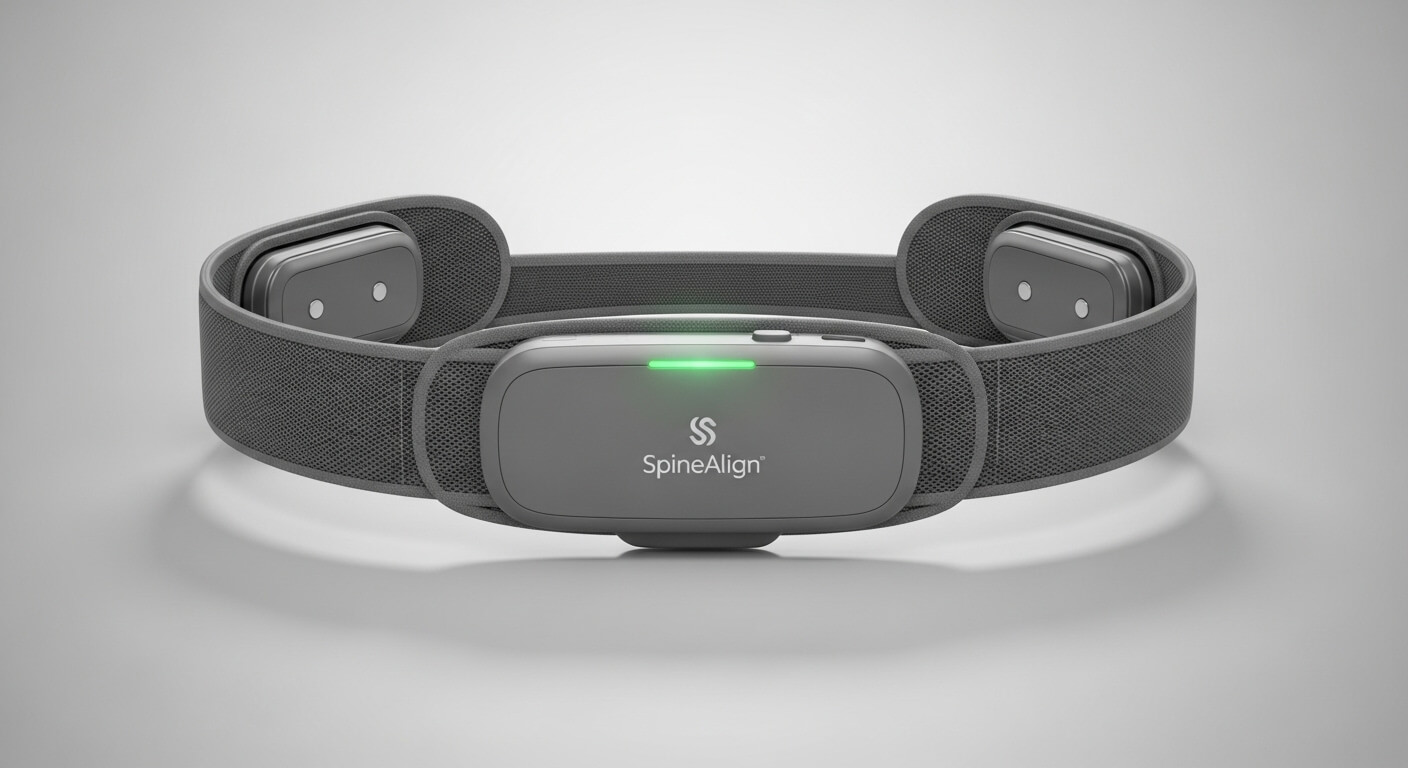
Clip-on devices are small sensors attaching to clothing near the collarbone or upper chest, monitoring upper body position. Popular models include Upright GO series and similar competitors. These typically measure 1-2 inches, weighing under an ounce.
Advantages include discrete size easily hidden under clothing, simple placement requiring minimal setup, affordable pricing ($50-$100 typically), and effective monitoring of forward head position and rounded shoulders—the most common postural issues.
Limitations include monitoring only upper body position without lower back or pelvic awareness, adhesive pads requiring replacement ($10-$20 per pack of 10-20), and potential for the device to fall off or shift position during movement.
These suit users with primarily upper body postural issues from desk work or screen use.
Smart Shirts and Wearable Garments
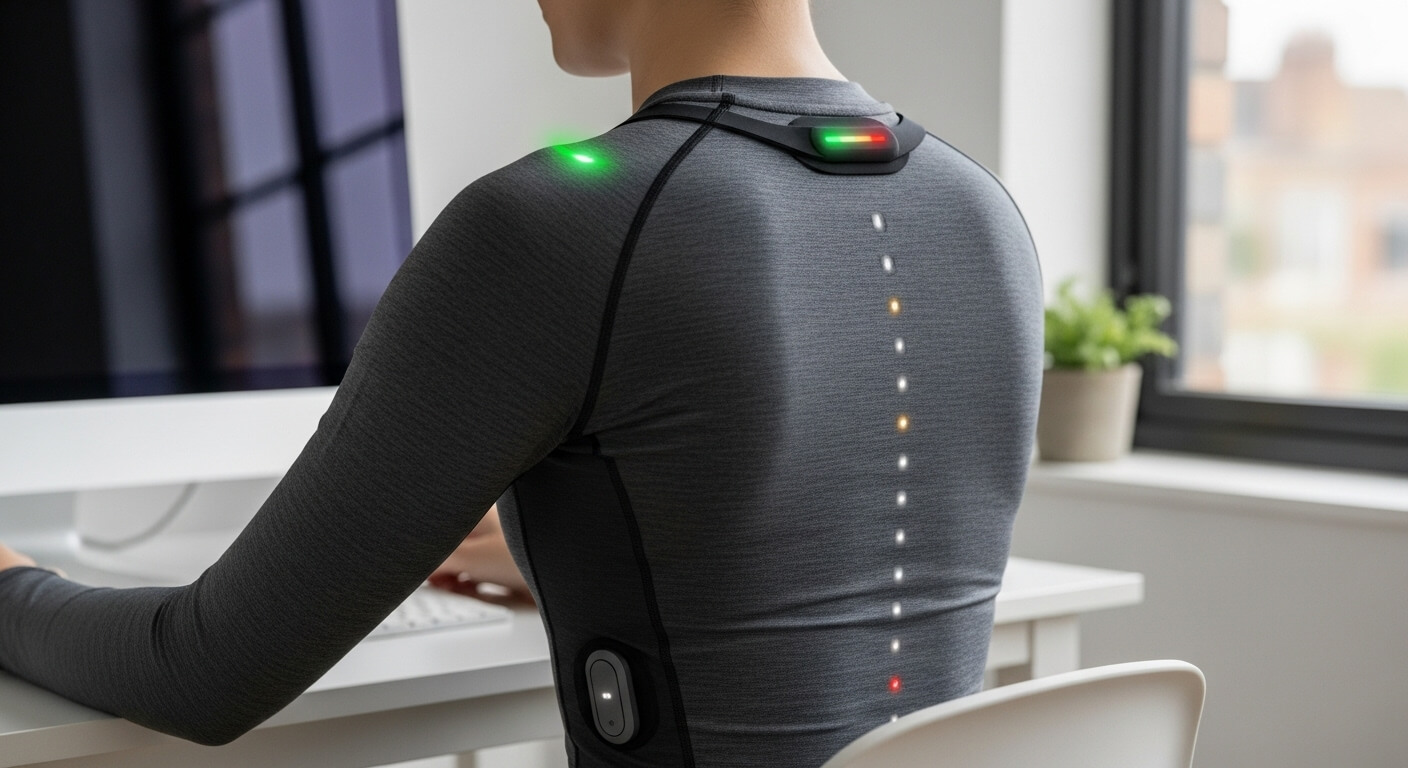
Smart posture shirts integrate sensors directly into fabric, typically using conductive threads or embedded sensors monitoring multiple body points simultaneously. Brands like Alignmed and others offer these garments at $150-$300.
Advantages include comprehensive monitoring of full torso position, no risk of device falling off or shifting, comfortable all-day wear integrated into clothing, and simultaneous monitoring of multiple postural angles.
Limitations include higher cost, requiring washing and care like regular clothing, less flexibility—must wear specific garment to get feedback, and bulkier than discrete clip-on devices.
These suit users wanting comprehensive postural monitoring who don’t mind wearing specific garments.
Posture Correcting Braces with Sensors
Some traditional posture braces now include sensors providing feedback in addition to physical support. These combine passive correction through brace structure with active feedback about position. Advantages include dual-action correction; physical support plus feedback, particularly helpful for severe postural issues, and an immediate physical reminder of proper position.
Limitations include being more visible and less discreet than other options, can be uncomfortable during extended wear, risk of muscle dependence; muscles may weaken if the brace does all the work, and higher cost ($100-$200+). These suit users with significant postural dysfunction need more support than feedback alone provides.
Headband and Neck-Mounted Devices
Some devices mount on the head or neck, specifically targeting forward head position and neck alignment. These are less common but available from speciality manufacturers.
Advantages include specific targeting of “tech neck”, a major modern postural problem, direct monitoring of head position relative to spine, and often lighter and more comfortable than full-torso devices.
Limitations include monitoring only head/neck position without full body awareness, which may be visible depending on hairstyle and clothing, and are less versatile than devices monitoring broader postural issues.
These suit users whose primary concern is forward head position rather than general posture.
Effectiveness: What Research and Users Say
Scientific Evidence on Posture Feedback
Research on posture wearables specifically is limited but growing. A 2020 study in the Journal of Physical Therapy Science found participants using vibration feedback devices showed significant improvement in forward head posture after four weeks compared to control groups. A 2019 study in Ergonomics demonstrated that real-time feedback reduced slouching time by approximately 25% during computer work.
Longer-term studies show mixed results—some users maintain improvements after discontinuing devices while others gradually revert to old habits. The devices appear most effective when combined with strengthening exercises and ergonomic improvements rather than used in isolation.
The primary mechanism of effectiveness is increased awareness—most people with poor posture simply don’t realize when they’re slouching. The feedback creates conscious awareness that, over time, can translate into improved automatic postural control.
User Experience and Adherence
Real-world user experiences reveal patterns in success and failure. Many users report dramatic initial awareness increase—being shocked by how frequently they slouch. Initial improvement is common as conscious attention to posture increases. Some users successfully develop better automatic posture habits over 4-8 weeks.
However, adherence challenges are significant. Many users find vibration alerts annoying after the novelty wears off, leading to disabling or ignoring feedback. Some remove devices or “just tolerate” alerts without actually correcting posture. Battery management and charging becomes a barrier to consistent use for some.
Adhesive replacement costs for clip-on devices add ongoing expenses. The initial enthusiasm often wanes after several weeks, with many devices abandoned in drawers. Studies of adherence show 30-50% of users stop using devices within 2-3 months.
Success correlates with viewing devices as temporary training tools rather than permanent solutions, combining use with exercises strengthening postural muscles, and maintaining ergonomic workspace improvements alongside device use.
What Works Best
Evidence suggests optimal use patterns include structured programs with progressive goals rather than indefinite use, sessions of focused attention (2-4 weeks of intensive use) rather than passive long-term wearing, combination with targeted exercises for postural muscles, and ergonomic workspace optimization complementing device feedback.
Users should view devices as training wheels—tools to develop awareness and habits, not permanent solutions. Setting realistic goals focused on awareness development rather than expecting automatic perfect posture proves more effective.
Benefits and Limitations
Key Benefits
Posture wearables offer several genuine advantages. Increased awareness is the primary benefit—conscious recognition of slouching throughout the day that most people lack without feedback. Objective tracking provides data on postural habits and measurable progress metrics motivating improvement.
Convenient real-time feedback allows immediate correction rather than waiting for pain to signal poor posture. Non-invasive intervention requires no medication, injections, or procedures. Portable and discrete design enables use throughout normal daily activities.
Potential for habit formation exists—some users successfully develop better automatic posture with consistent use. Cost-effectiveness compared to ongoing professional therapy or chiropractic visits provides accessible entry to posture improvement.
For users who respond well and use devices consistently with realistic expectations, benefits can be meaningful.
Significant Limitations
Despite benefits, important limitations exist. Devices don’t address underlying causes including weak muscles, tight muscles, or structural issues requiring different interventions. They provide awareness but don’t strengthen muscles—you need exercises for that.
False positives can occur; alerts during normal movement or activities requiring different positions. The dependence risk means some users struggle to maintain good posture without device feedback. Annoyance factor leads many to disable or ignore alerts over time.
Limited scientific evidence supports long-term effectiveness beyond the initial use period. The devices don’t work for everyone, individual variation in response is significant. Discomfort during extended wear affects some users. The technology has a learning curve requiring initial setup, calibration, and understanding feedback patterns.
Realistic expectations are essential; these devices facilitate awareness and training but aren’t magic solutions for complex postural problems.
Choosing the Right Posture Wearable
Assess Your Specific Needs
Consider several factors when selecting devices. What are your primary postural issues, forward head position, rounded shoulders, lower back slouching, or multiple problems? How severe is your posture problem, mild awareness needed or significant dysfunction?
What’s your lifestyle and work environment; sedentary office work, active job, or varied activities? What’s your budget, $50 for basic clip-on or $200+ for comprehensive systems? Do you want discrete minimal devices or are you comfortable with visible wearables?
How tech-savvy are you, comfortable with apps and Bluetooth setup or prefer simple plug-and-use? What’s your commitment level, willing to use consistently for weeks or just casual experimentation?
Honest self-assessment guides toward appropriate device types and features.
Key Features to Consider
Evaluate devices on several criteria. Monitoring accuracy and sensitivity determines how precisely the device detects postural deviations. Battery life affects convenience—some last days while others need daily charging. Comfort during extended wear is crucial for consistent use.
Feedback customization including vibration intensity, timing, and alert thresholds allows personalization. App quality and features for data visualization, goal setting, and tracking matter for long-term engagement. Water resistance is important if you’ll wear during exercise or in humid conditions.
Size and discretion affect whether you’ll actually wear the device in professional or social settings. Adhesive quality and replacement cost matter for clip-on devices requiring adhesive pads. Warranty and customer support provide protection for defective devices.
Price should balance with features—expensive doesn’t always mean better for your specific needs.
Top Posture Wearable Recommendations
Upright GO 2 ($100): Most popular clip-on device with effective vibration feedback, comprehensive app with training programs, small discrete size, and good battery life (30 hours). Best for upper body posture monitoring with proven track record and positive user reviews.
Upright GO S ($80): Simpler version of GO 2 with essential features at lower cost. Good entry point for those uncertain about committing to premium pricing.
Lumo Lift (discontinued but available used): Pioneer in the space with good technology, though company ceased operations. Available used for $30-$60 if you find it—good for budget experimentation.
AlignMed Posture Shirt ($150-$250): Comprehensive garment-based system for users wanting full torso monitoring and willing to wear specific clothing. Higher cost but more complete postural feedback.
UPRIGHT Trainer ($150): Back-mounted device providing lower back and thoracic feedback in addition to upper body monitoring. Better for comprehensive posture including lower back awareness.
Best Practices for Success
Proper Use and Training Protocol
Maximize effectiveness through structured approach. Start with calibration by sitting or standing in proper alignment for device baseline learning. Begin with training mode providing frequent feedback to build awareness rapidly. Progress to tracking mode with reduced feedback as awareness improves.
Use consistently for 4-8 weeks minimum allowing habit formation. Combine with exercises strengthening core, upper back, and neck muscles supporting good posture. Implement ergonomic improvements to your workspace making good posture easier to maintain.
Practice mindful awareness during device-free times applying lessons learned. Set progressive goals—start with 50% of day in good posture, work toward 70-80% rather than perfection. Take breaks if alerts become overwhelming—better to use intermittently than abandon completely.
Complementary Exercises
Posture wearables work best alongside targeted exercises. Strengthen weak postural muscles through chin tucks for forward head position, wall angels for rounded shoulders, rows and reverse flies for upper back, and planks and bird dogs for core stability.
Stretch tight muscles including chest doorway stretches, hip flexor lunges, and upper trapezius stretches. Practice postural awareness through body scans noting alignment throughout the day and mirror checks to see and feel proper versus poor posture.
Perform movement variety by taking regular breaks from sustained positions and including different activities throughout the day.
When to Seek Professional Help
While wearables help many people, professional evaluation is necessary for severe pain not improving with self-care, postural issues following injury or trauma, suspected structural problems or scoliosis, and chronic issues significantly impacting daily life.
Physical therapists assess muscle imbalances, provide targeted exercises, and address underlying dysfunction. Chiropractors evaluate spinal alignment and provide adjustments if appropriate. Occupational therapists help with ergonomic setup and adaptive strategies. Posture wearables complement but don’t replace professional care for serious postural problems.
Cost-Benefit Analysis
Investment Breakdown
Initial costs range from $50-$100 for basic clip-on devices to $100-$200 for premium devices or comprehensive systems. Ongoing costs include replacement adhesives for clip-on devices ($10-$20 per pack every 1-3 months), battery replacement for non-rechargeable models, and potential app subscriptions for premium features ($5-$10 monthly for some devices).
Typical total first-year cost runs $80-$150 for basic devices with ongoing expenses or $150-$300 for premium systems.
Value Compared to Alternatives
Professional physical therapy costs $75-$150 per session with typical treatment plans of 6-12 sessions totaling $450-$1,800. Chiropractic care runs $60-$100 per visit requiring ongoing maintenance. Ergonomic assessments cost $100-$300 for professional evaluation.
Posture wearables at $100-$200 one-time cost provide accessible alternative or complement to professional care. The value proposition depends on whether devices effectively improve your posture. If successful, they’re extremely cost-effective. If you abandon them unused, even $50 is wasted.
Long-Term Value
Devices typically last 1-3 years with regular use before requiring replacement due to battery degradation or component failure. Success stories justify cost through avoided professional care expenses, reduced pain medication, improved productivity from reduced discomfort, and better overall wellbeing.
However, high abandonment rates mean many users don’t achieve sufficient value from their investment. The device gathering dust provides zero value regardless of price.
Frequently Asked Questions
Do posture wearables actually work?
For motivated users who use them consistently as training tools combined with exercises and ergonomic improvements, yes—they increase awareness and can help develop better postural habits. However, they don’t work for everyone, require commitment to be effective, and don’t address underlying muscle weakness or tightness without complementary exercises.
How long until I see results?
Most users notice increased awareness immediately. Measurable posture improvements typically appear within 2-4 weeks of consistent use. Habit formation sufficient to maintain good posture without device feedback takes 6-12 weeks for most people, though individual variation is significant.
Can I wear these all day?
Most devices are designed for all-day wear, though many users find 8-12 hours sufficient. Some prefer training mode for a few hours daily rather than continuous wearing. Listen to your body—if discomfort develops from the device itself, reduce wearing time.
Will my posture revert after stopping use?
Results vary. Some users successfully develop automatic good posture habits that persist after discontinuing devices. Others gradually revert to old patterns. Combining device use with strengthening exercises and ergonomic improvements increases likelihood of maintaining improvements.
Are these safe for everyone?
Generally safe for most people. Consult healthcare providers before using if you have spinal injuries, recent surgery, severe structural issues, or chronic pain conditions. Pregnant women should check with doctors. Anyone experiencing increased pain should discontinue use and seek professional evaluation.
Which type of device works best?
Clip-on devices work well for most users with upper-body postural issues, the most common problem. Smart garments provide more comprehensive feedback but require wearing specific clothing. Choice depends on your specific issues, comfort preferences, and budget.
Conclusion
Posture training wearables represent valuable tools for increasing body awareness and developing healthier alignment habits, but they’re training aids rather than magic solutions. The devices work best for motivated users willing to commit to 4-8 weeks of consistent use, combine wearable feedback with targeted strengthening and stretching exercises, implement ergonomic improvements alongside technology feedback, and view devices as temporary training wheels rather than permanent solutions.
For individuals with primarily upper body postural issues from desk work or screen use, moderate postural dysfunction without severe structural problems, willingness to invest $80-$200 and commit to several weeks of focused use, and interest in quantified self-tracking and technology-assisted improvement, posture wearables provide accessible, cost-effective entry to postural improvement.
However, they’re not suitable magic fixes for everyone. Users with severe structural issues, chronic pain, or injury-related postural problems need professional evaluation. Those expecting passive correction without effort or complementary exercises will be disappointed. Budget-conscious users may find free alternatives like smartphone reminders or simple awareness practices equally effective.
The smartest approach involves starting with a mid-range device like Upright GO 2 ($80-$100), using it intensively for 6-8 weeks combined with postural exercises, implementing ergonomic workspace improvements, and then gradually reducing dependence as awareness and habits improve. View the device as an investment in training rather than a permanent necessity.
Whether posture wearables make sense for you depends on your specific issues, commitment level, and learning style. For some, they provide the awareness breakthrough needed to escape chronic slouching. For others, simpler, cheaper approaches work equally well. Assess honestly whether you’ll actually use a device consistently before investing; the best posture wearable is the one you’ll actually wear.