

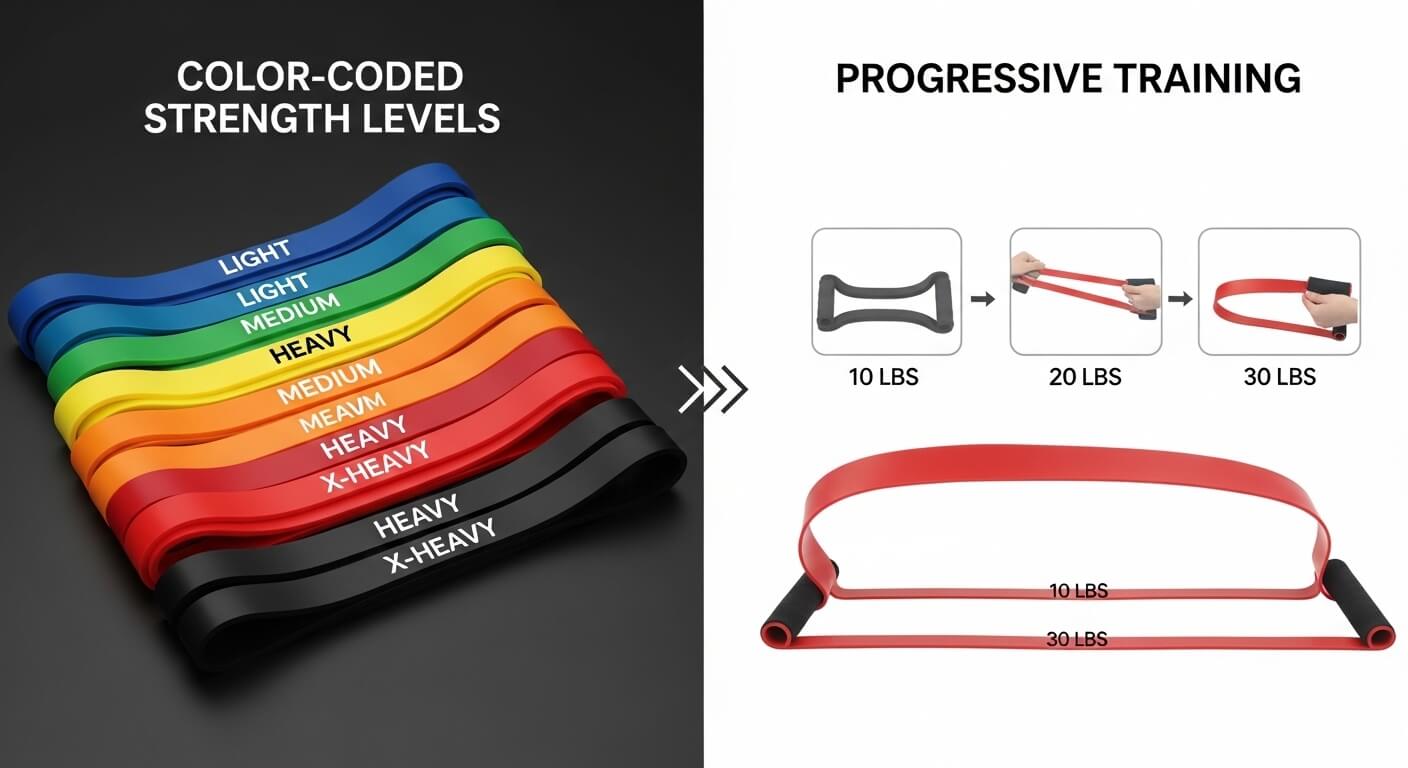
Pick up a yellow resistance band from a Theraband set and a yellow band from a generic online kit and you might assume they share the same resistance level. They almost certainly do not. The color-coding system that dominates the resistance band market is one of the most widely misunderstood standards in fitness equipment; partly because it is not, in any meaningful sense, a standard at all.
Different manufacturers use different colors for different resistance levels, the same color can represent tension ranges that vary by 50% or more across brands, and the relationship between a band’s color and its actual resistance changes dramatically depending on how far the band is stretched. Add to this the fact that most buyers have no framework for translating resistance band tension into equivalent free weight loading or progressive training variables, and you have a category where purchasing decisions are made almost entirely on price, color aesthetics, and vague strength descriptors.
This guide cuts through the color confusion, explains the physics of elastic resistance, provides a cross-brand color coding reference, and, most importantly, gives users a practical framework for using resistance bands as progressive training tools rather than static fitness accessories. Whether you are rehabilitating an injury, building strength at home, or supplementing a gym program, understanding tension progression is the variable that separates effective band training from busywork.
The Color Coding Problem: Why Yellow Does Not Equal Yellow
The color-coded resistance band system was pioneered by Thera-Band (now Hygenic Corporation) in the 1970s as a standardised system for physical therapy resistance progression. Thera-Band’s original color sequence: tan, yellow, red, green, blue, black, silver, gold; corresponded to specific resistance values measured at defined elongation percentages, giving physical therapists a reliable prescription framework. Within Thera-Band’s own product line, this system remains internally consistent and clinically validated.
The problem is that as resistance bands became a mass-market fitness product, dozens of manufacturers adopted color-coded systems with no reference to Thera-Band’s standards or any independent measurement protocol. A manufacturer can designate any color as “light,” “medium,” or “heavy” and produce any resistance value they choose under that color. The result is that a green band from one brand might deliver 10 lbs of resistance at 100% elongation while a green band from another delivers 30 lbs at the same elongation.
The elongation variable compounds the confusion further: Elastic resistance is not constant like a free weight. A band that provides 10 lbs of resistance at 50% elongation will provide 20+ lbs at 100% elongation. Resistance bands are typically rated at a specific elongation percentage (often 100% double their resting length), but this reference point is not always stated by manufacturers. Two bands might have identical rated resistance values but deliver entirely different tension curves across a movement’s range of motion if their elastic modulus differs.
| Brand | Yellow Band | Red Band | Green Band | Blue Band | Black Band |
| Thera-Band | ~1.3 kg (2.9 lb) | ~1.6 kg (3.5 lb) | ~2.1 kg (4.6 lb) | ~2.8 kg (6.2 lb) | ~3.6 kg (7.9 lb) |
| Perform Better | ~2.3 kg (5 lb) | ~4.5 kg (10 lb) | ~9 kg (20 lb) | ~13.6 kg (30 lb) | ~18 kg (40 lb) |
| WOD Nation | ~11 kg (25 lb) | ~20 kg (45 lb) | ~29 kg (65 lb) | ~38 kg (85 lb) | ~52 kg (115 lb) |
| Rogue Fitness | N/A | ~22 kg (48 lb) | ~33 kg (73 lb) | ~48 kg (106 lb) | ~70 kg (155 lb) |
| Generic / Budget | Highly variable | Highly variable | Highly variable | Highly variable | Highly variable |
The table above illustrates the scale of the cross-brand problem. Thera-Band yellow provides approximately 1.3 kg of resistance a physical therapy starting point for rehabilitation patients. WOD Nation yellow provides approximately 11 kg; a warm-up or activation tool for a trained athlete. A beginner who purchases WOD Nation bands expecting a gentle starting resistance equivalent to their physical therapist’s recommendation is in for a painful and potentially injurious surprise.
A Practical Progressive Band Training Framework
| Training Phase | Thera-Band Level | WOD/Fitness Level | Training Goal | Progression Trigger |
| Rehabilitation / Beginner | Tan → Yellow → Red | Not recommended at this stage | Motor control, joint stability | 12+ reps with full control and no pain |
| Foundational Strength | Green → Blue | Yellow → Red | Basic strength, muscular endurance | 3 sets of 15 reps with clean form |
| Intermediate Strength | Black → Silver | Red → Green | Hypertrophy, power endurance | 3 sets of 12 reps, plateau reached |
| Advanced / Performance | Gold | Green → Blue → Black | Maximal strength assist, power | Failure under 8 reps with good form |
| Band Stacking (Any Level) | Multiple bands combined | Multiple bands combined | Fine-grained intermediate resistance | When single band steps are too large |
The most common mistake in band training progression is treating bands as interchangeable warm-up tools and never systematically advancing resistance. Users who do three sets of 15 with the same band for months are performing maintenance activity, not progressive training. The same periodization logic that governs barbell programming; progressive overload, deload weeks, rep range variation; applies directly to structured band programs.
Band Type Comparison: Loop, Tube, and Flat Bands
Beyond the color and resistance level question, band format significantly affects training application and progression options. The three primary formats have distinct mechanical properties and training applications.
| Band Format | Resistance Range | Best Applications | Progression Method | Durability |
| Flat / Sheet Bands (Thera-Band style) | 2–80+ lbs | Rehab, mobility, shoulder, ankle work | Color progression, stacking | High — no seams |
| Loop / Mini Bands | 5–60 lbs | Glute activation, lateral walks, upper back | Color/thickness progression | Good — seam at weld joint |
| Tube Bands with Handles | 5–50 lbs per tube | Upper body exercises, cable machine substitute | Color + stacking + anchor point | Moderate — tube can crack over time |
| Pull-Up / Power Bands (Large Loop) | 10–200+ lbs | Pull-up assist, deadlift band tension, barbell work | Thickness progression + stacking | Excellent — thick continuous loop |
| Figure-8 / Specialty Bands | 10–30 lbs | Inner thigh, shoulder, specific rehab | Limited — few resistance levels | Moderate — fixed geometry |
Price Analysis: What Band Quality Actually Costs
Resistance band quality is directly correlated with the consistency and longevity of the tension they provide. Natural latex bands maintain their elastic modulus more consistently across temperature extremes and use cycles than synthetic rubber alternatives, and they are less prone to the microscopic surface cracking that leads to sudden band failure. For training purposes, band failure under load is a safety issue, not just a product inconvenience; a snapping band under tension can cause significant facial, hand, or joint injury.
| Price Tier | Material Quality | Resistance Accuracy | Durability | Color System | Best Use | Cost |
| Budget | Synthetic rubber / TPE | Low — highly variable | 6–12 months heavy use | Proprietary, inconsistent | Casual light use only | $5–15 per set |
| Mid-Range | Blended latex / rubber | Moderate | 1–3 years | Brand-specific, labeled | Regular home training | $20–50 per set |
| Premium Fitness | Natural latex | Good — brand-consistent | 3–5+ years | Brand-consistent, often rated | Structured training programs | $40–$100 per set |
| Physical Therapy Grade | Medical-grade latex | Excellent — clinically validated | 3–5+ years | Thera-Band standard | Rehab, clinical, precise progression | $25–60 per set |
| Performance / Competition | Premium latex, certified | Excellent — consistent across units | 5+ years | Published lb/kg ratings | Athletes, certified programs | $80–$200+ per set |
The investment calculus for band quality is straightforward: physical therapy-grade bands (Thera-Band, Perform Better) offer the highest resistance accuracy relative to price — their tension values are clinically validated and cross-lot consistent, meaning a red band today will behave identically to a red band purchased next year. For fitness applications requiring heavier loading, premium natural latex loop and power bands (Rogue, WOD Nation, EliteFTS) provide resistance ratings backed by actual measurement rather than color convention. Budget synthetic bands are appropriate for light, infrequent use and inappropriate for any structured training program where progressive overload is the goal.
Product Recommendations by Use Case
Best for Rehabilitation and Physical Therapy: Thera-Band Professional Resistance Band Set
The Thera-Band Professional set ($25–$40 for a multi-colour set) is the only consumer resistance band product with clinically validated resistance values and cross-lot consistency verified by independent measurement. Its 6-color progression system from yellow to black covers the full rehabilitation and light fitness resistance range, and its resistance values are the reference standard against which physical therapists write band prescriptions. For any user in formal rehabilitation or following a therapist’s band protocol, Thera-Band is the only appropriate choice. Avoid substitutions. Recommended for: rehab patients, beginners, older adults, and anyone following a clinically prescribed band program.
Best for Structured Home Strength Training: Serious Steel Resistance Band Set
Serious Steel’s natural latex loop bands ($60–$90 for a 5-band set) publish actual resistance ranges in pounds for each color, measured at defined elongation percentages — a practice that distinguishes them from the majority of brands that provide only vague descriptors. Their bands span from approximately 5–35 lbs (light) to 150–200 lbs (monster), covering the full progression range for body weight and strength training applications. Durability reports from structured users consistently rate them among the longest-lasting bands in the mid-premium category. Recommended for: home gym users, body weight strength training, pull-up assistance, and anyone building a systematic band-based program.
Best Power Bands for Athletic Training: Rogue Monster Bands
Rogue’s Monster Band line ($20–$50 per band) sets the standard for heavy-duty power band applications: deadlift band tension, squat accommodating resistance, and heavy pull-up assistance. Each band comes with published resistance ratings verified against Rogue’s own testing protocol, and their thick natural latex construction has a longevity record that justifies the per-band pricing for serious athletes. The lightest Monster Band (“#0”) starts at approximately 15–35 lbs and they scale to the “#5” at 200+ lbs. Recommended for: strength athletes adding accommodating resistance to barbell training, advanced pull-up assistance, and competitive functional fitness athletes.
Best Mini Loop Band Set: Fit Simplify Resistance Loop Exercise Bands
For glute activation, lateral band walks, hip abduction, and upper back accessory work, Fit Simplify’s 5-band mini loop set ($10–$15) offers the best documented quality-to-price ratio in the category. Their natural latex construction is above-average for the price point, and their resistance progression from extra-light to extra-heavy is gradual enough to support actual progressive training rather than jumping between levels that are too far apart. They represent the appropriate entry point for lower body activation work before upgrading to heavier single bands as strength develops. Recommended for: glute and hip work, lateral movement training, physical therapy lower body exercises, and beginners building toward heavier bands.
Best Tube Band Set for Upper Body: Bodylastics Stackable Resistance Bands
Bodylastics’ stackable tube band system ($30–$60) allows users to combine multiple bands on a single handle, creating resistance increments of approximately 3–10 lbs per band added — the finest progression granularity available in any resistance band format. This stackable architecture solves the large-step problem that makes progression difficult in fixed-resistance band sets. Their door anchor and handle quality are consistently rated above category average, and the published resistance values for each tube are among the most reliable in the tube band segment. Recommended for: upper body cable-substitute work, users who need fine progression granularity, and anyone whose primary training focus is bicep, tricep, and shoulder isolation.
Frequently Asked Questions
Q: Is there any universal color coding standard I can rely on across brands?
A: Not in the fitness band market. The only internally consistent, clinically validated color system is Thera-Band’s, and it only applies to Thera-Band products. For all other brands, treat color as a relative indicator within that specific brand’s product line only — never across brands. When in doubt, look for bands that publish actual resistance values in pounds or kilograms at a stated elongation percentage (e.g., “20–30 lbs at 100% elongation”). Brands that publish specific values are making a testable claim; brands that use only light/medium/heavy descriptors are not.
Q: How do I convert resistance band tension to free weight equivalents for program design?
A: The most practical method is to estimate the band’s resistance at the point of peak contraction in each exercise — the position of greatest elongation. A band that provides 20 lbs of resistance at peak stretch provides a rough 20 lb equivalent stimulus at that moment, diminishing through the rest of the range of motion. For program design, use the peak resistance as your “working weight” and adjust rep ranges and sets accordingly. Most trainers recommend using 10–20% higher rep counts with bands than with equivalent free weights to account for the reduced resistance through the movement’s easier range.
Q: When should I advance to the next resistance level?
A: Use a simple mastery threshold: when you can complete 3 sets of 15 repetitions with good technique and controlled tempo on a given exercise with a given band, that band level has been mastered for that exercise. Move up to the next resistance level and expect your rep count to initially drop to 8–10 before building back to 15. If the jump to the next level is too large (below 5 reps with good form), use band stacking or anchor adjustment to create an intermediate resistance step rather than forcing the full level jump.
Q: How do I know if my resistance band is worn out and needs replacing?
A: Look and feel are the primary indicators. Surface cracking, visible nicks or tears, white stress marks when stretched, significant loss of tension at a given elongation compared to when the band was new, and any asymmetry in how the band stretches (suggesting uneven internal degradation) all indicate the band should be retired. For safety, inspect bands visually before each use and do not use bands that show any surface cracking or damage — a failed band under load snaps back at high velocity and can cause serious injury to the face, hands, or nearby structures. Natural latex bands that are properly stored typically last 3–5 years of regular use before tension degradation becomes significant.
Q: Can resistance bands build the same muscle mass as free weights?
A: Current exercise science literature suggests that resistance bands can produce comparable hypertrophy to free weights when training variables (volume, progressive overload, time under tension, proximity to failure) are equivalent. The key is structured progressive overload — bands used haphazardly without systematic resistance advancement will not produce the same adaptation as a structured free weight program. The ascending resistance curve of bands, which loads the muscle most heavily at its strongest point in the range of motion, creates a distinct but equally valid mechanical stimulus for hypertrophy compared to the constant load of free weights.
Q: What is band stacking and how do I do it safely?
A: Band stacking involves using two or more bands simultaneously on the same exercise to combine their resistance values and create intermediate tension levels between discrete band steps. For tube bands with handles, stacking means attaching multiple tubes to the same handle set. For loop bands, stacking means stepping on or anchoring multiple bands and holding them together. Safety considerations: ensure all bands are anchored equally and symmetrically to avoid uneven loading; check that handle clips or anchor points can support the combined tension of stacked bands; and inspect each band individually before stacking, as a failure in one band while stacking can cause sudden load release and snapping injury.
The Verdict
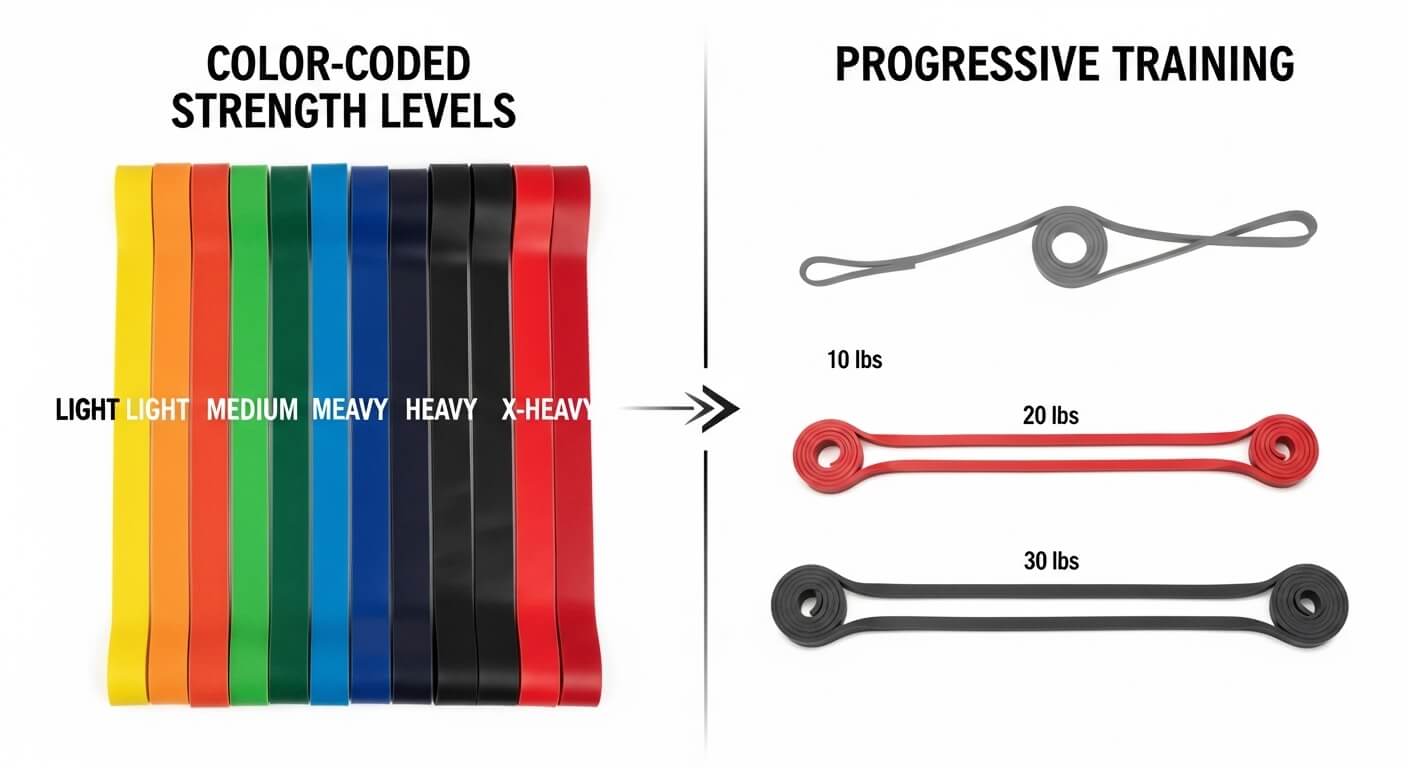
The color-coded resistance band system is a convenience convention, not a scientific standard and treating it as the latter is the single most common source of confusion, training inefficiency, and equipment mismatch in the band training category. The productive approach is to select a brand whose resistance values are published in measurable units, stay within that brand’s ecosystem for cross-exercise consistency, and apply the same progressive overload principles that govern any effective strength or conditioning program.
Resistance bands are not a beginner-only, rehabilitation-only, or travel-only training tool. Used with structured progression systematic resistance advancement, anchor point manipulation, volume periodization, and deliberate tempo control; they represent a complete and evidence-supported training modality capable of producing strength, hypertrophy, and conditioning adaptations equivalent to free weight and machine training. The limiting factor is never the bands themselves. It is whether the user has a progression plan or is simply reaching for the same colored band every session and wondering why nothing is changing.