

After a long day on your feet, an intense workout, or hours sitting at a desk, leg fatigue and muscle tension can make even simple activities uncomfortable. Whether you’re an athlete seeking faster recovery, someone with circulation issues, or simply dealing with everyday leg tiredness, effective leg massage can provide significant relief.
Two popular at-home solutions have emerged: compression leg massagers that use automated air pressure to squeeze and release your legs, and manual massage rollers where you control the pressure and movement yourself. But which approach delivers better results? Do the convenience and technology of compression devices justify their higher price, or do manual rollers provide superior muscle work at a fraction of the cost?
In this comprehensive guide, we’ll compare compression leg massagers and manual massage rollers across effectiveness, cost, convenience, and user experience to help you determine which tool best fits your specific needs, goals, and budget.
Understanding Leg Muscle Recovery and Circulation
Our legs work harder than we often realize. They support our entire body weight during standing and movement, contain some of the largest muscle groups requiring substantial recovery, and face gravity’s constant pull, affecting circulation back to the heart. The venous system must work against gravity to return blood from the feet, which becomes increasingly challenging with age, prolonged sitting or standing, or circulatory conditions.
Common leg issues include muscle soreness and tightness from exercise or overuse, poor circulation causing cold feet, swelling, or heaviness, delayed onset muscle soreness (DOMS) 24-48 hours after intense activity, restless leg syndrome affecting sleep quality, and general fatigue from standing occupations. Lymphatic congestion can cause fluid retention and swelling, particularly in the ankles and feet.
Regular leg massage provides numerous benefits supported by research. It improves circulation by mechanically pushing blood and lymph fluid toward the heart, reducing pooling in the lower extremities. This enhanced circulation delivers oxygen and nutrients while removing metabolic waste products like lactic acid.
Massage reduces muscle tension and breaks up adhesions or knots that develop from overuse or poor posture. For athletes, proper recovery techniques can reduce soreness by 30-50% and accelerate return to training. Massage also stimulates the parasympathetic nervous system, promoting overall relaxation that extends beyond just the massaged area.
For people with circulatory issues, regular leg massage can reduce swelling, improve vein function, and decrease the risk of blood clots during extended immobility. The psychological benefits include stress reduction, improved sleep quality, and simply feeling cared for and refreshed.
Various massage techniques target different needs. Compression massage uses rhythmic squeezing and releasing that mimics natural muscle pumping action, making it particularly effective for circulation. Deep tissue work applies sustained pressure to reach deeper muscle layers, releasing chronic tension and adhesions. Myofascial release targets the connective tissue surrounding muscles, improving mobility and reducing restriction.
Percussion or vibration provides rapid, pulsing pressure that reduces muscle tension through neurological mechanisms. Lymphatic drainage uses gentle, rhythmic movements specifically designed to move lymph fluid and reduce swelling. Each approach has distinct benefits, and the ideal technique depends on your specific goals and conditions.
Compression Leg Massagers: Details
How Compression Leg Massagers Work
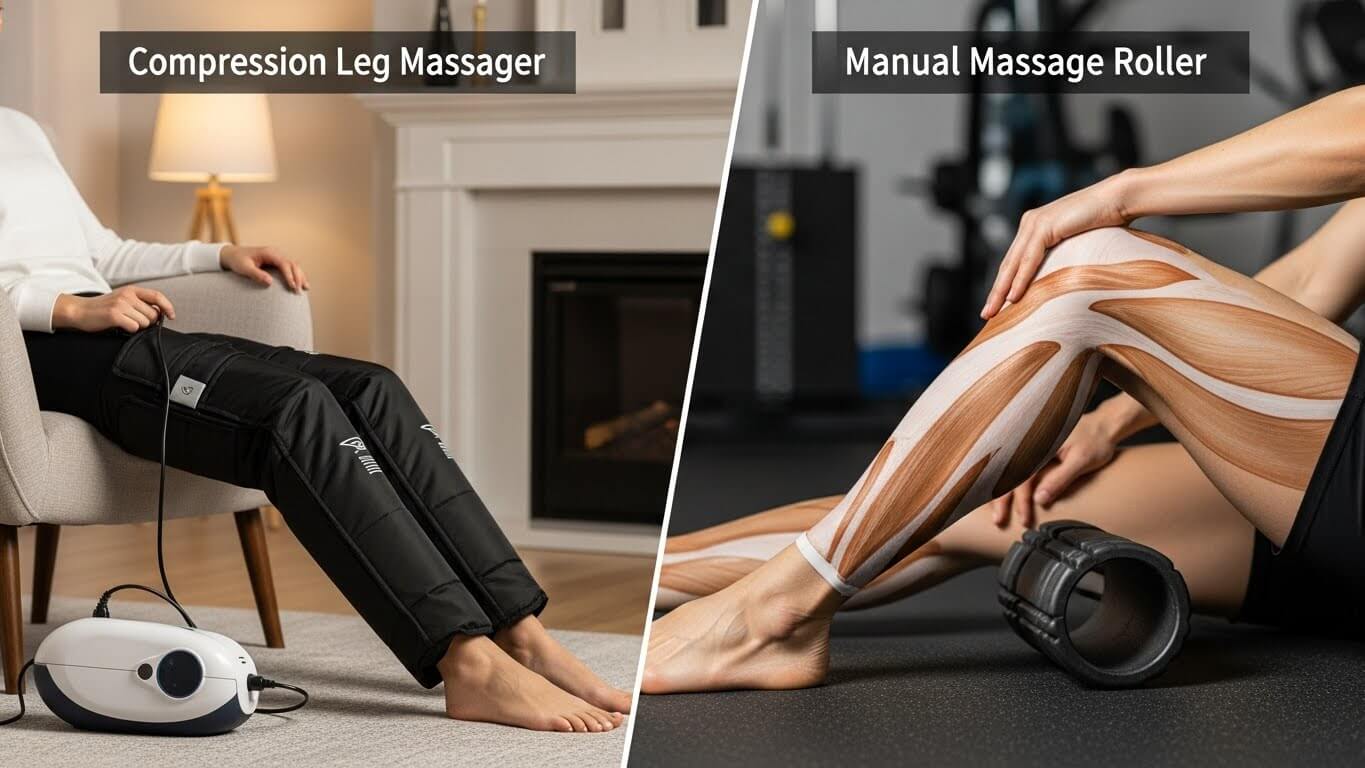
Compression leg massagers feature boot- or sleeve-like chambers that wrap around your legs. Internal air chambers inflate and deflate in programmed sequences, creating waves of pressure that travel up your legs. This sequential compression mimics the natural muscle pump action, pushing blood and lymph fluid toward the heart.
Most devices offer multiple pressure levels (typically 3-5 settings from gentle to firm) and various massage modes, including sequential compression moving from ankle to thigh, uniform compression squeezing all chambers simultaneously, and wave patterns with different timing sequences. Session durations typically last 15-30 minutes with automatic shut-off.
Advanced models include heating elements for enhanced muscle relaxation, app connectivity for program customization, separate foot chambers for targeted attention, and adjustable chamber configurations for different leg sizes.
Types and Price Ranges
Budget compression massagers ($80-$150) offer basic sequential compression with limited pressure settings and simple controls. They typically cover calves only or calves with minimal thigh coverage. Brands like FIT KING and RENPHO dominate this segment with adequate performance for casual users.
Mid-range devices ($150-$300) provide full leg coverage from feet to upper thighs, multiple pressure zones, various massage modes, and better build quality with longer warranties. Popular options include Quinear and Amzdeal models that balance features with affordability.
Premium compression systems ($300-$800+) deliver commercial-grade compression, highly customizable programs, superior materials and construction, extended warranties, and sometimes medical-grade features for serious recovery or therapeutic use. Brands like Normatec (now part of Hyperice) represent the gold standard, widely used by professional athletes.
Medical-grade pneumatic compression devices ($500-$2,000+) are prescribed for medical conditions like lymphedema or chronic venous insufficiency. These often qualify for insurance coverage but require medical justification.
Effectiveness and Benefits
Research strongly supports compression therapy’s benefits. Studies show compression massage significantly improves venous blood flow, reduces post-exercise muscle soreness by 20-40%, decreases recovery time between training sessions, and reduces swelling in people with circulatory issues. Athletes using compression therapy report feeling fresher for subsequent workouts and experiencing less fatigue.
The passive nature means you can relax completely during treatment—no effort required. Consistent pressure ensures even treatment across all covered areas. The devices work particularly well for people who sit or stand for long periods, athletes in heavy training, individuals with circulation problems or mild swelling, and anyone seeking convenient, effort-free leg recovery.
Limitations and Drawbacks
Compression massagers have notable limitations. They provide only one type of massage—compression—without the deep tissue work or myofascial release that manual tools offer. They can’t target specific tight spots or trigger points precisely. The one-size-fits-all approach may fit some leg shapes poorly, with too-large chambers providing insufficient pressure or too-small ones causing discomfort.
The devices are bulky and require dedicated storage space. They need electricity and can’t be used everywhere. Initial costs are high compared to manual alternatives. Some users find the sensation uncomfortable or claustrophobic. Noise from air pumps can be bothersome in quiet environments.
For muscle knots or specific problem areas, compression may provide relief but rarely resolves issues as effectively as targeted manual work. The devices excel at circulation and general recovery but fall short for localized muscle problems.
Manual Massage Rollers: Complete Analysis
Types of Manual Massage Rollers
The manual massage roller category includes diverse tools. Traditional foam rollers (6-36 inches long, $10-$50) come in various densities and surface textures. Smooth surfaces suit beginners, while textured or ridged surfaces provide more aggressive treatment. High-density foam works deeper but feels more intense.
Massage sticks or rolling sticks ($15-$40) feature multiple rollers on a handled rod, allowing targeted pressure on specific muscles. The Tiger Tail and Stick Roller are popular options. Massage balls ($10-$30) range from lacrosse ball size to larger therapy balls, excellent for precise trigger point work on areas rollers can’t reach effectively.
Vibrating foam rollers ($50-$150) combine traditional rolling with vibration therapy, potentially enhancing muscle relaxation and reducing pain perception. Brands like Hyperice Vyper lead this category. Specialized rollers include the R8 ($100), which provides deep compression massage with precise control, and various textured or segmented designs targeting specific needs.
How Manual Rolling Works
Manual massage rolling applies myofascial release principles. As you roll your body weight over the tool, pressure compresses muscles and fascia, breaking up adhesions, improving tissue mobility, and releasing tension. The sustained pressure triggers the Golgi tendon organ reflex, signalling muscles to relax.
Rolling also increases blood flow to treated areas, promotes lymphatic drainage through mechanical movement, provides proprioceptive feedback improving body awareness, and can be integrated into warm-up or cool-down routines. The key is applying appropriate pressure—enough to feel it working but not so much that you tense up or cause injury.
Effectiveness and Benefits
Research supports foam rolling’s effectiveness for specific applications. Studies show foam rolling can reduce DOMS without compromising performance, improve range of motion and flexibility before and after exercise, accelerate recovery markers in some research, and provide pain relief for muscle tension. Meta-analyses suggest foam rolling is most effective when performed immediately post-exercise and on non-training days for recovery.
The precision advantage is significant, you control exactly where pressure goes, how much force is applied, and how long you work each area. You can target problem spots that compression boots can’t reach effectively. The active engagement creates better body awareness and muscle control. Cost-effectiveness is unbeatable, with quality tools available for $15-$50 lasting years.
Portability means you can roll anywhere—home, gym, office, or travel. No electricity, batteries, or setup required. The tools work for the entire body, not just legs, providing excellent versatility.
Limitations and Drawbacks
Manual rolling requires significant effort and time. You must actively work each muscle group, which can be tiring after already fatiguing workouts. Technique matters—poor form reduces effectiveness or causes injury. Some areas are difficult or impossible to reach effectively, particularly the back of thighs and glutes when fatigued.
The process can be quite painful, especially when first starting or working extremely tight muscles. While “good pain” is expected, determining the line between beneficial discomfort and harmful pain requires experience. Self-motivation is essential; it’s easy to skip sessions when tired or unmotivated.
Foam rolling provides no specific circulation benefits beyond localized blood flow increases at treatment sites. It doesn’t create the systemic venous return that compression boots provide. For circulation-focused goals, manual rolling falls short.
Head-to-Head Comparison
Recovery and Muscle Soreness
Winner: Tie (different strengths)
Compression massagers excel at overall leg recovery through improved circulation, reduced swelling, and general fatigue relief. They’re ideal for athletes needing consistent full-leg recovery between training sessions. Research supports their effectiveness for reducing general muscle soreness and accelerating recovery.
Manual rollers shine for localized muscle work, targeting specific tight spots or trigger points that compression boots miss. They’re superior for addressing muscle adhesions and restricted fascia. For spot treatment of particular problem areas, manual tools outperform compression.
The ideal approach often combines both compression for overall recovery and circulation, manual rolling for specific problem areas.
Circulation and Swelling
Winner: Compression Massagers
Compression therapy specifically targets circulation through sequential pressure that mechanically moves blood and lymph fluid toward the heart. Research clearly demonstrates improved venous return and reduced edema with compression therapy.
Manual rolling provides localized blood flow increases but doesn’t create systemic circulation improvements. For people with circulation issues, chronic swelling, or conditions like restless leg syndrome, compression massagers offer superior benefits.
Convenience and Time Efficiency
Winner: Compression Massagers
Put your legs in, press start, and relax for 15-30 minutes while the device does all the work. You can read, watch TV, or work on your laptop simultaneously. No physical effort or technique required.
Manual rolling demands active engagement, proper technique, and time working each muscle group individually. A thorough leg rolling session might take 15-20 minutes of focused, effortful work. After exhausting workouts, finding motivation for manual rolling can be challenging.
Targeting Specific Problem Areas
Winner: Manual Massage Rollers
Manual tools allow precise targeting of specific tight spots, trigger points, or problem areas. You control pressure, angle, and duration for each area. Small tools like massage balls reach spots compression boots can’t access effectively.
Compression massagers treat entire regions uniformly without distinguishing between areas needing more or less attention. They can’t focus on that one stubborn knot in your calf or address ITB tightness specifically.
Cost and Value
Winner: Manual Massage Rollers
Quality foam rollers cost $15-$50 and last for years. Massage sticks run $20-$40. Even premium vibrating rollers at $100-$150 cost less than mid-range compression devices. The low entry cost makes manual tools accessible to everyone.
Compression massagers start around $80 for basic models, with effective mid-range options at $150-$300 and premium systems exceeding $500. While they provide good value if used regularly, the upfront cost creates a significant barrier.
For budget-conscious users or those uncertain about committing to leg recovery tools, manual rollers offer no-risk entry at minimal cost.
Portability and Flexibility
Winner: Manual Massage Rollers
Foam rollers fit in gym bags. Massage sticks travel easily. You can roll anywhere—hotel rooms, gyms, outdoors, or office spaces. No power outlets, setup, or dedicated space required.
Compression massagers are bulky, require electricity, need storage space, and aren’t practical for travel. They’re home-use devices that must stay relatively stationary.
Whole-Body Versatility
Winner: Manual Massage Rollers
Manual rolling tools work on legs, back, shoulders, neck, arms, and virtually any muscle group. One $30 foam roller serves your entire body’s myofascial release needs.
Compression massagers are leg-specific devices. Some brands offer arm attachments, but the primary and often sole function is leg compression.
Who Should Choose Each Option
Choose Compression Leg Massagers If…
Compression massagers suit several user profiles. Serious athletes in heavy training need consistent, reliable recovery between sessions. Endurance athletes particularly benefit from the circulation improvements. People with circulation issues like chronic swelling, venous insufficiency, or lymphedema need the targeted circulation benefits that only compression provides.
Those who sit or stand for long work hours experience leg fatigue and pooling that compression effectively addresses. People seeking maximum convenience who want passive, effort-free recovery will appreciate the set-it-and-forget-it nature. Users recovering from injuries who need gentle, controlled compression for rehabilitation find it valuable under professional guidance.
If you have budget flexibility to invest $150-$300+ and storage space for bulky equipment, compression massagers provide excellent value through daily use.
Choose Manual Massage Rollers If…
Manual rollers work best for different scenarios. Budget-conscious users spending $15-$50 get effective recovery tools that last years. People who need portability for gym, travel, or multiple locations benefit from compact, lightweight tools.
Those who want full-body versatility beyond just legs gain the most value from tools that address all muscle groups. Individuals with specific trigger points or localized tight spots need the precision targeting that only manual work provides.
Users who don’t mind active engagement and potentially uncomfortable pressure understand that results require effort. People seeking pre-workout mobility work or dynamic warm-ups benefit from foam rolling’s integration into exercise routines.
If you have limited storage space in apartments or small homes, manual rollers store easily in closets or under furniture.
Many serious recovery enthusiasts use both tools strategically. Compression massagers handle overall recovery, circulation, and daily leg maintenance—particularly after hard training or long work days. Manual rollers address specific problem areas, integrate into pre-workout routines for mobility, travel easily for on-the-go maintenance, and provide full-body myofascial release.
This combination maximizes benefits while acknowledging each tool’s strengths. Start with manual rollers to learn proper recovery techniques and assess your needs. Add compression later if budget allows and benefits justify the investment.
Cost-Benefit Analysis
Initial Investment Comparison
Manual foam rollers cost $15-$50 for quality options. Massage sticks run $20-$40. Vibrating rollers cost $50-$150 for premium models. Total investment for comprehensive manual tool set: $50-$100.
Budget compression massagers cost $80-$150, mid-range devices run $150-$300, and premium systems cost $300-$800+. Most users find mid-range devices adequate, representing $150-$300 investment.
The compression massager costs 3-10 times more than a complete manual roller set.
Long-Term Value
Both tool types offer excellent longevity. Quality foam rollers last 3-5+ years with regular use before needing replacement. Massage sticks can last 5-10 years. Total replacement costs over five years might be $30-$60.
Compression massagers typically last 3-5 years with regular use, sometimes longer. No replacement parts needed typically, though occasional chamber repairs might be necessary. Warranty coverage varies from 1-3 years depending on brand.
The value proposition depends entirely on usage frequency. Used daily, a $200 compression massager over four years costs just $0.14 per session. Used weekly, cost per session jumps to $1. Unused in a closet, it’s wasted money regardless of price.
Manual rollers cost pennies per use regardless of frequency, making them low-risk investments even for occasional users.
Comparing to Professional Massage
Professional sports massage costs $80-$150 per hour-long session. Weekly sessions total $320-$600 monthly. A $200 compression massager pays for itself in 1-2 sessions, while a $30 foam roller pays for itself in less than one session.
Both tools provide significant savings versus professional care. However, neither fully replaces skilled manual therapy for serious muscle issues. The best approach often combines regular self-care with occasional professional treatment for stubborn problems.
Best Practices for Maximum Benefit
Using Compression Leg Massagers Effectively
Start with gentle pressure settings and gradually increase as you adapt. Use devices for 15-30 minutes per session, avoiding excessive duration. Timing matters—post-workout recovery within 2 hours maximizes benefits, evening use improves sleep quality and circulation overnight, and daily consistency produces better results than sporadic intensive use.
Stay hydrated before and after sessions to support circulation and waste removal. Elevate legs slightly during treatment if possible for enhanced drainage. Wear comfortable clothing or use devices on bare skin per manufacturer recommendations.
Avoid compression during acute injuries with active inflammation, if you have DVT or blood clotting disorders without medical clearance, or with open wounds, severe varicose veins, or certain medical conditions. Consult healthcare providers if uncertain about safety.
Using Manual Massage Rollers Effectively
Roll slowly, spending 30-60 seconds on each muscle group. Faster isn’t better—slow rolling allows tissue to respond. When finding tender spots, pause for 20-30 seconds applying steady pressure until sensitivity decreases. Breathe deeply and relax; tensing against pain reduces effectiveness.
Roll major muscle groups systematically: calves, hamstrings, quadriceps, IT band, glutes, and adductors for comprehensive leg work. Start with lighter pressure initially, gradually increasing as tissues adapt. Never roll directly on joints, bones, or injured areas.
Best timing includes post-workout cool-downs, non-training days for recovery, morning mobility sessions, or before bed for relaxation. Rolling pre-workout should be brief (5-10 minutes) focusing on mobility rather than aggressive tissue work that might temporarily reduce muscle activation.
Stay hydrated and combine rolling with stretching for optimal flexibility improvements.
Frequently Asked Questions
Can I use compression massagers every day?
Yes, daily use is safe and often beneficial for most people. Sessions of 15-30 minutes once or twice daily are typical. However, listen to your body; if you feel overly fatigued or experience increased soreness, reduce frequency. People with medical conditions should consult healthcare providers about appropriate usage.
How often should I foam roll?
Daily foam rolling is safe for most people, with 10-20 minutes covering major muscle groups adequately. Many athletes roll after every workout, plus on rest days. At a minimum, rolling 2-3 times weekly provides benefits. More isn’t always better—excessive aggressive rolling can cause tissue irritation.
Which is better for lymphedema or circulation problems?
Compression massagers are significantly more effective for circulation issues and lymphedema. They specifically target venous and lymphatic flow through sequential compression. Manual rolling provides minimal circulation benefits. However, medical-grade compression devices with doctor supervision are ideal for serious medical conditions.
Can these tools help with restless leg syndrome?
Both tools may provide relief, with compression massagers generally more effective due to improved circulation. Many RLS sufferers report reduced symptoms with evening compression therapy. Manual rolling can help if muscle tension contributes to symptoms. However, RLS has multiple causes—consult healthcare providers for comprehensive treatment.
Are vibrating foam rollers worth the extra cost?
Vibrating rollers provide added benefits for some users, potentially enhancing pain relief and muscle relaxation beyond standard rolling. Research shows modest additional benefits. However, standard foam rollers are highly effective; vibration is supplementary, not essential. If the budget allows and you’ll use it regularly, vibration adds value. Otherwise, standard rollers work excellently.
Can I use these tools if I have varicose veins?
Mild varicose veins generally tolerate both compression and foam rolling, though avoid rolling directly on prominent veins. Severe varicose veins require medical evaluation before using compression therapy. When in doubt, consult vascular specialists about appropriate self-care methods.
Conclusion
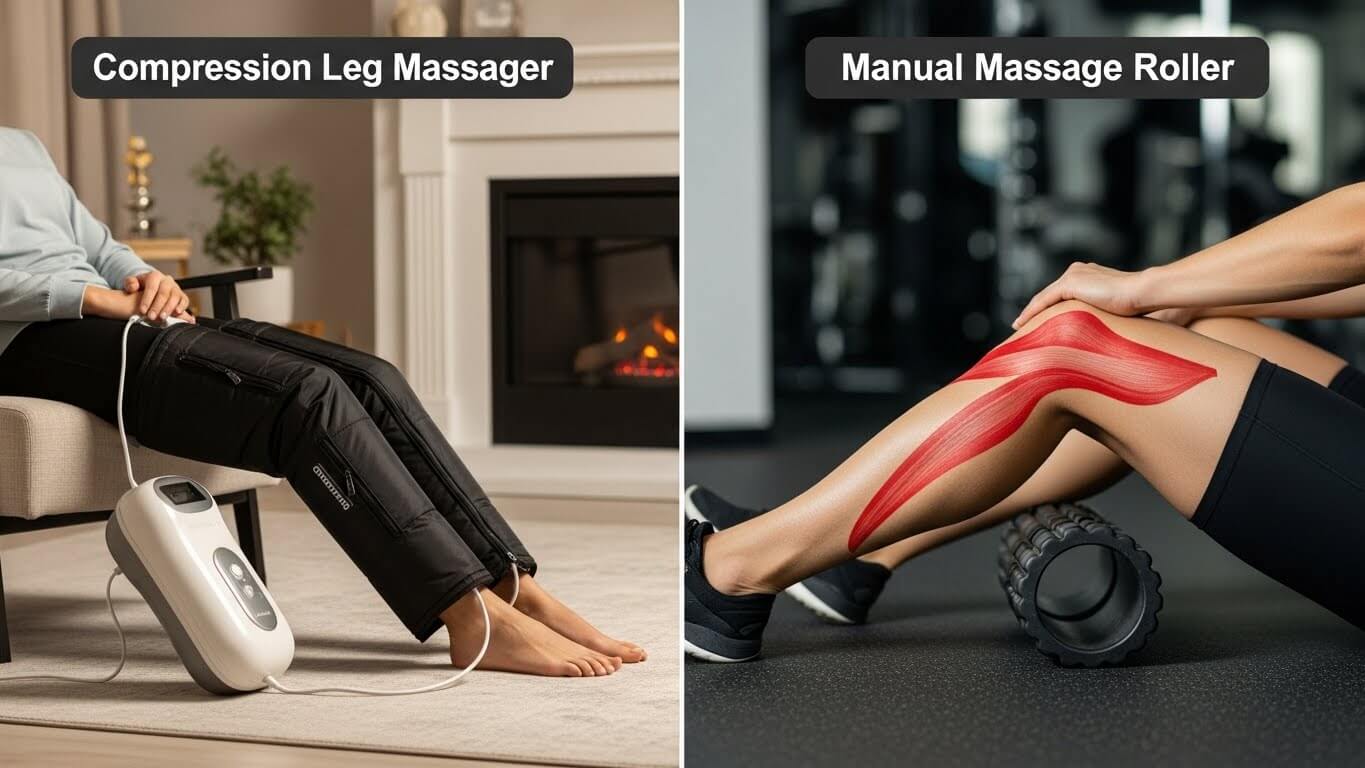
Both compression leg massagers and manual massage rollers offer valuable benefits for leg recovery, circulation, and muscle maintenance, but they excel in different areas. Compression massagers provide superior convenience, overall circulation enhancement, and passive recovery, making them ideal for serious athletes, people with circulation issues, and anyone wanting effortless daily leg maintenance. Manual massage rollers deliver precise muscle work, full-body versatility, and exceptional value, making them perfect for budget-conscious users, those needing targeted trigger point work, and people wanting portable tools they can use anywhere.
The choice ultimately depends on your specific needs, budget, and recovery goals. If circulation, convenience, and whole-leg recovery are priorities, and you can invest $150-$300, compression massagers provide excellent value through daily use. If budget matters, you need portability and full-body versatility, or you want to target specific problem areas precisely, manual rollers deliver outstanding results at minimal cost.
For many people, the optimal approach combines both tools using compression for convenient overall recovery and circulation while relying on manual rolling for specific muscle work and full-body maintenance. Start with affordable manual rollers to establish recovery habits and understand your needs, then add compression later if benefits justify the investment. Whichever path you choose, consistent use of quality recovery tools will enhance your leg health, reduce soreness, improve circulation, and help you feel better whether you’re training hard, working long hours, or simply wanting healthier, more comfortable legs.