

Working from home was meant to improve comfort, flexibility, and overall well-being. Instead, for many professionals, it has introduced a new set of physical challenges. One of the most common and overlooked issues is lower back pain caused by poor sitting posture and inadequate support.
Unlike traditional office environments that often provide ergonomic chairs, most home workspaces are improvised. Dining chairs, sofas, or even beds have become workstations. Over time, this creates strain on the spine, leading to discomfort, fatigue, and reduced productivity.
If you regularly feel stiffness, tension, or pain in your lower back after a workday, your setup is likely the problem. The good news is that simple, targeted tools can make a significant difference.
This guide explores two highly effective solutions: lumbar support massagers and ergonomic chair cushions. By the end, you will understand how they work, when to use each, and how to create a healthier and more productive work-from-home routine.
Reader Roadmap
This article will walk you through:
- A deeper look at the work-from-home posture problem
- Clear definitions of both tools
- The science behind spinal support
- A detailed comparison of lumbar massagers and cushions
- Step-by-step selection and usage guidance
- Practical daily habits that enhance results
- Mistakes that reduce effectiveness
- Recommended tools with mini reviews
- A simple decision-making framework
The Hidden Cost of Poor Sitting Posture
Many people underestimate how harmful prolonged sitting can be. The spine has a natural S-shaped curve that distributes weight evenly. When you sit without support, especially for long periods, this curve flattens or becomes exaggerated in the wrong areas.
This leads to:
- Increased pressure on spinal discs
- Muscle fatigue and imbalance
- Reduced blood circulation
- Gradual posture deterioration
Over weeks and months, this can evolve into chronic discomfort or even long-term back issues.
Remote workers, freelancers, students, and even business owners are particularly at risk because they often spend extended hours sitting without structured breaks.
Ignoring this problem can affect more than your physical health. It can reduce concentration, lower productivity, and even impact your mood and energy levels.
Key Definitions
Lumbar Support Massager
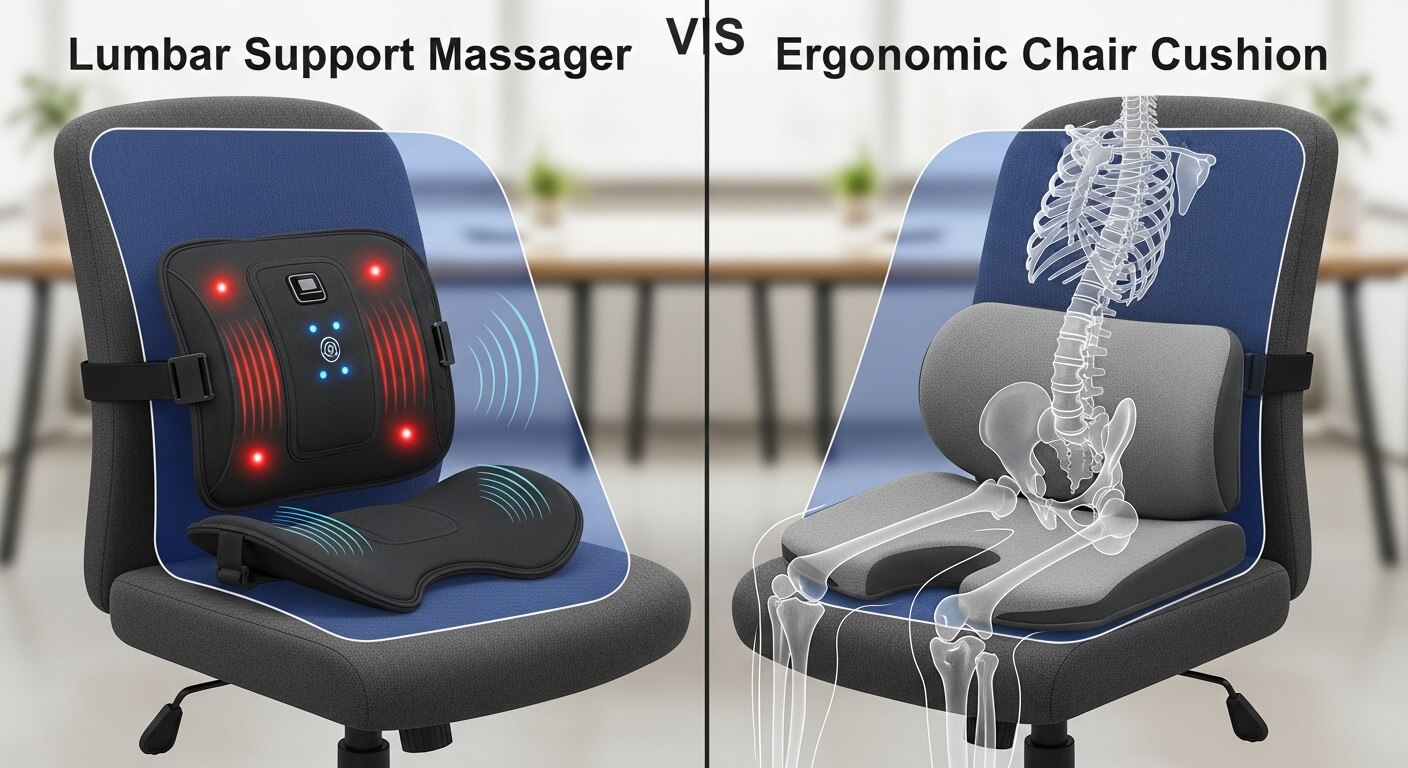
A lumbar support massager is a device designed to both support and actively relieve the lower back. It typically includes features such as vibration, rolling massage, or heat therapy.
It serves two purposes:
- Maintaining spinal alignment
- Actively reducing muscle tension
This makes it a dual-function solution for both comfort and recovery.
Ergonomic Chair Cushion
An ergonomic chair cushion is a structured support accessory, often made of memory foam, designed to maintain the natural curve of the spine.
It works passively by:
- Filling the gap between your lower back and chair
- Encouraging proper posture
- Reducing pressure on the lumbar region
It is simple, effective, and widely used for prevention.
The Science Behind Lumbar Support
The lumbar region of the spine naturally curves inward. When this curve is not supported, the body compensates by engaging muscles that are not designed for prolonged strain.
Over time:
- Muscles become overworked
- Ligaments stretch beyond their optimal range
- Discs experience uneven pressure
Proper lumbar support restores the natural alignment of the spine. This reduces strain and allows muscles to relax.
Active tools like massagers go a step further by stimulating blood flow and loosening tight muscles, which enhances recovery and reduces stiffness.
Lumbar Support Massager: Deep Relief and Recovery
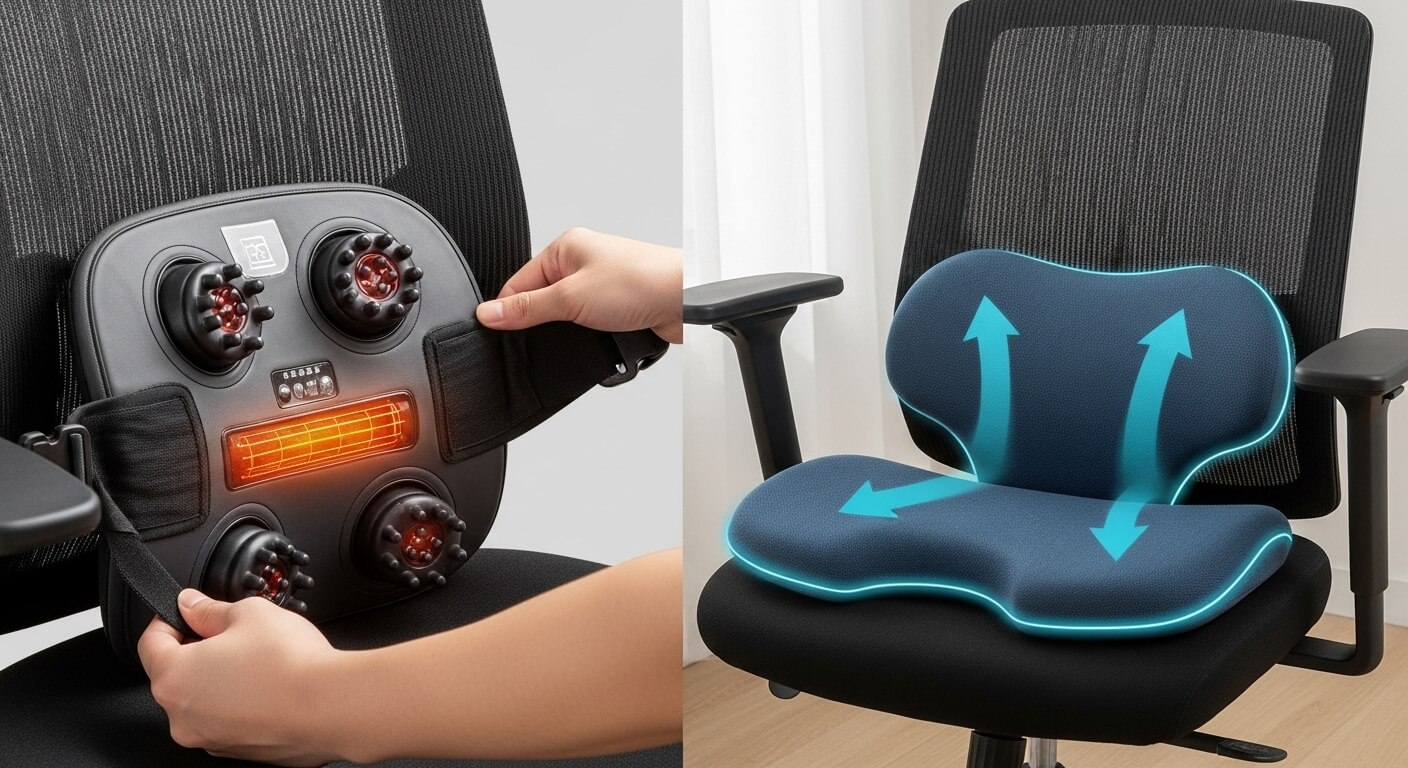
A lumbar support massager is ideal for people who already experience discomfort.
Key Benefits
- Provides immediate relief from stiffness
- Improves blood circulation
- Reduces muscle tightness
- Offers relaxation during work breaks
Best Use Cases
- Long workdays exceeding 6 hours
- Existing lower back pain
- High-stress work environments
- Individuals who prefer comfort with added functionality
Limitations
- Requires power source
- Higher cost compared to cushions
- Not ideal for continuous all-day use
Ergonomic Chair Cushion: Prevention and Stability
An ergonomic cushion focuses on maintaining proper posture throughout the day.
Key Benefits
- Encourages healthy sitting posture
- Lightweight and portable
- Affordable and low maintenance
- Suitable for all-day use
Best Use Cases
- Preventing back pain
- Daily office work
- Students and remote workers
- Minimalist setups
Limitations
- Does not provide active relief
- Less effective for existing pain
- Requires consistent posture awareness
Step-by-Step Guide to Choosing the Right Option
Step 1: Assess Your Pain Level
- No pain but occasional discomfort → Cushion
- Frequent stiffness or pain → Massager
- Chronic discomfort → Consider combining both
Step 2: Analyze Your Work Routine
- Short work sessions → Cushion
- Long, uninterrupted hours → Massager or both
Step 3: Evaluate Your Environment
- Fixed desk setup → Cushion
- Flexible or mobile workspace → Massager
Step 4: Consider Your Long-Term Goals
Ask yourself:
- Do I want prevention or recovery?
- Do I prioritize simplicity or comfort features?
Your answer will guide your choice.
How to Use Each Tool Effectively
Using a Lumbar Support Massager
1. Position it at the natural curve of your lower back
2. Secure it properly to your chair
3. Start with the lowest intensity setting
4. Use for short sessions of 15 to 30 minutes
5. Turn off after use to avoid overstimulation
Pro tip:Use it during breaks or after long sitting sessions for best results.
Using an Ergonomic Chair Cushion
1. Place it firmly against your lower back
2. Sit fully back in your chair
3. Keep your shoulders relaxed
4. Ensure your feet are flat on the floor
5. Maintain a neutral spine position
Pro tip: Combine with a proper desk setup for maximum benefit.
Daily Habits That Enhance Results
1. Take Regular Movement Breaks
Set a timer to stand, stretch, or walk every 30 to 60 minutes. Movement resets your posture and reduces stiffness.
2. Optimize Your Workstation
Ensure:
- Your screen is at eye level
- Your elbows are at a 90-degree angle
- Your chair height supports proper leg positioning
3. Strengthen Your Core Muscles
A strong core supports your spine naturally. Simple exercises like planks or light stretching can make a big difference.
4. Practice Posture Awareness
Check in with your posture throughout the day. Small corrections prevent long-term strain.
5. Stay Hydrated
Spinal discs rely on hydration to maintain flexibility and cushioning.
Common Mistakes to Avoid
Ignoring Early Signs of Discomfort
Mild discomfort is often the first warning sign. Address it early before it becomes chronic.
Using the Wrong Tool for Your Needs
Choosing a cushion when you need active relief may delay recovery.
Poor Positioning
Incorrect placement reduces effectiveness significantly.
Overdependence on Devices
These tools support your body but do not replace healthy habits.
Skipping Breaks
Even the best ergonomic setup cannot replace movement.
Recommended Tools and Products (Mini Reviews)
1. Generic Ergonomic Lumbar Support Massager Cushion
What it does:
Provides vibration-based massage combined with lumbar support.
Best for:
Beginners looking for affordable relief.
Price range:
Budget-friendly
2. Heated Shiatsu Lumbar Massager Pillow
What it does:
Delivers deep-kneading massage with heat for muscle relaxation.
Best for:
Users with persistent or moderate back pain.
Price range:
Mid-range to premium
3. Memory Foam Ergonomic Lumbar Cushion
What it does:
Supports spinal alignment and improves posture.
Best for:
Daily prevention and long work hours.
Price range:
Affordable
4. Wooden Bead Lumbar Support Cushion
What it does:
Provides airflow and light pressure stimulation.
Best for:
Hot climates and extended sitting periods.
Price range:
Budget to mid-range
Comparison Table
| SN | Feature | Lumbar Support | Ergonomic Chair Cushion |
| 1 | Function | Active relief | Passive support |
| 2 | Pain Relief | High | Moderate |
| 3 | Prevention | Moderate | High |
| 4 | Portability | Medium | High |
| 5 | Power Needed | Yes | No |
| 6. | Cost | Higher | Lower |
Decision Framework
Choose a lumbar support massager if
- You experience regular back pain
- You want relaxation and recovery
- You prefer advanced features
Choose an ergonomic cushion if:
- You want to prevent discomfort
- You prefer simplicity
- You need a budget-friendly option
Choose both if:
- You work long hours daily
- You want complete support and relief
- You value long-term health and productivity
The Bigger Picture: Comfort, Health, and Performance
Your physical comfort directly affects how you work. A well-supported spine allows you to focus better, work longer without fatigue, and maintain higher energy levels throughout the day. Investing in your comfort is not a luxury. It is a necessity for sustainable productivity and long-term health.
Final Thoughts
Your work-from-home experience should empower you, not strain your body. The difference between daily discomfort and lasting comfort often comes down to small, intentional changes. Choosing the right support tool is one of those changes. Start by identifying your needs. If you feel pain, go for relief. If you want prevention, choose support. If possible, combine both for the best results. Then go a step further. Build habits that protect your posture, support your spine, and improve your overall well-being. Do not wait until discomfort becomes a serious problem. Take action today. Upgrade your workspace, protect your back, and create a healthier, more productive work life from home.