

Post-workout recovery determines how quickly you bounce back for the next training session. Portable recovery tools have become gym bag staples for athletes prioritizing muscle care and injury prevention. Mini massage guns deliver powered percussion therapy in compact form, while muscle roller sticks provide manual myofascial release through hands-on technique. Both promise effective muscle recovery in portable packages, but they work through different mechanisms and suit different user profiles. This comprehensive comparison examines both tools to help you choose the ideal portable recovery solution.
Introduction
Mini Massage Guns: Compact Percussion Therapy
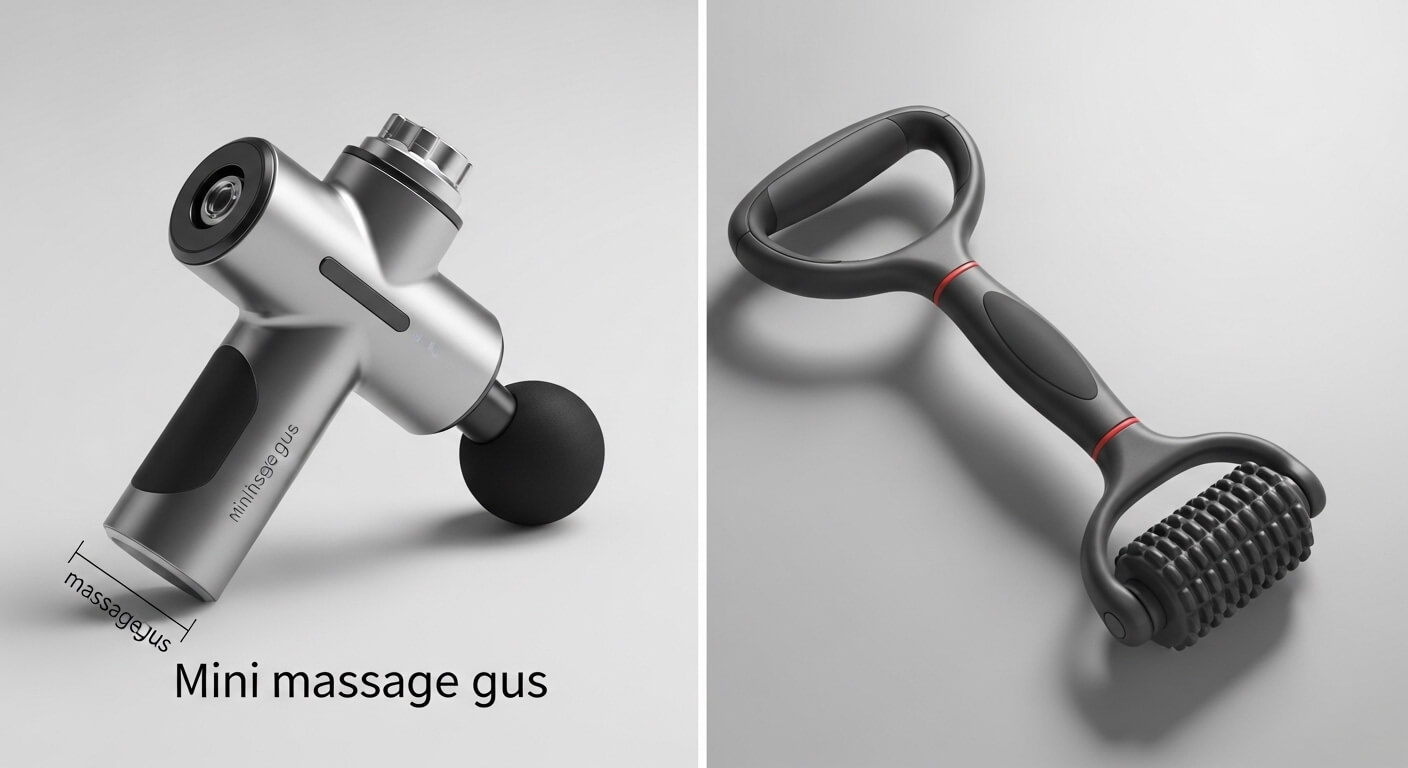
Mini massage guns shrink professional percussion therapy into pocket-sized devices. They use battery-powered motors creating rapid back-and-forth movements (percussion) that penetrate muscle tissue. The mechanical action stimulates blood flow, breaks up adhesions, and provides neurological relaxation through rapid sensory input.
The “mini” designation indicates devices 6-8 inches long weighing 1-1.5 pounds—roughly half the size and weight of full-sized massage guns. Despite compact form, quality mini guns deliver 1,800-3,200 percussions per minute at amplitudes of 8-12mm, providing therapeutic effectiveness approaching full-sized models.
The technology creates rapid muscle oscillation that flushes metabolic waste while delivering fresh blood and nutrients. The percussion disrupts pain signals through gate control theory—the intense sensory input from massage overwhelms pain signal transmission to the brain.
Most mini guns include 2-4 interchangeable attachment heads addressing different muscle groups and sensitivity levels. Ball heads work universally, flat heads suit large muscle groups, bullet points target trigger points, and fork heads work around bones like the spine.
Battery life typically provides 2-4 hours of runtime per charge, translating to 15-30 recovery sessions before recharging. USB-C charging is standard, allowing convenient recharging from laptops, power banks, or wall adapters.
The devices operate at 40-60 decibels—comparable to conversation volume. Quality mini guns run quietly enough for gym use without disturbing others, though budget models can be annoyingly loud.
Muscle Roller Sticks: Manual Myofascial Release
Muscle roller sticks feature a central bar with rotating segments creating a rolling massage effect when you apply pressure and move the stick across muscles. The manual design requires no power, batteries, or charging; pure mechanical advantage through leverage.
The rolling action breaks up fascial adhesions and trigger points through sustained pressure and movement. Unlike massage guns’ rapid percussion, roller sticks provide continuous pressure that you control entirely through hand force and speed.
Stick length varies from 12-20 inches. Shorter sticks (12-14 inches) maximize portability but limit leverage for deep pressure. Longer sticks (17-20 inches) provide better mechanical advantage for aggressive muscle work but increase bulk in gym bags.
The rotating segments create the massage effect. Premium sticks use ball bearings for smooth, effortless rolling. Budget sticks use plastic bushings that create more friction and wear faster. The rolling resistance affects how much arm strength you need for effective treatment.
Handle design matters significantly. Cushioned grips reduce hand fatigue during extended sessions. Some sticks include multiple grip positions accommodating different body areas and hand sizes.
Materials range from plastic (budget options) to reinforced nylon to carbon fiber. Premium materials reduce weight while maintaining strength and durability. An 18-inch stick weighs 6-12 ounces depending on materials—negligible in gym bags.
The simplicity means essentially unlimited lifespan. No motors to burn out, no batteries to degrade, no electronics to fail. A quality roller stick lasts decades with minimal maintenance beyond occasional cleaning.
Portability and Convenience
Mini Massage Gun Gym Bag Reality
Mini massage guns fit gym bags easily; most measure 6-7 inches long, similar to a large smartphone. The compact size allows packing alongside shoes, towels, and water bottles without consuming excessive space.
Weight is the trade-off. At 1-1.5 pounds, mini guns add noticeable weight to gym bags. Combined with other gear, the cumulative weight matters for those carrying bags long distances or commuting by foot/bike.
The charging requirement creates logistics. You must remember to charge the device, monitor battery life, and potentially pack charging cables for extended trips. Dead batteries mid-workout frustrate users and render the device temporarily useless.
The single-handed operation provides convenience during use. Point the gun at a muscle, press the power button, and apply. No special positioning or second hand required—you can massage while scrolling your phone or talking.
Noise considerations matter in shared gym spaces. Quality mini guns operate quietly enough for locker room use. Budget models creating loud motor noise may draw unwanted attention or annoy fellow gym-goers.
The attachment heads require storage. Losing small accessories is easy—dedicated pouches or cases keep everything together. Some users leave extra attachments at home, carrying only favorite heads to minimize clutter.
Muscle Roller Stick Simplicity
Roller sticks offer ultimate portability through simplicity. No charging, no batteries, no power requirements. Grab the stick and go—it works anywhere, anytime, without preparation or planning.
The weight is minimal. A 12-ounce stick barely registers in gym bags. Even longer, heavier sticks rarely exceed 1 pound, and the weight is evenly distributed making it less noticeable than compact massage guns.
The length creates the only portability consideration. An 18-inch stick won’t fit in small gym bags or purses. Most gym duffels accommodate roller sticks easily, but minimalist shoulder bags may not.
Some sticks feature breakdown designs separating into 2-3 pieces for ultra-compact storage. The segments reconnect securely for use. This clever engineering allows 18-inch functionality with 6-inch stored length.
The durability means you can treat the stick roughly. Toss it in your bag, drop it accidentally, forget about it for weeks—it’ll work perfectly whenever needed. The resilience suits chaotic gym bag environments where expensive electronics might suffer damage.
No accessories to track or lose. The stick is the complete system. This simplicity appeals to users who hate managing multiple components or remembering to pack various pieces.
Effectiveness for Post-Workout Recovery
Mini Massage Gun Recovery Benefits
Massage guns excel at rapid muscle flushing immediately post-workout. The percussion drives blood through muscle tissue, accelerating removal of metabolic waste products like lactate that contribute to soreness.
The mechanical stimulation breaks up muscle tension and micro-adhesions forming during intense training. The rapid percussion disrupts the tension patterns before they become entrenched, potentially reducing delayed-onset muscle soreness (DOMS).
Research on percussion therapy shows promise for recovery. A 2020 study found massage gun use reduced muscle soreness and improved range of motion compared to passive recovery. The effects were modest but measurable.
The neurological effects provide immediate relief. The sensory input from percussion temporarily masks pain signals, offering psychological benefit that enhances perceived recovery even before physiological changes occur.
Deep muscle penetration reaches layers manual tools struggle to access. The 10-12mm amplitude of quality mini guns drives percussion deeper than surface-level pressure, addressing muscles like the glutes or deeper back muscles.
However, the time commitment limits comprehensive treatment. Most users spend 1-2 minutes per muscle group for quick post-workout sessions. This brief exposure provides some benefit but falls short of thorough recovery protocols.
Muscle Roller Stick Recovery Benefits
Roller sticks provide targeted trigger point release manual massage cannot achieve alone. The sustained pressure directly on adhesions and knots helps break up fascial restrictions contributing to muscle dysfunction.
The continuous pressure approach aligns with traditional massage therapy principles. Manual therapists use sustained pressure on trigger points for 30-90 seconds—roller sticks replicate this technique with mechanical advantage.
The proprioceptive awareness developed through manual rolling helps identify problem areas. You feel exactly where tension exists and can adjust pressure, angle, and duration responsively. This feedback loop enhances treatment effectiveness.
Research on foam rolling (similar mechanism) shows benefits for flexibility and reduced muscle soreness. While sticks differ from foam rollers, the myofascial release mechanism is similar, suggesting comparable benefits.
The ability to apply extreme pressure serves serious athletes. When you need aggressive muscle work that borders on painful, roller sticks allow as much force as you can generate. Massage guns have maximum intensities that some users find insufficient.
The extended time commitment allows thorough treatment. Users easily spend 5-10 minutes comprehensively rolling major muscle groups. The longer contact time may provide superior cumulative benefits compared to brief massage gun sessions.
Ease of Use and Learning Curve
Mini Massage Gun Operation
Massage guns are immediately intuitive. Turn it on, select intensity, point at muscle, done. Minimal technique required for basic effectiveness. This simplicity encourages consistent use since no learning barrier exists.
The depth of percussion is automatic. Unlike manual tools requiring you to generate force, the motor delivers consistent percussion regardless of user strength or fatigue. A tired athlete gets the same treatment intensity as a fresh one.
Finding optimal settings takes brief experimentation. Most mini guns offer 3-5 speeds. Start low, increase until you find a comfortable intensity providing desired depth. The adjustment process takes one session.
Attachment selection is logical. Ball head for most applications, flat head for large muscles like quads or back, bullet for pinpoint work. The choice becomes obvious after one or two uses.
The hands-off approach allows awkward positioning. Treating your own back or rear shoulders is possible with massage guns, where manual tools require contortion or assistance.
However, the ease can lead to misuse. Overusing percussion guns, excessive duration, too much pressure, or treating injured areas inappropriately can cause bruising or irritation. The power requires responsible application.
Muscle Roller Stick Technique
Roller sticks require understanding basic myofascial release principles. Learn where muscles are located, identify trigger points, and understand appropriate pressure and duration. The learning curve is modest but exists.
Effective rolling demands proper pressure and speed. Too light provides minimal benefit, too aggressive causes pain without additional benefit, and too fast doesn’t allow fascial release. Finding the sweet spot takes practice.
Body positioning matters significantly. You need a stable posture and appropriate angles to generate sufficient pressure on target muscles. Some positions are awkward, particularly for calves or IT bands.
Hand and arm strength become a limiting factor. Aggressive rolling for 5-10 minutes creates forearm fatigue. Users with lower grip strength or hand issues may struggle to maintain effective pressure throughout sessions.
The bilateral design helps but isn’t perfect. Two-handed operation provides good leverage, but treating one arm with the other arm is geometrically challenging. Some body areas resist effective self-treatment.
The feedback teaches body awareness. Over time, you develop understanding of your muscle condition and problem areas. This education provides value beyond the physical treatment itself.
Specific Muscle Group Application
Mini Massage Gun Versatility
Legs (Quads, Hamstrings, Calves): Excellent. Large muscle groups respond well to percussion. The gun reaches all areas easily, delivers effective depth, and covers large surface areas quickly.
Glutes: Outstanding. The percussion depth penetrates the thick glute muscles better than manual pressure. Sitting on the massage gun while it works provides hands-free treatment.
Back: Very good. The one-handed operation allows reaching most back areas yourself. The percussion relieves spinal muscle tension effectively. Hard-to-reach areas between shoulder blades remain challenging.
Shoulders and Neck: Good with caution. The percussion relieves muscle tension but requires careful intensity management. Too much percussion on smaller neck muscles causes discomfort or headaches.
Arms (Biceps, Triceps, Forearms): Excellent. The compact size perfectly suits arm muscles. Easy positioning and appropriate power for smaller muscle groups.
Feet: Good. The percussion relieves plantar fascia tension and arch discomfort. The ball attachment works well on foot muscles.
Muscle Roller Stick Applications
Legs (Quads, Hamstrings, Calves): Excellent. The rolling action works perfectly on legs. The leverage allows significant pressure, and the continuous contact comprehensively treats entire muscle groups.
Glutes: Moderate. The stick length limits the angles needed for effective glute treatment. Foam rollers work better for glutes than sticks.
Back: Difficult. The stick length and arm reach limit effective self-treatment of back muscles. Partners or longer sticks help, but it’s the stick’s weakest application.
Shoulders and Neck: Very good. The precision control allows careful neck work. You can apply exact pressure needed without overshooting into pain.
Arms (Biceps, Triceps, Forearms): Outstanding. The stick’s design perfectly suits arm rolling. Easy to position, appropriate force generation, comprehensive coverage.
Feet: Moderate. Possible but awkward. The curved roller segments don’t match foot anatomy well. Specialized foot rollers work better.
Noise and Social Acceptability
Mini Massage Gun Noise Levels
Quality mini guns operate at 45-55 decibels—slightly quieter than normal conversation. In typical gym environments with background music and activity noise, they blend in without drawing attention.
Budget models often exceed 65-70 decibels, approaching vacuum cleaner volume. This noise level feels disruptive in gym locker rooms or quiet spaces, potentially discouraging use in shared environments.
The motor whine quality matters as much as volume. Smooth, low-pitched motor sounds are less annoying than high-pitched whining even at similar decibel levels. Premium motors sound professional while cheap motors sound cheap.
In quiet home environments, even quality mini guns are noticeable. Early morning or late night use may disturb household members or neighbors in apartments. The noise isn’t prohibitive but isn’t invisible either.
Some users find the motor sound meditative and the vibration sensation comforting. The mechanical rhythm provides psychological relaxation benefits beyond the physical muscle work.
Muscle Roller Stick Silence
Roller sticks are completely silent during normal use. The rolling action produces no noise beyond soft friction sounds. This silence makes them usable anywhere without consideration for disturbing others.
The ability to use roller sticks during conference calls, while watching TV, or in any quiet environment without creating noise provides significant practical advantage over powered devices.
Some sticks develop squeaking as bearings wear or accumulate debris. Regular cleaning and occasional lubrication maintains silent operation. Even worn sticks rarely create disruptive noise.
The silence suits personality types that find motor sounds irritating or anxiety-inducing. Some users prefer pure mechanical tools over battery-powered devices on principle.
Cost Analysis and Long-Term Value
Mini Massage Gun Investment
Device Costs:
- Budget mini guns: $30-$80 (adequate for basic use, durability concerns)
- Mid-range mini guns: $100-$150 (good performance, reliable brands)
- Premium mini guns: $200-$300 (excellent motors, extended battery, quiet operation)
Ongoing Costs: Minimal. Replacement attachments cost $5-$15 if lost, though rarely necessary. Battery degradation over 2-3 years may require replacement or new device purchase.
Lifespan: Budget devices: 6-18 months before motor or battery failure Mid-range devices: 2-4 years with regular use Premium devices: 3-5+ years with proper care
Cost Per Use: $150 device used 3x weekly for 3 years = ~450 uses = $0.33 per session
Muscle Roller Stick Investment
Device Costs:
- Budget sticks: $10-$20 (plastic construction, basic function)
- Mid-range sticks: $25-$40 (quality materials, smooth rolling)
- Premium sticks: $50-$80 (carbon fiber, ball bearings, superior engineering)
Ongoing Costs: Zero. No batteries, no replaceable parts, no consumables.
Lifespan: Budget sticks: 1-3 years before roller degradation Mid-range sticks: 3-7 years with regular use Premium sticks: 10+ years, essentially lifetime tools
Cost Per Use: $30 stick used 3x weekly for 5 years = ~750 uses = $0.04 per session
Value Proposition
Roller sticks provide dramatically better cost-per-use economics. The one-time investment, zero ongoing costs, and extended lifespan create unbeatable value for budget-conscious athletes.
Mini massage guns cost more upfront and face eventual replacement. However, the superior convenience and passive operation may improve compliance, delivering better real-world results despite higher financial cost.
For most gym-goers, mid-range options ($100-$150 mini gun or $25-$40 roller stick) provide optimal value. The performance gap between mid-range and premium devices is modest, while the improvement over budget options is substantial.
Making Your Decision
Choose Mini Massage Gun If:
You want effortless recovery. The powered percussion requires minimal physical effort—ideal after exhausting workouts when you lack energy for active recovery.
Immediate relief matters. The instant muscle relaxation and pain reduction provide psychological rewards encouraging consistent use.
You value convenience over cost. The higher investment and eventual replacement costs are acceptable given the ease of use and effectiveness.
Deep muscle work is priority. The percussion amplitude reaches tissue depths manual tools struggle to access, particularly on thick muscles like glutes.
You have budget for quality devices. Cheap massage guns disappoint with poor performance and short lifespans. Commit to $100+ devices or choose roller sticks instead.
You prefer hands-free operation. The ability to treat muscles while doing other activities appeals to multitaskers.
Choose Muscle Roller Stick If:
Budget is primary concern. The dramatically lower cost provides excellent recovery tools at minimal investment.
You prefer manual control. The hands-on technique and responsive pressure adjustment suit users who like active engagement.
Reliability matters intensely. The zero-electronics design means nothing fails—the stick works forever without batteries or charging.
You want minimal gym bag clutter. The compact, self-contained design with no accessories or charging cables appeals to minimalists.
You appreciate simplicity. The straightforward mechanical function without technology dependence suits users preferring basic tools.
Long-term value trumps convenience. The extended lifespan and zero ongoing costs make sticks economically superior despite requiring more effort.
Consider Both If:
Budget allows dual investment. The $150-$200 total cost for both tools isn’t prohibitive for serious athletes prioritizing recovery.
Different situations suit different tools. Use the massage gun for quick post-gym sessions and the roller stick for thorough evening recovery at home.
You want comprehensive recovery. The percussion and manual pressure provide complementary benefits addressing muscles through different mechanisms.
Frequently Asked Questions
Can these tools replace professional massage?
No. While both provide legitimate muscle relief, they cannot replicate skilled manual therapy assessing muscle condition and adjusting techniques dynamically. Use these tools for maintenance between professional sessions rather than as complete replacements. They extend the benefits of professional massage and reduce frequency needed.
How long should recovery sessions last?
Massage gun: 30 seconds to 2 minutes per muscle group, 5-15 minutes total. Longer provides diminishing returns. Roller stick: 1-3 minutes per muscle group, 10-20 minutes for comprehensive full-body rolling. The manual effort allows longer sessions than powered percussion.
Is soreness normal after using these tools?
Mild soreness is normal, particularly when new to myofascial release or treating severely tight muscles. Excessive soreness, bruising, or prolonged pain indicates too much pressure or duration. Start gently and increase intensity gradually as your body adapts.
Can I use these tools on injury or acute pain?
Avoid treating acute injuries, severe pain, or inflamed areas. These tools address muscle tightness and recovery from training, not injury rehabilitation. Consult healthcare professionals for injury treatment. Once cleared for activity, these tools can support rehabilitation under professional guidance.
Do massage guns damage muscles with excessive use?
Overuse can cause bruising, irritation, or temporary muscle soreness. Limit percussion to 2 minutes per muscle group and avoid treating the same area multiple times daily. The rapid percussion is powerful—respect the intensity and follow reasonable protocols.
Which is better for IT band issues?
Roller sticks excel for IT band work. The continuous pressure along the band’s length effectively addresses tightness. Massage guns work but the percussion may feel uncomfortable on the thin tissue over bones. Many users prefer sticks for IT bands specifically.
Can I share these tools with training partners or family?
Massage guns can be shared with sanitizing between users. Wipe attachments with antibacterial solution or alcohol. Roller sticks should not share without thorough cleaning—the direct skin contact and sweat exposure create hygiene concerns. Consider individual tools for regular use.
Will these tools improve performance or just recovery?
Primarily recovery benefits. Improved recovery allows training harder and more frequently, indirectly improving performance. Some evidence suggests pre-workout percussion or rolling enhances muscle activation and range of motion, potentially helping performance. The primary value is recovery and injury prevention.
Conclusion
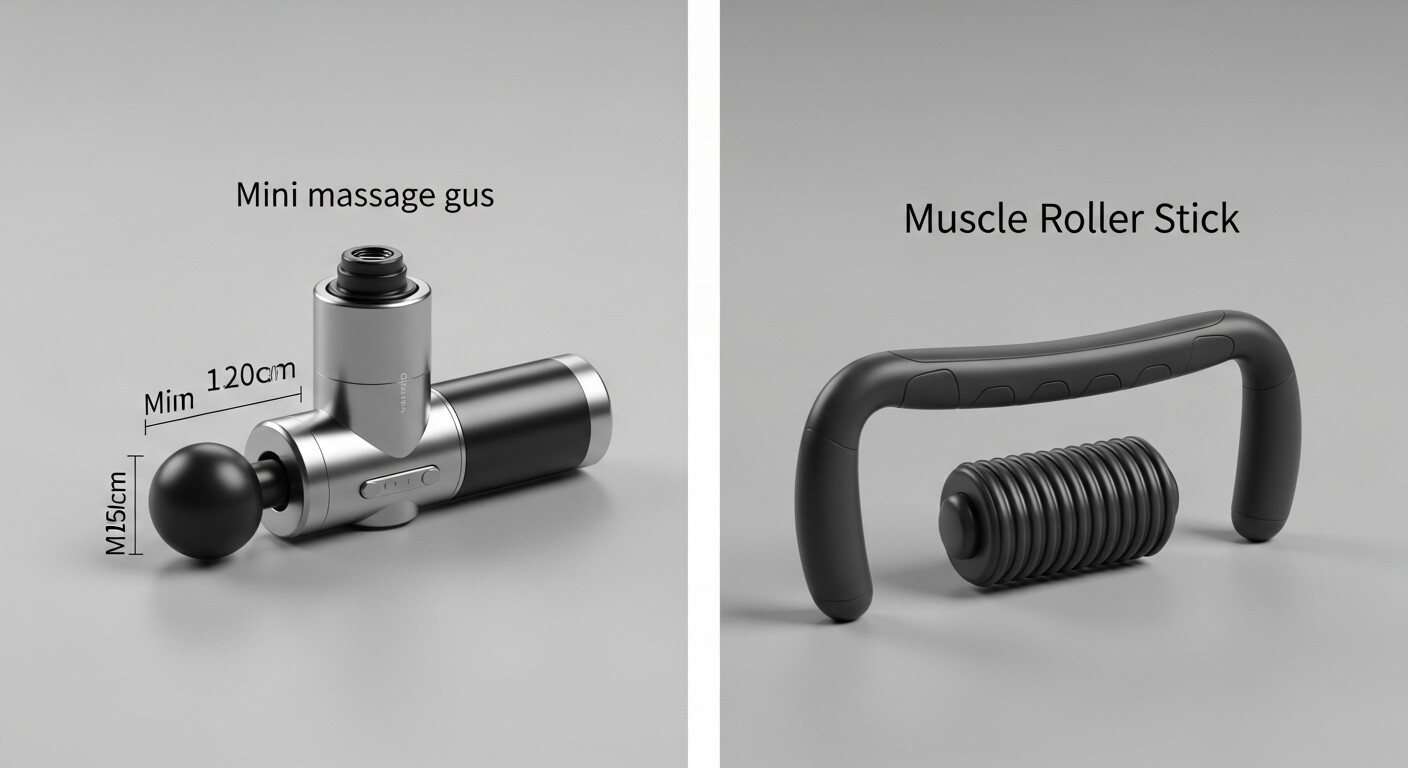
Mini massage guns and muscle roller sticks both deserve gym bag space as legitimate recovery tools addressing muscle tightness and soreness. Neither is universally superior—the ideal choice depends on budget, preference for convenience versus manual control, and which trade-offs matter most to individual users.
Mini massage guns provide effortless percussion therapy delivering immediate muscle relief and comprehensive depth with minimal physical effort. The convenience and instant results encourage consistent use, potentially providing better real-world outcomes despite higher costs. The technology suits users willing to invest $100-$300 for powered convenience and who value hands-free operation requiring minimal energy after exhausting workouts.
Muscle roller sticks offer exceptional value through simplicity and mechanical reliability. The manual approach costs a fraction of powered alternatives while delivering effective myofascial release for decades without batteries or replacement. The technology suits budget-conscious athletes, users preferring active engagement in recovery, and those valuing zero-maintenance tools that work anywhere, forever.
For most gym-goers, starting with a quality roller stick ($25-$40) provides an excellent introduction to active recovery without significant investment. The tool teaches body awareness and recovery principles while delivering legitimate muscle benefits. Upgrade to mini massage guns when budget allows and convenience becomes a priority.
Serious athletes committed to optimal recovery benefit from owning both tools. The combined investment of $150-$200 provides comprehensive recovery capabilities: massage guns for quick post-workout sessions and roller sticks for thorough evening recovery work. The complementary approaches address muscles through different mechanisms, potentially enhancing overall recovery beyond either tool alone.
Ultimately, the best recovery tool is the one you’ll actually use consistently. Massage guns’ convenience often translates to better adherence despite roller sticks’ superior economics. Choose the option matching your personality, budget, and recovery style; both can significantly improve your training recovery and overall muscle health when incorporated into regular routines.