

Most massage gun owners use the ball attachment for everything. It came pre-installed, it feels intuitive, and; for general use on large muscle groups; it works well enough that the four or five other heads in the carrying case go largely untouched. This is one of the most common and consequential mistakes in percussive therapy: using the wrong attachment for the target tissue, or abandoning attachments entirely that would deliver meaningfully superior results for specific regions.
Massage gun attachment design is not cosmetic variation. Each head shape changes the contact area, pressure distribution, depth of percussive penetration, and the type of mechanical stimulus delivered to underlying tissue. A flat head concentrates force differently than a ball. A fork head does something physically impossible for either of the others. A bullet head reaches tissue that the ball and flat heads cannot access without compensating pressure that risks bruising. Matching the attachment to the muscle group transforms percussive therapy from a blunt instrument into a precise one.
This guide covers the three primary attachment categories in depth; ball, flat, and fork, alongside the extended attachment set that serious users should understand, maps each head to its optimal muscle groups and use cases, and provides a practical reference framework for building a complete attachment-based therapy protocol.
Why Does This Matter?
Percussive therapy devices work by delivering rapid, repetitive axial force into soft tissue — typically at 1,400–3,200 percussions per minute; creating a combination of mechanical stimulation, vibration propagation, and localized pressure that increases blood flow, disrupts fascial adhesions, reduces muscle spindle sensitivity, and promotes metabolic waste clearance. The attachment head determines how this force is transmitted to the tissue.
Contact area is the primary variable that changes with attachment shape. A smaller contact area concentrates the same percussive force across fewer square centimeters of tissue, increasing pressure per unit area; producing more targeted, penetrating stimulation appropriate for dense, isolated muscle bellies or trigger point work. A larger, softer contact surface distributes force across more tissue simultaneously, producing broader, more diffuse stimulation appropriate for surface-level recovery and large muscle group treatment.
Hardness is the second critical variable. Foam attachments absorb more of the percussion energy before it reaches tissue, producing vibration-dominant stimulation with minimal percussive impact. Hard plastic or metal attachments transmit a higher proportion of force directly into the tissue, producing deeper, more penetrating percussion. Rubber and silicone heads fall between these extremes, providing a balance of percussive delivery and surface comfort. Most standard ball heads are high-density foam; flat and fork heads are typically hard plastic or rubber with less energy absorption.
The direction of force relative to muscle fiber orientation matters as well — a consideration particularly relevant to the fork attachment, which straddles anatomical structures rather than pressing directly into them, allowing percussive energy to travel along the sides of a muscle or tendon rather than through its bulk.
The Ball Head
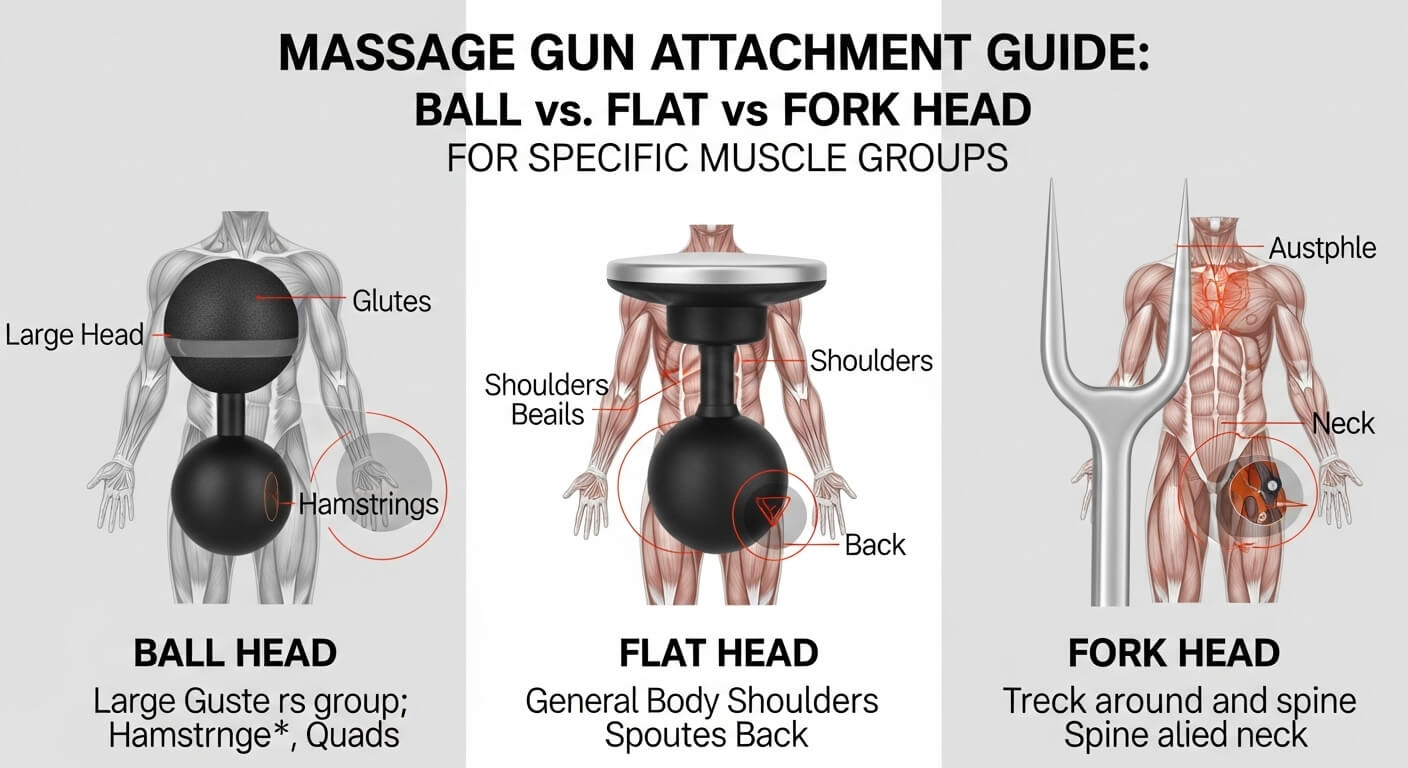
The standard ball attachment, typically a 55–60mm diameter high-density foam sphere, is the defining attachment of percussive therapy and the correct default for most large muscle group applications. Its rounded profile and moderate hardness create a pressure distribution that is broad enough to cover a significant tissue area per stroke but focused enough to provide a genuine percussive stimulus rather than pure surface vibration.
The ball head’s rounded geometry means contact area and pressure automatically adjust with application angle; pressing straight into a muscle belly creates a smaller, more focused contact zone than sweeping across the surface at an angle. This geometry-driven pressure modulation makes the ball head forgiving and intuitive for untrained users while remaining genuinely useful for experienced practitioners who understand how to vary pressure and angle deliberately.
Optimal muscle groups for ball head: quadriceps (rectus femoris, vastus lateralis, vastus medialis), hamstring complex, gluteus maximus, gluteus medius, gastrocnemius, soleus, upper trapezius, latissimus dorsi, pectoralis major, deltoid heads, and thoracic erector spinae. These large-bellied muscles benefit from the ball head’s combination of coverage area and percussive depth.
Ball head limitations: the rounded profile rolls away from narrow or convex anatomical structures — the Achilles tendon, IT band, and tibialis anterior all require more targeted attachment geometry. The ball head also cannot straddle the spine for paraspinal work without risking direct spinal contact, a role the fork head handles definitively.
The Flat Head
The flat attachment; a disc-shaped head typically 45–55mm in diameter made from hard plastic or dense rubber, delivers more concentrated force than the ball head due to its flat contact geometry and harder material. Where a foam ball distributes percussion across a curved surface, the flat head’s edge geometry creates a sharper pressure boundary that penetrates more directly into dense or fibrotic tissue.
The flat head is particularly effective for tissue that has developed notable density from training adaptation, chronic tension, or fascial thickening, the IT band, thoracolumbar fascia, and the plantar fascia are classic examples. It is also the preferred attachment for pre-workout muscle activation, where the goal is not relaxation but neuromuscular priming: the flat head’s more aggressive stimulus increases motor unit recruitment and tissue temperature more rapidly than the softer ball head.
Optimal muscle groups for flat head: iliotibial band (ITB), thoracolumbar fascia and lower back musculature, plantar fascia and intrinsic foot muscles, dense glute tissue (especially post-competition), pectoralis minor and subscapularis (with care), adductors, and tibialis anterior. The flat head also performs well as a warm-up activation tool across any major muscle group before training.
Flat head limitations: the harder, flatter profile can feel aggressive on superficial tissue or areas with less muscle mass underlying the skin; the shin, bony areas of the knee region, and the anterior tibial crest should be avoided. Users new to percussive therapy should start with the ball head and transition to the flat head once they are comfortable managing pressure and contact duration.
The Fork Head
The fork (or spine) attachment is the most anatomically specific head in a standard massage gun kit and the most commonly misunderstood. Its two-prong design is not simply a smaller, dual-contact version of the ball head, it exists to solve a specific anatomical problem: how to apply percussive therapy to the muscles immediately adjacent to a bony or tendinous structure without applying force to the structure itself.
The most important application of the fork head is paraspinal muscle work. The erector spinae and multifidus run in long columns on either side of the vertebral spinous processes — the bony prominences of the spine that are palpable down the center of the back. Applying a ball or flat head to the paraspinal muscles risks contact with these spinous processes, which are inappropriate targets for percussive force. The fork head’s two tines straddle the spinous processes, allowing the device to travel along the full length of the spine while the prongs deliver percussion to the paraspinal muscle bellies on either side, with the fork’s gap maintaining clearance from the vertebrae themselves.
Optimal applications for fork head: paraspinal muscles (erector spinae, multifidus) along the full spinal column, Achilles tendon and surrounding calf tissue (tines straddle the tendon, percussing the medial and lateral gastrocnemius-soleus junction), cervical paraspinals (with reduced speed and pressure), forearm flexors and extensors along the ulna and radius, and the peroneal muscles along the fibular shaft.
Fork head technique note: the fork head should be oriented so the gap aligns with the bony structure being straddled, not across it. Running the fork head perpendicular to the spine, for example, defeats its purpose entirely. When used correctly along the length of the paraspinals, the fork is one of the most therapeutically distinctive attachments in the set, producing results in spinal muscle recovery that no other head can replicate safely.
Head-to-Head: Ball vs. Flat vs. Fork Across Key Factors
| Factor | Ball Head | Flat Head | Fork Head |
| Contact Area | Medium-Large (curved) | Medium (flat edge) | Dual-point (narrow) |
| Percussive Depth | Moderate — foam absorbs some force | High — hard material transmits fully | Moderate-High — targeted |
| Best Tissue Type | Large, well-bellied muscles | Dense, fibrotic, or activating tissue | Paraspinal, tendon-adjacent tissue |
| Spinal Use Safety | Unsafe — no gap for vertebrae | Unsafe — no gap for vertebrae | Designed for spinal use |
| Pre-Workout Activation | Good | Excellent | Specific use only |
| Post-Workout Recovery | Excellent | Good — better for dense areas | Excellent for back/Achilles |
| Trigger Point Work | Adequate | Better — more concentrated force | Best for spinous-adjacent TrPs |
| Beginner Friendliness | High — forgiving geometry | Moderate — can feel harsh | Moderate — technique dependent |
| Sensitivity on Thin Tissue | Tolerable | Can be aggressive | Variable — depends on placement |
| Versatility Score | 9 / 10 | 7 / 10 | 5 / 10 (specialized) |
| Recommended Speed Setting | Medium-High (2,000–2,800 PPM) | Low-Medium (1,400–2,200 PPM) | Low-Medium (1,400–2,000 PPM) |
| Typical Inclusion | Standard — always included | Standard — usually included | Standard on most kits |
The Extended Attachment Set: Bullet, Cushion, and Thumb Heads
Beyond the three primary heads, most premium massage gun kits include additional attachments that address specific use cases the core three cannot serve optimally.
Bullet (Cone) Head: a tapered, hard-tipped attachment designed for pinpoint trigger point release and targeted pressure on small, isolated areas. The bullet head excels on the plantar fascia, anterior tibialis, palm and intrinsic hand muscles, and any area where a specific adhesion or trigger point needs direct, concentrated percussion. It is the most aggressive attachment in a standard kit — excessive pressure or duration on superficial areas can cause bruising. Recommended for experienced users only, at low speeds, with brief application time (15–30 seconds per trigger point).
Cushion / Dampener Head: a super-soft foam or gel head that absorbs the maximum proportion of percussive energy, producing primarily vibration with minimal impact. This head is appropriate for sensitive areas with little overlying muscle mass; the anterior shin, bony knee areas, and for users with heightened pain sensitivity or during recovery from acute soreness when any percussive impact is uncomfortable. It is also effective for gentle neck work where the standard ball head’s impact level feels too intense.
Thumb Head: shaped to mimic the pressure profile of a manual thumb technique, the thumb attachment is used for deep tissue work along muscle bellies, particularly the erector spinae, gluteus medius, and IT band. Its tapered profile concentrates force more than the ball but less than the bullet, occupying a middle ground useful for users who find the ball insufficient but the bullet too aggressive.
Quick Reference: Attachment Selection by Muscle Group
| Muscle Group | Primary Attachment | Secondary Option | Avoid | Notes |
| Quadriceps | Ball | Flat (activation) | Bullet | Slow sweeping strokes across muscle belly |
| Hamstrings | Ball | Flat | Fork | Avoid popliteal fossa (back of knee) |
| Glutes (Maximus) | Ball | Flat (dense tissue) | — | Deeper pressure tolerated here |
| Glutes (Medius) | Thumb or Ball | Flat | Bullet | Smaller target; precision needed |
| Calves (Gastrocnemius) | Ball | Fork (Achilles area) | Flat on shin | Fork straddles Achilles tendon |
| IT Band | Flat | Ball | Bullet | Slow passes; not too aggressive |
| Paraspinals (Erectors) | Fork | — | Ball / Flat | Fork only for safe spinal use |
| Upper Trapezius | Ball | Flat | Fork | Medium pressure; avoid neck arteries |
| Lats / Thoracic Back | Ball | Flat | — | Large area; ball works well |
| Pectorals | Ball | Flat | Bullet | Avoid sternum and rib edges |
| Deltoids | Ball | Flat | Bullet | All three heads respond well to ball |
| Forearms | Fork | Flat | Bullet | Fork straddles radius/ulna effectively |
| Plantar Fascia | Flat | Bullet (trigger pts) | Ball | Firm pressure tolerated; bony heel excluded |
| Tibialis Anterior | Ball | Fork | Flat on bone | Avoid contact with tibial crest |
| Neck (Cervical) | Cushion | Ball (reduced speed) | Flat / Bullet / Fork | Maximum caution; avoid arteries |
Equipment Analysis: Attachment Quality Across Device Tiers
Attachment quality is not uniform across the massage gun market. Budget devices frequently include soft, low-density foam heads that absorb so much percussive energy they deliver primarily surface vibration regardless of the head shape negating the functional differences between attachments that higher-quality devices preserve. Understanding what to expect at each price tier informs both device selection and attachment use strategy.
| Device Tier | Typical Brands | Attachment Material Quality | Head Count | Functional Differentiation | Approx. Cost |
| Budget | Renpho, Toloco | Soft foam — high energy loss | 4–6 heads | Low — heads feel similar | $30–$80 |
| Mid-Range | Theragun Relief, Bob & Brad | Mixed foam/plastic — adequate | 5–7 heads | Moderate differentiation | $80–$180 |
| Premium | Theragun Pro, Hypervolt 2 Pro | Quality materials — good transmission | 6–8 heads | Clear functional differences | $300–$500 |
| Professional | Theragun PRO Plus, TimTam | Clinical-grade materials | 8+ heads | Full therapeutic differentiation | $500–$600+ |
The attachment differentiation gap — the degree to which different heads actually feel and perform differently from one another — is a reliable quality indicator. On a budget device, swapping from ball to flat head produces a barely perceptible change in sensation because both heads are absorbing most of the energy before it reaches tissue. On a premium device, the same swap produces a distinctly different pressure profile that experienced users can calibrate to their therapeutic goals. If attachment-specific therapy is a priority, device quality floor matters.
Product Recommendations by Use Case
Best Overall Device for Attachment Diversity: Theragun PRO (Gen 6)
Theragun’s PRO line has consistently led the category in attachment quality and differentiation. The Gen 6 PRO includes six attachments (dampener, standard ball, wedge, thumb, cone/bullet, and a supersoft head) with consistently high-density materials that transmit percussive force faithfully across all head types. The 16mm amplitude (stroke depth); among the highest in consumer devices means the functional difference between a ball and flat head is fully expressed rather than absorbed by insufficient stroke travel. At $499, it is the standard against which other premium devices are measured. Recommended for: serious users who want full therapeutic differentiation across the attachment set.
Best Mid-Range Attachment Performance: Hypervolt 2 Pro
Hy;perice’s Hypervolt 2 Pro ($329) offers five attachments with good material quality and 14mm amplitude enough stroke depth for meaningful attachment differentiation. The included fork head is particularly well-executed, with prong spacing calibrated well for average adult spinal width. The Hyperice app provides attachment-specific guided protocols by muscle group — a practical feature for users building structured recovery routines. Recommended for: users who want guided attachment protocols and good overall performance without the top-tier price.
Best Budget Device with Functional Attachments: Bob and Brad Q2 Mini
Among budget and mid-budget devices, the Bob and Brad Q2 Mini ($100–$130) offers the most meaningful attachment differentiation below the premium tier. Its six included heads use denser foam and firmer plastic than typical budget competitors, and the device’s 12mm amplitude preserves enough of the attachment-specific force profile to be usable therapeutically rather than merely cosmetically different. Best for users who want basic attachment diversity for home recovery use without the investment in a premium device.
Best for Clinical and Professional Use: Theragun PRO Plus
The Theragun PRO Plus ($599) adds PEMF (pulsed electromagnetic field) therapy and integrated heat and cold functionality to the PRO’s percussive platform; technologies with independent therapeutic evidence that complement percussive attachment work. For physical therapists, athletic trainers, and serious self-treaters building a comprehensive soft tissue toolkit, the PRO Plus represents the most capable multi-modality percussive device available in the consumer market. Recommended for: professionals, high-volume athletes, and users seeking clinical-adjacent therapeutic capability.
Frequently Asked Questions
Q: How long should I use each attachment on a muscle group?
A: A general guideline for post-workout recovery is 60–120 seconds per muscle group with the ball head at medium speed. Flat head work on dense tissue like the IT band can be productive for up to 90 seconds per pass. Fork head paraspinal work benefits from slower, longer passes; 2–3 full passes along the length of the erectors rather than time-limited application. Trigger point work with the bullet head should be limited to 15–30 seconds per point to avoid bruising. The primary signal to stop is discomfort that increases rather than decreases over the first 30 seconds; muscle guarding in response to percussion indicates excessive pressure or speed.
Q: Should I use a massage gun before or after exercise, and does the attachment change?
A: Both pre- and post-exercise applications are evidence-supported but serve different goals, and attachment selection shifts accordingly. Pre-exercise: use the flat head or ball head at higher speeds (2,000–2,800 PPM) for 30–45 seconds per muscle group to activate motor units and increase tissue temperature; prioritize the prime movers for your session. Post-exercise: use the ball head at medium speed for longer durations (60–120 seconds) for broad recovery, switching to the fork for paraspinal work and the flat for any areas of notable density. The cushion head is appropriate post-exercise for sensitive or acutely sore areas.
Q: Can I use a massage gun on my neck safely?
A: With significant caution and specific technique, yes. The posterior cervical muscles (upper trapezius, cervical erectors) can be treated with the cushion or standard ball head at the lowest speed setting, keeping the device on the muscle belly rather than the cervical spine or the lateral neck where the carotid artery and jugular vein run. Direct application to the anterior or lateral neck is contraindicated. If you have cervical disc pathology, a history of cervical injury, or significant cervical spine degeneration, consult a physical therapist before any massage gun neck work.
Q: What speed setting should I use with different attachments?
A: As a starting framework: cushion and foam ball heads work well across the full speed range, with higher speeds (2,400–3,200 PPM) for activation and lower speeds (1,400–2,000 PPM) for relaxation. Flat and plastic heads should generally be used at lower-to-medium speeds (1,400–2,200 PPM) because their harder material already transmits more force; high speed with a hard attachment can feel painfully aggressive on most tissue. The fork head performs best at low-to-medium speed (1,400–2,000 PPM) where the user has control to maintain correct anatomical alignment along the treatment path. Bullet head: always the lowest available speed.
Q: Are aftermarket attachment sets worth buying?
A: For users who have identified specific therapeutic needs not served by their device’s included heads — a proprietary brand’s attachment system often limits aftermarket compatibility, while some brands (notably Theragun and several competitors) use universal 18mm ballistic receivers that accept third-party attachments. Quality varies enormously in the aftermarket. The key specifications to verify are attachment diameter (must match your device), material density (soft foam attachments are rarely worth the cost regardless of shape), and receiver compatibility. Legitimate clinical-grade aftermarket attachments exist from brands like Sidekick and RAD that outperform many OEM inclusions; generic marketplace attachments rarely do.
The Verdict
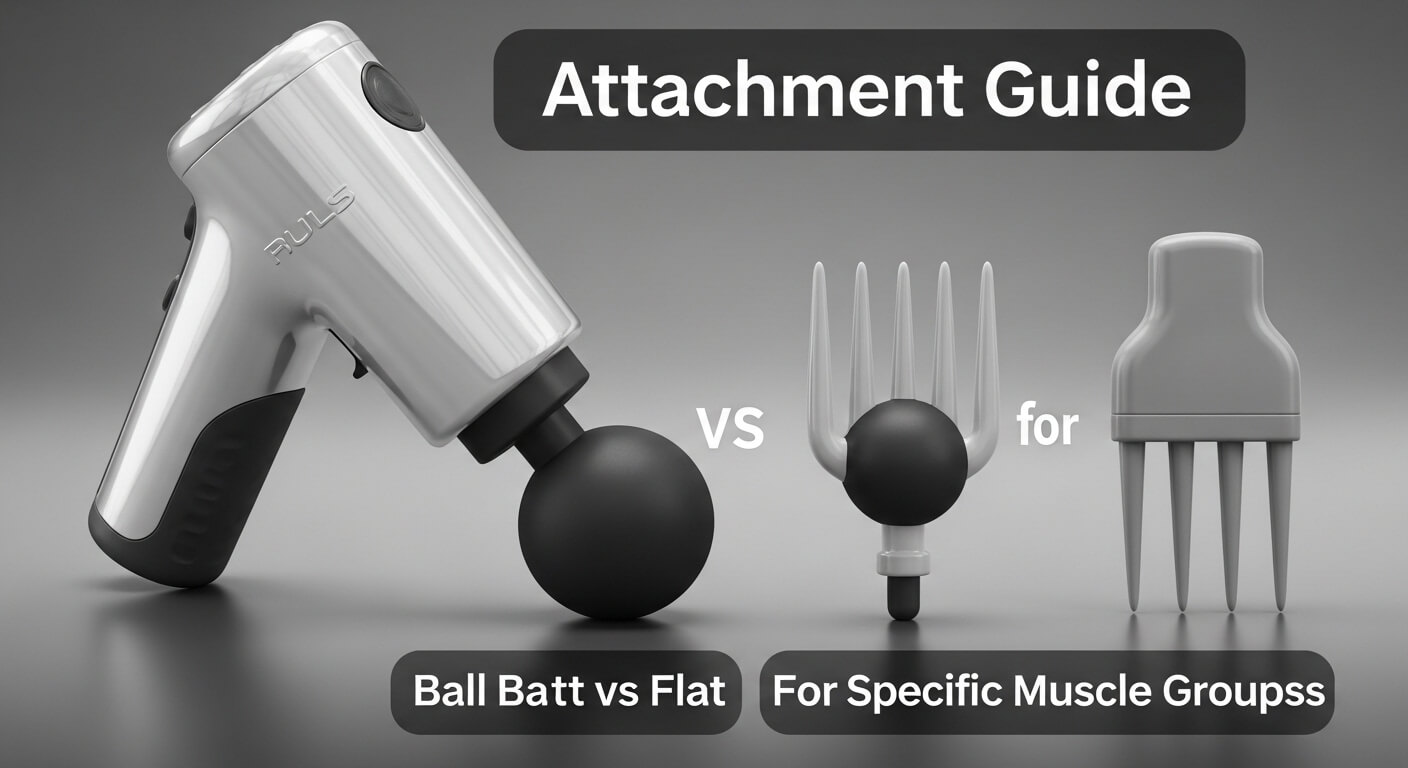
The attachment you choose determines the therapy you receive, not in the abstract sense of varied sensation, but in the concrete sense of which tissue receives meaningful therapeutic stimulus and which does not. A ball head on the paraspinals is not just suboptimal; it is potentially contraindicated. A flat head on the IT band is not just marginally better than a ball; for dense, trained tissue it is often the difference between a treatment that produces change and one that produces only surface warmth. A fork head used correctly along the spine is anatomically irreplaceable; nothing else in the kit does what it does.
The practical takeaway is simple: take the time to learn two or three specific applications for each attachment in your kit. The fork along the paraspinals, the flat along the IT band and plantar fascia, and the ball for everything else as the default; these three patterns alone will transform percussive therapy from a single-tool habit into a targeted recovery system. Add the bullet for known trigger points and the cushion for sensitive days, and the full kit earns its presence in the bag.