

The material your acupressure mat is made from affects a lot more than its price tag. It determines how the mat feels against bare skin, whether it releases chemical odors during use, how long it holds its shape and spike integrity, and how its production aligns with environmental values. For users with sensitive skin, eczema, latex sensitivities, or chemical sensitivities, material choice is not a preference. It is a health consideration.
This guide breaks down the three most common acupressure mat material categories, explains what each feels like in use, compares their performance across skin sensitivity and durability, and gives you a clear framework for choosing the right mat for your body, your skin type, and your values.
Note: Acupressure mats are not suitable for use over open wounds, broken skin, varicose veins, or active inflammation. If you have a skin condition, latex allergy, or chemical sensitivity, consult a dermatologist or physician before selecting and using an acupressure mat. This article does not constitute medical advice.
How Acupressure Mat Materials Affect Your Experience
An acupressure mat consists of three components: the base foam layer, the fabric cover, and the plastic spike discs. Each component can be made from different materials, and the combination determines the mat’s overall sensory experience, chemical safety profile, and environmental footprint.
The base foam provides cushioning and structural support. The fabric cover is the surface your skin contacts most broadly between spike points. The spike discs are what actually penetrate the skin’s surface sensation and stimulate pressure receptors. For users with sensitive skin, all three components matter. A natural linen cover means nothing if the foam base off-gasses synthetic chemicals or the spike plastic contains irritating additives.
The off-gassing factor: new acupressure mats, particularly those made from conventional PVC and synthetic foam, frequently emit a distinct chemical smell when first unpackaged. This odor comes from volatile organic compounds (VOCs) released by plasticizers, adhesives, and foam blowing agents used in manufacturing. For most users this dissipates within a few days of airing out. For users with chemical sensitivities, respiratory conditions, or fragrance sensitivities, it can trigger headaches, nausea, or skin irritation that makes the mat unusable regardless of its other qualities.
PVC Acupressure Mats: The Conventional Standard
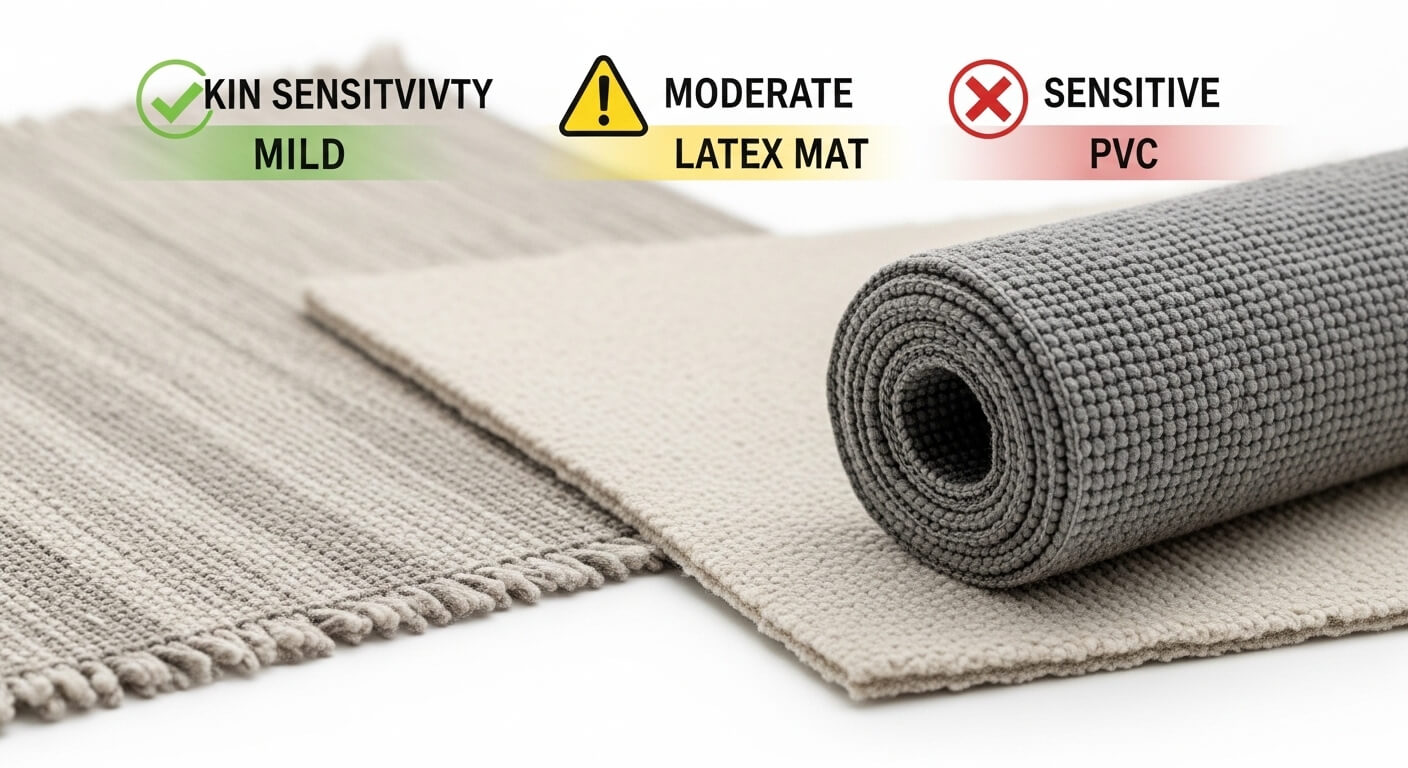
Polyvinyl chloride (PVC) is the dominant material for acupressure mat spike discs and is also used in many base foam layers. It is inexpensive to produce, highly moldable, and durable enough to maintain spike sharpness across thousands of use sessions. The majority of budget and mid-range acupressure mats on the market use PVC spike discs and an EVA (ethylene-vinyl acetate) or PE foam base.
From a performance standpoint, PVC spikes deliver consistent, firm pressure points. The material holds its shape reliably, meaning the spike geometry that determines point distribution and pressure intensity stays accurate throughout the mat’s lifespan. PVC also allows manufacturers to produce the high spike density (typically 4,000 to 8,000 spikes per mat) needed for effective distributed pressure at a price point accessible to most buyers.
The skin sensitivity concern with PVC: standard PVC contains phthalate plasticizers that improve flexibility. Several phthalate compounds have been identified as potential endocrine disruptors, and some users report skin irritation from prolonged contact with plasticized PVC, particularly when the skin is warm and slightly moist during a session. The European Union has restricted certain phthalates in consumer products, and premium PVC mats increasingly specify phthalate-free formulations, which address the most common skin contact concern.
The environmental concern with PVC centers on its production process, which generates chlorine-based pollutants, and its end-of-life profile. PVC is notoriously difficult to recycle and most PVC products end their life in landfill or incineration. For buyers prioritizing environmental impact, PVC is the least favorable material choice regardless of its performance credentials.
Eco-Friendly Alternatives: TPE, Natural Rubber, and Plant-Based Foam
The eco-friendly acupressure mat category encompasses several distinct material approaches, each with different performance and skin sensitivity profiles.
Thermoplastic Elastomer (TPE) Spike Discs
TPE is the most common PVC alternative in mid-range and premium eco-positioned acupressure mats. It is a rubber-plastic hybrid that does not require phthalate plasticizers to achieve flexibility, making it significantly more skin-friendly than standard PVC for chemically sensitive users. TPE is also recyclable, which gives it a better end-of-life profile than conventional PVC.
In performance terms, TPE spikes are slightly softer in feel than PVC spikes of equivalent geometry. This translates to a marginally less intense initial sensation that many users, particularly beginners and those with sensitive skin, find more accessible. For experienced users accustomed to PVC spike intensity, TPE mats may feel slightly gentler at the same session duration. TPE spikes also maintain shape integrity well across long-term use, with durability comparable to PVC under normal conditions.
Natural Rubber and Latex Bases
Some premium eco-friendly mats replace synthetic foam bases with natural rubber or latex-derived foam, which offers better pressure redistribution than EVA foam and has superior breathability. Natural rubber is biodegradable and sourced from renewable trees, giving it a significantly better environmental profile than petroleum-derived foams.
The critical caveat is latex allergy. Natural rubber latex is one of the most common contact allergens, with prevalence estimates of 1 to 6% in the general population and significantly higher rates among healthcare workers. Any buyer with a known or suspected latex sensitivity must avoid natural rubber-based mats entirely, regardless of the material’s other qualities. TPE and synthetic alternatives are the appropriate choice for latex-sensitive users.
Plant-Based and Recycled Fabric Covers
The fabric cover is where the most accessible and universally safe eco-friendly improvements occur. Organic linen, hemp, and GOTS-certified organic cotton covers replace the synthetic polyester and nylon covers of standard mats. These natural fiber covers are breathable, less likely to cause skin irritation during extended contact, and free from the finishing chemicals applied to many synthetic fabrics.
Linen is the most commonly used natural fiber cover in premium eco-friendly acupressure mats. Its slightly textured surface reduces direct spike-to-skin sliding during repositioning and its natural moisture-wicking properties keep the surface drier during longer sessions. For users who experience skin redness or sensitivity at the spike perimeter rather than at the spike tip, a natural fiber cover often resolves the issue independently of the spike material.
Head-to-Head Comparison: PVC vs. Eco-Friendly Materials
| Factor | Standard PVC | TPE | Natural Rubber Base | Natural Fabric Cover |
| Skin contact safety | Moderate (phthalate concern) | Good (no phthalates) | Good unless latex allergy | Excellent (no synthetics) |
| Chemical off-gassing | Noticeable on new mats | Mild to none | Mild natural rubber smell | None |
| Spike firmness | Firm, consistent | Slightly softer | N/A (base only) | N/A (cover only) |
| Durability | Excellent, long-lasting | Very good | Very good | Good with proper care |
| Latex allergy risk | None | None | High risk | None (if linen or cotton) |
| Environmental impact | High (non-recyclable) | Lower (recyclable) | Low (biodegradable) | Low (organic/renewable) |
| Breathability in use | Low | Moderate | Good | Excellent |
| Odor on first use | Strong chemical smell | Minimal odor | Natural rubber scent | No odor |
| Price premium over PVC | Baseline | 10 to 25% more | 20 to 40% more | 15 to 30% more |
| Suitable for beginners | Yes (firm may be intense) | Yes (gentler feel) | Yes | Yes (most comfortable) |
Skin Sensitivity Guide: Which Material for Which Skin Type
Normal to non-sensitive skin: PVC mats with phthalate-free certification are safe and cost-effective. The firm spike feel is appropriate for most users who have established baseline tolerance and do not report irritation from synthetic material contact. Air the mat for 24 to 48 hours before first use to dissipate initial off-gassing odors.
Sensitive or reactive skin: TPE spike discs with a natural linen or organic cotton cover is the recommended combination. The absence of phthalate plasticizers reduces chemical irritation risk at the spike contact points, and the breathable natural cover reduces moisture-related irritation between spikes. If redness persists after switching to this combination, reduce session duration and ensure the mat is used on clean, dry skin.
Eczema-prone skin: use only on unaffected areas with clear skin. TPE or natural material mats are preferable to PVC. Start with a thin fabric layer between skin and mat to modulate spike intensity and reduce direct chemical contact during the sensitization period. Avoid sessions during active flares entirely.
Chemical or fragrance sensitivities: prioritize natural material mats and air thoroughly before first use regardless of material type. Avoid mats that list undisclosed fragrance additions or antimicrobial treatments, which are common in budget mats and can trigger reactions independent of the base material. Organic cotton or linen covers with certified dye-free options are the safest choice.
Latex allergy: this is a binary exclusion criterion for natural rubber-based mats. Choose TPE spikes and synthetic or linen covers only. Cross-reactivity is possible with some natural materials, so verify the full material disclosure of any eco-friendly mat before purchase if you have a confirmed latex allergy.
User Experiences: What Owners Report Across Material Types
- Users who switched from PVC to TPE mats as their first upgrade most commonly cited reduced initial session discomfort and the absence of chemical smell as the primary benefits, while noting the overall pressure stimulation felt qualitatively similar after the first week of use.
- Eco-conscious buyers who prioritized natural linen covers reported the highest satisfaction with skin comfort during sessions lasting 20 minutes or more, attributing it to reduced sweating and less skin adhesion to the mat surface compared to synthetic covers.
- Users with self-reported chemical sensitivities overwhelmingly rejected PVC mats on first use regardless of spike quality, with the off-gassing smell cited as immediately intolerable in enclosed rooms. Several reported that even airing PVC mats for a week did not fully resolve the odor sensitivity issue for indoor use.
- Dermatologists and estheticians who recommend acupressure mats to clients consistently specified TPE spike and natural fabric cover combinations as their standard recommendation for anyone with skin conditions, stating that the phthalate-free and chemical-reduced profile meaningfully lowered the risk of contact dermatitis responses.
- Budget PVC mat users who did not report skin sensitivity noted that the main downside was durability of the mat’s fabric cover rather than the spike material, with synthetic covers showing pilling and wear after 6 to 12 months of regular use, while the spikes themselves remained effective for considerably longer.
Price Analysis: Material Quality Across Tiers
| Price Tier | Typical Spike Material | Base Material | Cover Material | Best For | Price Range |
| Budget | Standard PVC | EVA foam | Synthetic polyester | Trying acupressure for the first time | $15 to $35 |
| Mid-range | Phthalate-free PVC or TPE | PE foam | Synthetic or partial linen blend | Regular home use, most users | $35 to $70 |
| Premium eco | TPE | Natural or recycled foam | Organic linen or cotton | Sensitive skin, eco-conscious buyers | $70 to $130 |
| Ultra-premium | TPE or natural material | Natural rubber or latex | GOTS organic linen | Luxury wellness, clinical adjacent use | $130 to $250 |
The most meaningful price jump for skin sensitivity purposes is from standard PVC to phthalate-free PVC or TPE, which occurs at approximately the $45 to $60 price point. Above that threshold, improvements are incremental in skin safety terms and increasingly focused on environmental profile, cover quality, and overall product experience rather than chemical safety. Users with standard non-sensitive skin do not need to purchase above the mid-range tier for safety reasons.
Product Recommendations by Material and Skin Type
Best Eco-Friendly Overall: Shakti Mat Original
The Shakti Mat at $79 to $99 uses non-toxic ABS plastic spikes with a certified organic cotton cover and a plant-based foam base. ABS plastic (acrylonitrile butadiene styrene) is a phthalate-free alternative to PVC that produces firm, consistent pressure points without the plasticizer concern. The organic cotton cover eliminates synthetic finishing chemical exposure at the fabric contact layer. Recommended for: eco-conscious buyers who want firm spike intensity in a chemically cleaner package.
Best for Sensitive Skin: Nayoya Acupressure Mat
The Nayoya at $40 to $55 uses TPE spike discs with a linen-blend cover that is noticeably softer against skin than synthetic alternatives. Its spike density of approximately 6,210 points delivers distributed pressure that most sensitive skin users find manageable at session durations of 10 to 20 minutes. The mat ships with minimal chemical odor compared to PVC alternatives in the same price range. Recommended for: users with reactive or sensitive skin beginning an acupressure practice.
Best Budget Non-Sensitive Option: ProSource Acupressure Mat and Pillow Set
At $20 to $30, the ProSource set uses standard PVC spikes and synthetic cover that represent functional quality at the entry price tier. Air for 48 hours before first use to manage off-gassing. The included pillow makes it one of the most complete starter kits available at this price. Recommended for: users without skin sensitivities who want to try acupressure before investing in a premium mat.
Best Premium Natural Mat: Bed of Nails Original Mat
The Bed of Nails Original ($80 to $110) uses ABS plastic spikes embedded in a natural cotton fabric cover over a foam base, with the brand’s certified non-toxic manufacturing process as its key differentiator. Its spike geometry uses a flower-shaped disc design that distributes pressure across more points of contact than circular discs, reducing per-point pressure intensity in a way that sensitive skin users consistently rate as more comfortable. Recommended for: users who want a verified non-toxic mat with a gentler initial sensation.
Best for Chemical Sensitivity: SPOONK Organic Acupressure Mat
The SPOONK Organic at $90 to $120 is the most comprehensively certified option for chemically sensitive users, featuring OEKO-TEX certified materials throughout and a full disclosure of all components. Its organic cotton cover, TPE spikes, and foam base with no added fragrances or antimicrobial treatments make it the lowest chemical exposure risk in the consumer category. Recommended for: users with fragrance sensitivities, multiple chemical sensitivities, or a history of contact dermatitis from wellness products.
Frequently Asked Questions
Is PVC safe to use directly on skin?
Standard PVC used in consumer products is considered safe for incidental skin contact by regulatory agencies including the FDA and EU consumer product standards. The concern with extended direct skin contact is the potential migration of phthalate plasticizers, which some studies associate with hormonal disruption at high exposure levels. Phthalate-free PVC or TPE alternatives eliminate this concern entirely and are recommended for users who use acupressure mats daily for extended sessions.
How do I know if my mat is truly eco-friendly and not just marketed that way?
Look for third-party certifications rather than brand claims. OEKO-TEX Standard 100 certifies that all components of a textile product have been tested for harmful substances. GOTS (Global Organic Textile Standard) certifies organic fiber processing. Greenguard Gold certifies low chemical emissions. Brands that provide full material disclosure (listing each component and its material composition) are more trustworthy than those that use eco-friendly language without certification backing.
Can I use an acupressure mat if I have eczema?
Use on skin that is currently unaffected and in remission is generally considered safe with appropriate material selection. Never use on active eczema flares, broken skin, or areas of active inflammation. TPE spikes and natural fiber covers minimize additional chemical irritation risk. A dermatologist’s guidance is recommended before establishing a regular acupressure practice if you have diagnosed eczema.
What is the best way to clean an acupressure mat without damaging the spikes?
Hand wash with mild soap and lukewarm water, then air dry flat away from direct sunlight. Machine washing is not recommended as agitation can dislodge spike discs from the fabric base. For PVC and TPE spikes, avoid alcohol-based cleaners that can degrade the plastic over time. Natural covers can tolerate gentle soap; check the manufacturer’s care instructions for certified organic covers, which may specify particular cleaning products to maintain their certification compliance.
Does spike density matter more than material for effectiveness?
Both variables matter but serve different purposes. Spike density determines pressure distribution: higher spike density (above 6,000 spikes per mat) distributes load across more points, producing a more even and often more tolerable sensation. Lower density (below 4,000 spikes) concentrates load on fewer points, producing more intense per-point stimulation. Material determines the chemical and sensory profile of each spike contact. For most users, spike density matching their tolerance level is the first selection criterion; material choice is the second layer of optimization.
What focus keyphrase should I use for this article?
The focus keyphrase is: acupressure mat material. Supporting keyphrases include best eco-friendly acupressure mat, acupressure mat for sensitive skin, PVC vs TPE acupressure mat, and non-toxic acupressure mat.
The Verdict

PVC remains the dominant acupressure mat material because it performs consistently, lasts well, and keeps prices accessible. For users without skin sensitivities or chemical concerns, a phthalate-free PVC mat with a natural fabric cover represents a reasonable and cost-effective choice.
For users with sensitive skin, eczema, chemical sensitivities, or environmental priorities, TPE spikes combined with an organic linen or cotton cover is the recommended material combination. It delivers equivalent therapeutic pressure stimulation without the phthalate contact concern, produces minimal off-gassing, and has a better end-of-life profile than conventional PVC.
Latex allergy is the one material constraint that requires absolute exclusion rather than preference. Natural rubber base mats must be avoided entirely by anyone with a confirmed or suspected latex allergy. TPE and synthetic foam alternatives are universally available across every price tier and provide equivalent or superior performance for this user group.