

You bought the mask, or the wand, or the panel. You have used it faithfully for a week, maybe two. You lean into the bathroom mirror, tilt your face toward the light, and look for the change everyone promised. And you are not sure you see anything yet.
If that is you, take a breath, because you are asking the single most important question about this technology, and almost every marketing page dodges it. How long does red light therapy actually take to work on skin? The honest answer is not “instantly,” and it is not “never.” It is a specific, realistic range that depends on what you are treating, how consistent you are, and what your expectations were in the first place.
This guide gives you that realistic timeline, week by week, grounded in what dermatology sources and clinical research actually say rather than what a sales banner wants you to believe. By the end you will know what to expect at two weeks, at a month, at three months, what speeds results up, what quietly sabotages them, and how to tell the difference between “it is not working” and “it is not done yet.” Those two things look identical for the first several weeks, and confusing them is why so many people quit right before the payoff.
The Short Answer, Up Front
For skin concerns like fine lines, texture, and firmness, most people should expect to see noticeable results somewhere in the range of four to twelve weeks of consistent use, with the more structural, collagen-driven changes clustering toward the later end of that window. Some concerns, like redness or a subtle overall glow, can show earlier. Deeper changes like reduced wrinkle depth and improved firmness generally take the longest because they depend on your skin gradually building new collagen, which is a slow biological process no gadget can rush.
The two words that matter most in that answer are consistent and gradual. Red light therapy is cumulative. It works a little at a time, session after session, and the results build quietly before they become obvious. If you internalize nothing else from this article, internalize that skipping sessions and expecting overnight change are the two fastest routes to disappointment.
Now let us break the timeline down properly, because “four to twelve weeks” is a range, and knowing what happens inside that range is what keeps you going.
First, What Red Light Therapy Is Actually Doing
To understand the timeline, you have to understand what is happening under your skin, because the timeline is really just the schedule of a biological process.
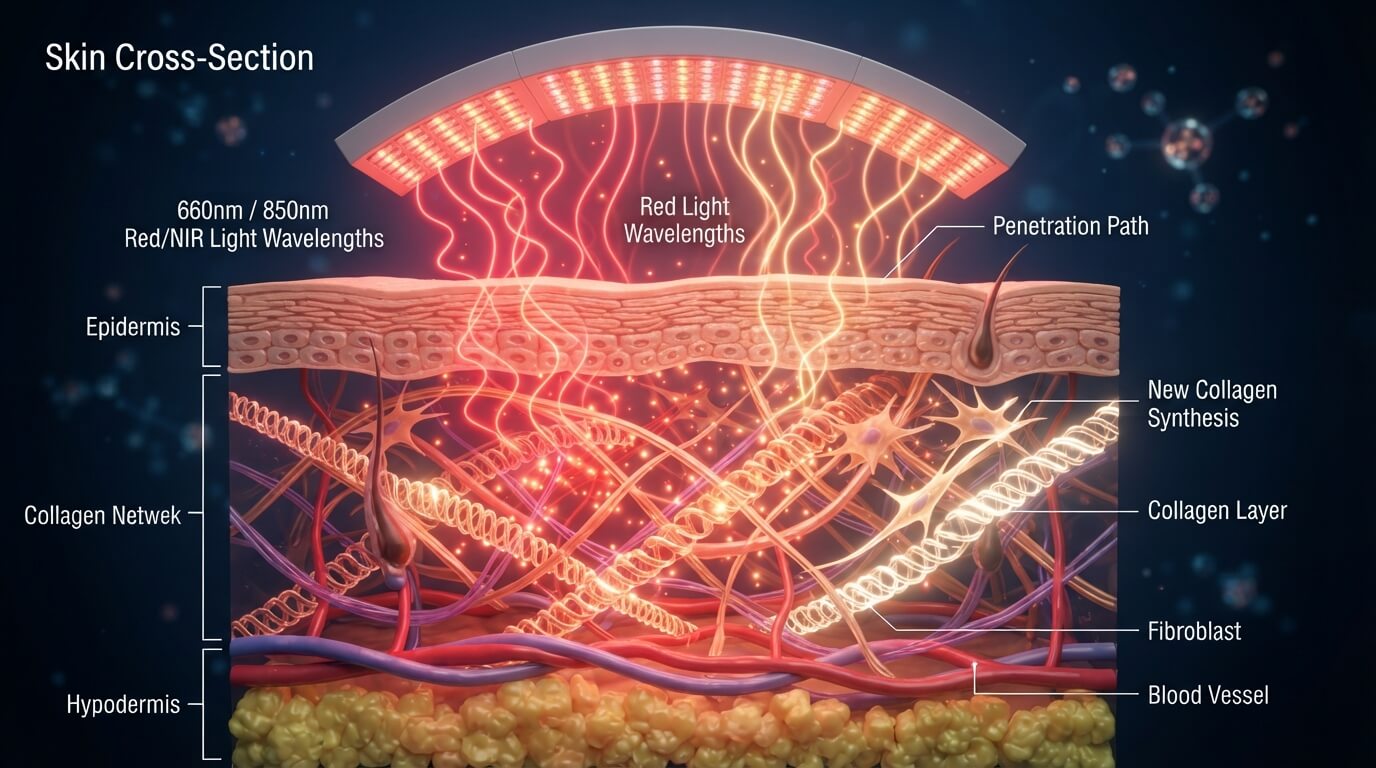
Red light therapy, known more formally as photobiomodulation, uses specific wavelengths of red and near-infrared light aimed at the skin. As Harvard Health explains in its overview of red light therapy for skin care, the light is believed to reduce inflammation and boost the production of collagen, and research suggests it can improve a range of skin concerns. The light is absorbed by your skin cells, where it is thought to support the cellular energy production that drives repair and renewal.
Here is the part that explains the wait. When that light nudges your fibroblasts, the cells responsible for making collagen, into producing more, you do not see new collagen the next morning. Collagen synthesis and remodeling is a slow, ongoing process. Your skin has to actually build the new structural proteins, and then those proteins have to accumulate enough to change how your skin looks and feels. That takes weeks, and there is no shortcut, because you are waiting on your own biology, not on the device.
This is why the timeline is what it is. The device starts working at a cellular level from early on, but the visible payoff lags behind the cellular activity by weeks. You are, in a real sense, seeing today the results of the sessions you did a month ago. That lag is the whole reason patience is not just a nice-to-have here, it is the mechanism.
The American Academy of Dermatology notes that most at-home devices use LEDs considered safe for home use, and that red-light LED devices can produce subtle to noticeable results on the face when used consistently. Note the language dermatologists use, subtle to noticeable, and consistently. That is the honest register for this technology, and it is worth adopting as your own.
The Realistic Week-by-Week Timeline
Every person’s skin is different, and your exact experience will vary with your age, your skin, your device, and your concern. But research and dermatology sources converge on a general shape that is useful to hold in your head. Here is that shape, framed honestly.
Week 1 to Week 2: the “am I sure this is working” phase. Early on, most of what is happening is invisible, at the cellular level. Some people notice small, superficial things in this window, a subtle glow, slightly better hydration, a bit less redness or puffiness, largely because circulation and inflammation respond relatively quickly. But do not expect changes to fine lines or firmness yet. If you see almost nothing, that is completely normal and is not a sign of failure. This is the phase where the most people wrongly conclude “it does not work” and give up. The single most valuable thing you can do here is not judge results yet and simply build the habit.
Week 3 to Week 4: the first visible signs. Around the one-month mark, earlier surface-level improvements often become more apparent. Skin may look and feel smoother, tone may look a little more even, and that glow tends to become more consistent rather than fleeting. For some people, very early softening of the most superficial fine lines begins here. Clinical studies frequently use a four-week checkpoint precisely because it is early enough to catch initial changes but too early to judge the deeper ones. Treat week four as an encouraging progress marker, not a final verdict.
Week 6 to Week 8: the momentum phase. This is where texture and tone improvements tend to become genuinely noticeable to you, and sometimes to other people. The cumulative sessions are adding up, and the collagen-related changes are beginning to surface. Many people who make it to this window are the ones who end up satisfied, because this is where “maybe it is working” turns into “yes, this is doing something.”
Week 10 to Week 12 and beyond: the collagen payoff. The deeper, structural results, reduced wrinkle depth, improved firmness and elasticity, are generally clearest from around ten to twelve weeks onward. This is the slow reward for consistency, and it is why serious protocols are measured in months rather than days. Beyond twelve weeks, with continued maintenance use, improvements can keep developing and, importantly, be sustained. Many people shift to a lighter maintenance schedule at this point rather than stopping entirely.
Put the whole arc together and you get a simple, honest headline. Early weeks are mostly invisible groundwork. The one-month mark shows early surface changes. The real, structural results arrive over two to three months. Anyone promising dramatic transformation in days is selling a fantasy, and now you know enough to recognize it.
Why the Timeline Varies So Much by Concern
“Four to twelve weeks” is a range and not a single number for a genuine reason, different skin concerns sit at different depths and respond on different schedules.
Concerns tied to inflammation and circulation, like redness or a dull, tired look, tend to respond earliest, because reducing inflammation and improving blood flow are relatively fast effects. That is why an early glow is one of the first things people report.
Surface texture and tone sit in the middle. Smoothing rough texture and evening out tone takes longer than calming redness but less time than rebuilding structure, so these improvements tend to land in the several-week range.
Structural, collagen-dependent concerns, fine lines, wrinkle depth, firmness, take the longest, because they require your skin to actually produce and organize new collagen, and that is a slow process by nature. These are the results that cluster at the ten-to-twelve-week end and keep developing with continued use.
Understanding this saves you from a common mistake, judging a slow-responding concern on a fast-responding schedule. If your main goal is firmer-looking skin, checking for dramatic change at week two is like checking whether a seed has become a tree a few days after planting. The schedule for that particular result is simply longer, and that is normal.
What Speeds Results Up, and What Slows Them Down
Two people can buy the same device and have completely different experiences, and the difference usually comes down to a handful of controllable factors. Here is what actually moves the needle.
Consistency is the biggest lever, by far. Red light therapy is cumulative, so sporadic use is the number one reason people fail to see results on the expected timeline. A device used faithfully several times a week will outperform a better device used haphazardly. The habit matters more than almost anything else on this list.
Frequency and following the protocol. Dermatology sources and studies generally describe consistent schedules, often on the order of a few sessions per week for at-home use, with each session lasting several minutes as directed by the device. More is not automatically better. Overlong sessions do not speed collagen up, and misusing a device can cause irritation. Follow the manufacturer’s instructions rather than improvising a more aggressive routine.
Device quality and correct use. At-home devices are, by design, gentler than the professional equipment used in clinics. As dermatology and consumer-health sources consistently note, that lower power lowers risk but also tends to lower the magnitude and speed of benefit. Using your device at the right distance and in the right way, per its instructions, helps it deliver what it is capable of.
Your starting point and biology. Age, skin type, and individual biology all influence how quickly and how much you respond. This is not something you control, but it is worth knowing so you calibrate expectations to yourself rather than to a stranger’s before-and-after photo.
Your broader skin habits. Red light therapy does not operate in a vacuum. Sun protection, a sensible skincare routine, hydration, and general skin health all affect your results. The device is one input among several, not a substitute for basic skin care.
The encouraging takeaway is that most of the biggest levers, consistency, correct use, sun protection, are entirely within your control. The people who get the most out of this technology are rarely the ones with the fanciest device. They are the ones who use a decent device correctly and regularly for long enough.
How to Actually Tell If It Is Working
Here is a frustrating truth about gradual change, you are the worst-positioned person to notice it, because you see your own face every single day. Incremental improvement is nearly invisible when you live inside it. This is exactly why people convince themselves nothing is happening when something actually is.
The fix is simple and worth doing from day one. Take photos. Photograph the same area, in the same lighting, from the same angle, at regular intervals, say every two weeks. Then compare the photos side by side rather than trusting your daily mirror impression. What feels like “no change” across a few days often reveals itself as clear improvement across eight weeks when you have the images lined up. Your memory is not a reliable instrument for slow change. A consistent photo series is.
A few practical tips for useful tracking. Use the same room and light source each time, since lighting dramatically changes how skin looks. Keep the angle and distance consistent. Avoid comparing a photo taken in harsh overhead light to one taken in soft window light and concluding the device failed. And be patient with the interval, comparing week one to week two will show you almost nothing, while comparing week one to week eight is where the story becomes visible.
This habit does something psychological as well as practical. It gives you objective evidence during the long middle stretch when your daily impression is telling you to quit. Seeing real, documented progress at the six-week mark is often exactly what carries someone through to the twelve-week payoff.
At-Home Versus Professional: Different Timelines, Different Trade-Offs
A question worth answering directly, since it shapes your expectations, is how the at-home timeline compares to what a dermatologist’s office delivers, because they are not the same and pretending otherwise sets you up wrong.
Professional and in-office LED and red light systems are typically more powerful than consumer devices. That higher power can mean faster or more pronounced results in some cases, along with the benefit of professional guidance on protocol and skin type. The trade-offs are the obvious ones, cost per session, booking and travel, and the fact that you are on someone else’s schedule rather than your own bathroom’s.
At-home devices sit at the other end of the trade. They are deliberately gentler, which lowers risk but, as dermatology and consumer-health sources consistently point out, also tends to lower the magnitude and speed of the benefit. In exchange, you get convenience, privacy, no appointments, no downtime, and a one-time purchase instead of recurring fees. The practical consequence for your timeline is that an at-home routine generally asks for more patience and more consistency to reach a given result than a professional course would, because you are working with a milder tool.
Neither path is simply better. They answer different questions. If you want the fastest, most pronounced results and are willing to pay per session and show up to appointments, the professional route has real advantages. If you want an affordable, private, no-downtime routine you control and are willing to trade some speed and intensity for that, the at-home route makes sense, as long as you go in understanding that the gentleness is exactly why the timeline runs longer. The mistake to avoid is buying a gentle home device and then judging it against clinical-speed expectations it was never built to meet.
There is also a sensible hybrid many people land on. Some use professional treatments for a more intensive initial course and then maintain at home, while others simply run a patient, consistent at-home routine from the start. Both are legitimate. What matters is matching your expectations to the tier you actually chose.
How Red Light Stacks With Other Technologies in Combined Devices
Increasingly, red light therapy does not arrive on its own. Many modern at-home devices bundle it with other technologies, and understanding how that affects your timeline and expectations is useful, because combined devices can muddy the question of what is actually producing your results.
You will commonly see red light paired with things like gentle warmth, sonic vibration, microcurrent, or serum-delivery methods such as electroporation. The logic is convenience, one device and one short routine instead of several separate tools, and the idea that different technologies address different concerns so a combined device covers more ground. If you want the deeper explanation of one of those pairings, our guide to what electroporation is in skincare devices covers how serum-delivery technology works alongside light.
For your timeline, a combined device does not change the fundamental truth about red light, the collagen-related results still build gradually over weeks. What it can do is add other effects on other schedules. A serum-delivery feature paired with a good serum might contribute hydration or other benefits on a different timeline. A vibration feature might feel pleasant immediately without contributing to long-term structural change at all. This is worth understanding so you can attribute your results correctly and not credit or blame the wrong feature.
There is also a caution here. Combined devices can make it genuinely hard to know which component is responsible for what, and clinical evidence for a specific combination in a specific consumer gadget is often thinner than the evidence for each technology studied on its own. That does not make combined devices bad, they can be a real convenience, but it does mean you should hold claims about a specific combined device a little more loosely than claims about the underlying, well-studied technologies. Judge the device on consistent real-world use and your own tracked results, not on the impressive-sounding stack of features on the box.
The practical upshot, regardless of how many technologies your device combines, is the same as it has been throughout this guide. The red light portion works on a gradual, weeks-long schedule, and your consistency is what determines whether you ever see what it can do.
Common Myths About Red Light Therapy Timelines
Let us directly clear up the misconceptions that lead people to quit too early or expect too much.
Myth: you should see dramatic results in a few days. No. The early weeks are mostly invisible cellular groundwork, and the structural results take two to three months. Anyone promising dramatic change in days is overselling, full stop.
Myth: if I do not see anything in two weeks, it is not working. This is the single most common and most costly mistake. Two weeks is squarely inside the invisible-groundwork phase for structural concerns. Judging results this early is like digging up a seed to check if it has sprouted. Give it eight weeks before drawing conclusions.
Myth: longer or more frequent sessions will speed things up. They will not, and they can cause irritation. The collagen-building process runs on its own biological schedule that intensity cannot rush. Follow the protocol rather than trying to force faster results.
Myth: once I see results, I can stop. Results are maintained through continued, if lighter, use. Many people transition to a maintenance schedule rather than stopping entirely, because the underlying processes benefit from ongoing support.
Myth: my daily mirror is a good way to judge progress. It is one of the worst, because you cannot perceive slow change in something you see every day. A photo series in consistent lighting is far more reliable, and it is the tool that keeps people motivated through the slow middle weeks.
Myth: all at-home devices deliver the same timeline. Device quality, correct use, your consistency, and your individual biology all shift the schedule. Two people with the same device can have quite different experiences based largely on how faithfully and correctly they use it.
What a Single Session Actually Looks Like
Since the timeline is built out of individual sessions, it helps to understand what one session involves, because a realistic picture of the routine tells you whether you can genuinely sustain it, and sustainability is what the entire timeline depends on.
The general shape is consistent across most at-home devices, though you should always defer to your specific product’s instructions. You start with clean skin, since makeup, heavy creams, or sunscreen can sit between the light and your skin. You position the device as directed, either wearing a mask, holding a wand against the treatment area, or sitting in front of a panel at the recommended distance. You run the session for the specified length, often just several minutes, and many devices simply switch off on their own when the session is complete. If your device or its instructions recommend eye protection, you use it.
The experience itself is usually undramatic, and that is a good sign, not a bad one. Most people feel little more than a mild warmth and see the glow of the light. Red light therapy at appropriate doses is generally non-thermal or low-heat, so you should not feel significant burning or discomfort. If you do, that is a signal to stop and check that you are using the device correctly and at the right distance, not something to endure in the belief that discomfort means it is working harder. It does not.
The brevity is intentional and is central to why the routine is sustainable for so many people. A session that takes only a few minutes is realistic to fit into an existing daily rhythm, which is exactly what consistency requires. This is also why anchoring the session to something you already do, applying it right after cleansing at night, for example, works so well. The easier the single session is to slot into your life, the more likely you are to string enough of them together to reach the results the timeline describes.
One practical note on frequency and rest. Some protocols intentionally space sessions out rather than running them every single day, because skin benefits from time between sessions to complete the cellular processes the light triggers. This is another reason not to assume more is better. Following the recommended cadence, rather than maximizing sessions, is part of using the technology correctly. When in doubt, the manufacturer’s schedule reflects how the device was intended to be used, and improvising a heavier routine rarely helps and can irritate.
When to Reassess Your Approach
Patience is essential, but patience is not the same as ignoring a genuine problem. So how do you tell the difference between normal slow progress and an approach that actually needs adjusting?
The general guidance from evidence-based sources is that most skin results are measured at eight to twelve weeks minimum, so four weeks is genuinely too early to conclude anything. If you have been consistent for eight weeks and your photo series shows truly nothing, that is the point to check the controllable variables rather than either quitting or blindly continuing.
At that point, run through the checklist. Are you actually being consistent, honestly, several times a week, or have sessions been slipping? Are you using the device correctly, at the right distance and duration per the instructions? Are your expectations matched to your concern, remembering that firmness is slower than glow? Is your device appropriate and functioning? More often than not, the issue is consistency or expectations rather than the technology itself.
And a note on the other direction, if you ever experience irritation, unusual skin changes, or discomfort, that is a reason to stop and reassess regardless of the timeline, not something to push through in pursuit of faster results.
Safety and Sensible Expectations
Because people sometimes assume “more and faster” when they are impatient, a few grounding safety points matter here, and they double as expectation-setters.
At-home LED red light devices are generally considered safe for home use by dermatology authorities when used as directed, and reported side effects tend to be mild and temporary, such as slight warmth, transient redness, or dryness. The AAD’s guidance on red light therapy is a solid, non-commercial reference, and Harvard’s dermatology coverage adds sensible cautions worth knowing, look for a device labeled FDA-cleared, avoid use if you have a light-sensitive condition or take light-sensitizing medications, wear eye protection if the device’s directions recommend it, and check with a dermatologist first if you have darker skin, since you may be more sensitive to visible light and may want to start with lower doses.
None of these cautions are meant to alarm you. They are the ordinary, responsible framing for a technology that is generally gentle but is still worth using thoughtfully. And crucially, none of them involve making the routine more intense to get faster results, because intensity is not the lever that helps here. Consistency is.
One more expectation-setter. Red light therapy is a tool for gradual, subtle-to-noticeable improvement, not a replacement for professional care or a treatment for serious medical conditions. Dermatology sources are candid that at-home devices deliver modest but real improvements when used consistently. Framing your expectations at “noticeably better over a couple of months” rather than “dramatically transformed in a couple of weeks” is not pessimism. It is accuracy, and accurate expectations are what make people satisfied rather than let down.
Putting It All Together: Your Realistic Game Plan
If you want the whole thing distilled into a plan you can actually follow, here it is.
Commit to a real schedule, several sessions a week as your device directs, and treat it like a small non-negotiable habit rather than something you do when you remember. Take a baseline photo today and repeat it every two weeks in identical lighting. Do not judge results at all for the first two weeks, that phase is groundwork. Expect the first encouraging surface changes around week four. Expect texture and tone to become clearly noticeable around weeks six to eight. Expect the deeper firmness and fine-line results to arrive and keep developing from about ten to twelve weeks. Reassess only after eight consistent weeks, using your photos, not your daily mirror impression. And once you have built results, shift to a lighter maintenance rhythm to keep them.
Follow that plan and you will have given the technology a genuine, fair chance to do what it can, which is the only way to actually find out whether it works for you. The people who are disappointed are overwhelmingly the ones who quit in the invisible early weeks. The people who are satisfied are the ones who understood the timeline and stayed the course.
Frequently Asked Questions
How long does red light therapy take to work on skin? For most skin concerns, expect noticeable results in roughly four to twelve weeks of consistent use. Surface changes like glow and redness can appear earlier, while collagen-driven results like firmness and reduced wrinkle depth cluster toward the later end and keep developing with continued use.
Will I see anything after one week? Usually not much visible on the skin’s structure. Some people notice a subtle glow, slightly better hydration, or reduced redness early, but fine-line and firmness changes take much longer. The first couple of weeks are mostly invisible cellular groundwork, so do not judge results yet.
Why does it take so long? Because a big part of the benefit depends on your skin gradually building new collagen, which is a slow biological process. The device starts working at a cellular level early, but the visible payoff lags weeks behind that activity. You are waiting on your own biology, not the gadget.
How often should I use it? Follow your device’s instructions. Dermatology sources generally describe consistent schedules on the order of a few sessions per week for at-home devices, with short sessions. More is not better, and overlong or overly frequent use does not speed collagen up.
How do I know if it is actually working? Take photos of the same area in the same lighting and angle every two weeks, and compare them side by side. Slow change is nearly invisible in a daily mirror but obvious across a photo series spanning several weeks.
When should I conclude it is not working for me? Give it at least eight consistent weeks before reassessing, since most skin results are measured at eight to twelve weeks minimum. If your photos show truly nothing after that, check consistency, correct use, and whether your expectations match your specific concern.
Is it safe to use long term? At-home LED devices are generally considered safe for home use by dermatology authorities when used as directed, with mild, temporary side effects at most. Follow the safety guidance, use an FDA-cleared device, and consult a dermatologist if you have a light-sensitive condition, take light-sensitizing medication, or have concerns.
Does a stronger or longer session get faster results? No. Intensity and marathon sessions are not the lever that helps, and can cause irritation. Consistency over weeks is what drives results, not aggressive single sessions.
The Bottom Line

How long does red light therapy take to work on skin? Plan for four to twelve weeks of consistent use, with the light surface changes arriving first and the deeper collagen-driven results arriving last and continuing to build. The technology is real but gradual, and its single biggest predictor of success is not the price of your device, it is whether you use it consistently for long enough to let your own skin do the slow work the light is encouraging.
Set your expectations to “subtle to noticeable improvement over a couple of months,” track your progress with photos instead of your daily mirror, respect the safety guidance, and give it a genuine eight-to-twelve-week run before you judge it. Do that, and you will actually find out what red light therapy can do for your skin, instead of quitting during the invisible weeks like most people do.
Disclaimer: This article is for informational and educational purposes only and does not constitute medical advice. It is not intended to diagnose, treat, cure, or prevent any disease or condition. Individual results from red light therapy vary. Consult a qualified healthcare professional or dermatologist before beginning red light therapy, particularly if you are pregnant, have a light-sensitive condition, take light-sensitizing medication, have darker skin and are concerned about pigmentation, or have any other medical concern.