

Massage guns have completed one of the fastest journeys in wellness technology history: from a niche tool spotted on the sidelines of professional sports to a device that sits in gym bags, office drawers, and bedside tables around the world. Along the way, the marketing has grown louder than the science. Product pages promise deeper recovery, faster gains, and melted-away knots, usually in the same breath as a discount countdown timer.
Underneath the noise, percussive therapy is a real intervention with a real mechanism, a growing research base, genuine limitations, and a small set of specifications that determine almost everything about how a given device performs. This guide covers all of it: what percussion actually does to muscle and nervous tissue, how to read the three numbers that matter on any spec sheet, what the research supports and what it does not, and how to use these devices in ways that help rather than harm.
One note before we begin. This article is educational, not medical advice. Percussive devices are wellness tools, and anyone with an injury, a circulation disorder, a bleeding disorder, or an implanted medical device should talk to their clinician before using one. We will flag the specific cautions where they belong throughout.
What Percussion Actually Does: Three Mechanisms
A massage gun drives a padded head into soft tissue and pulls it back, over and over, somewhere between 20 and 55 times per second. Three things happen as a result, and understanding them separately explains almost every claim you will read about these devices.
Mechanical effects on tissue and fluid. Rapid compression cycles physically deform muscle and the fascia around it, and tissue that is repeatedly deformed becomes temporarily more pliable, in the same general way that kneading softens dough. The pumping action also moves fluid. Muscle has no pump of its own for lymphatic drainage and venous return; it relies on movement and external compression, and rhythmic percussion provides exactly that. This fluid movement is the most physically plausible explanation for the reduced sensation of puffiness and heaviness many users report after sessions, and it is the same principle, delivered differently, that powers the pneumatic devices we examined in our guide to compression levels in leg massagers.
Neurological effects. This is the mechanism doing most of the work, and it is the least advertised. Muscle “tightness” is usually not a physical shortening of tissue; it is a state of elevated resting tension maintained by the nervous system. Sensory receptors in muscle and skin respond strongly to vibration and pressure, and flooding them with percussive input changes the signals reaching the spinal cord, which can reduce the perceived tightness and pain in the area. Pain scientists describe part of this through the gate control theory, in which non-painful input can dampen the transmission of pain signals. The practical consequence: much of what a massage gun does is talk to your nervous system, not remodel your tissue. That is not a lesser effect. Reduced perceived tightness translates into measurably better short-term range of motion in multiple studies. But it reframes expectations honestly: the gun is not physically breaking apart knots or scar tissue, whatever the advertisement says.
Circulatory and thermal effects. Percussion increases local blood flow to the treated area, which warms tissue slightly and supports the delivery of oxygen and clearance of metabolic byproducts. This is one reason percussion is popular before training as part of a warm-up: it produces some of the tissue-temperature and blood-flow benefits of light activity in a targeted area. It is a modest effect compared with actual exercise, but it is real, and it stacks sensibly with the thermal strategies we cover in our heat therapy temperature guide.
The Three Specs That Define Every Massage Gun
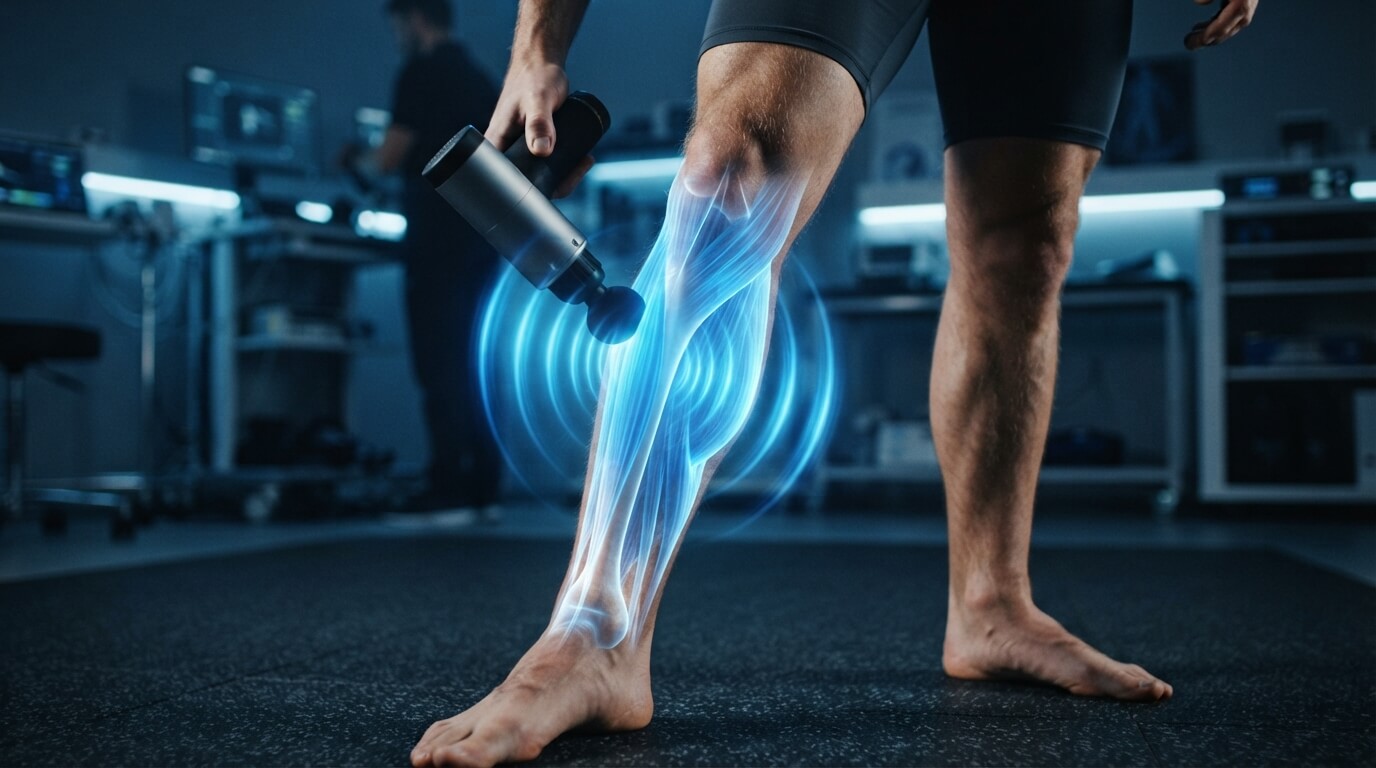
Strip away the app connectivity, the carrying case, and the influencer footage, and a percussion device is defined by three numbers. Learn them and you can rank any two devices in a minute.
Amplitude: How Deep Each Stroke Travels
Amplitude, sometimes listed as stroke length or travel, is the distance the head physically moves back and forth, measured in millimeters. It is the single most important spec on the sheet, and the one budget devices most often hide.
Typical values tell the story. Small mini guns run 6 to 8 mm. Mid-tier full-size devices run 10 to 12 mm. Professional-grade percussion devices run 14 to 16 mm. The difference is felt immediately: a 6 mm device delivers a fast, buzzy, surface-level vibration, while a 14 mm device delivers a distinct thumping punch that reaches deep muscle like the glutes, hamstrings, and quads.
Neither is universally better. Deep amplitude on the thin muscles of the forearm or around the shoulder blade is unnecessary and can be genuinely unpleasant, while shallow amplitude on a dense quadriceps barely registers. The honest framing is that amplitude determines which body areas a device can meaningfully treat. This is precisely the trade-off at the heart of the portability question we explored in our mini massage gun versus muscle roller comparison: minis sacrifice amplitude for portability, and whether that sacrifice matters depends entirely on which muscles you intend to treat.
A red flag worth knowing: listings that trumpet percussion speed and say nothing about amplitude are usually hiding a 6 to 7 mm stroke. Vibration is cheap to manufacture; travel is not.
Frequency: How Many Strokes Per Second
Frequency is listed in percussions per minute (PPM), typically 1,200 to 3,200, which translates to 20 to 53 strokes per second. Marketing treats higher numbers as better, but physiology disagrees with the simple version.
Lower frequencies with real amplitude feel like a rapid deep-tissue drumming and are generally preferred for slow, deliberate work on large muscles. Higher frequencies feel increasingly like vibration, engage those sensory receptors strongly, and are useful for warm-up, sensitive areas, and nervous-system-focused work at lighter pressure. Most quality devices offer several speeds precisely because the two ends of the range do different jobs.
There is also an interaction worth understanding: at very high frequencies, a motor with modest power cannot maintain full amplitude under pressure, so the advertised top speed often comes at the cost of stroke depth the moment the head meets your leg. Which brings us to the third spec.
Stall Force: How Hard You Can Press Before It Quits
Stall force is the amount of pressure, usually stated in pounds or kilograms, that stops the motor. Press a weak device firmly into a dense muscle and the head simply stops percussing; the motor stalls. Typical values run from around 20 pounds in budget minis to 60 pounds and beyond in professional devices.
Stall force determines whether the amplitude on the box survives contact with your body. A device with 12 mm of amplitude and 25 pounds of stall force is a 12 mm device against your forearm and something much weaker against your glute under real pressure. For self-treatment of large lower-body muscles, meaningful stall force (roughly 35 to 50 pounds) is what separates a therapeutic tool from an expensive tickle.
The three specs form a triangle, and honest devices balance all three. Amplitude decides depth, frequency decides character, and stall force decides whether the first two survive pressure. Battery life, noise level (look for figures under about 60 decibels for home use), and attachment variety are legitimate secondary considerations, but no accessory compensates for a weak triangle.
Attachment Heads: Small Physics, Real Differences
Attachment shape changes how the same percussion is delivered, because force spread over a larger area produces lower pressure at any single point.
The large ball or foam head spreads force widely, making it the default for general use and larger muscles. The flat head delivers slightly firmer, more even pressure and suits dense areas like quads and pecs. The bullet or cone head concentrates the entire stroke into a small point, producing very high local pressure; it is intended for specific trigger points and the feet, and it is the attachment most often misused, since concentrated percussion held too long on one spot is the easiest way to leave yourself bruised. The fork or spade shapes are designed to straddle the spine so that percussion reaches the muscles alongside it without hammering bone.
That last sentence contains the most important safety rule of attachment use, and of percussion generally: soft tissue only. Bones, joints, and the front and sides of the neck are not targets. Percussion over bone is painful and pointless, and the neck carries structures, including major blood vessels and nerve pathways, that should never receive percussive impact. For neck tension specifically, purpose-built devices with kneading nodes or heat are the appropriate category, a space we have mapped in detail in our electric neck massager versus heated neck wrap comparison.
What the Research Actually Supports
Percussive therapy research has grown rapidly, and the honest summary is more interesting than either the hype or the cynicism.
Range of motion: the most consistent finding. Multiple controlled studies and reviews find that brief percussive treatment acutely increases flexibility and range of motion, comparable to stretching, without the temporary strength reduction that long static stretching can cause before explosive activity. This makes pre-training use one of the better-supported applications.
Perceived soreness: reasonably supported. Studies on delayed-onset muscle soreness generally find that percussion and vibration therapy reduce how sore people report feeling in the days after hard exercise. Whether it changes the underlying muscle damage markers is much less clear; the relief appears to be substantially neurological, which, for the person who has to climb stairs two days after leg day, is still relief.
Performance and recovery of strength: mixed and modest. Evidence that massage guns restore strength or performance faster is inconsistent, and reviews generally describe effects as small. Percussion is a comfort and mobility tool with plausible circulation benefits, not a shortcut through physiology.
What the research does not support: claims of breaking down scar tissue, eliminating cellulite, flushing lactic acid (which the body clears on its own within roughly an hour of exercise regardless), or treating any medical condition. When a listing reaches for those claims, it is telling you about its marketing department, not its motor. Independent, plain-language summaries of massage research broadly are available from the National Center for Complementary and Integrative Health, and they are a useful calibration for the whole category.
How to Use One Well: Technique, Duration, and Timing
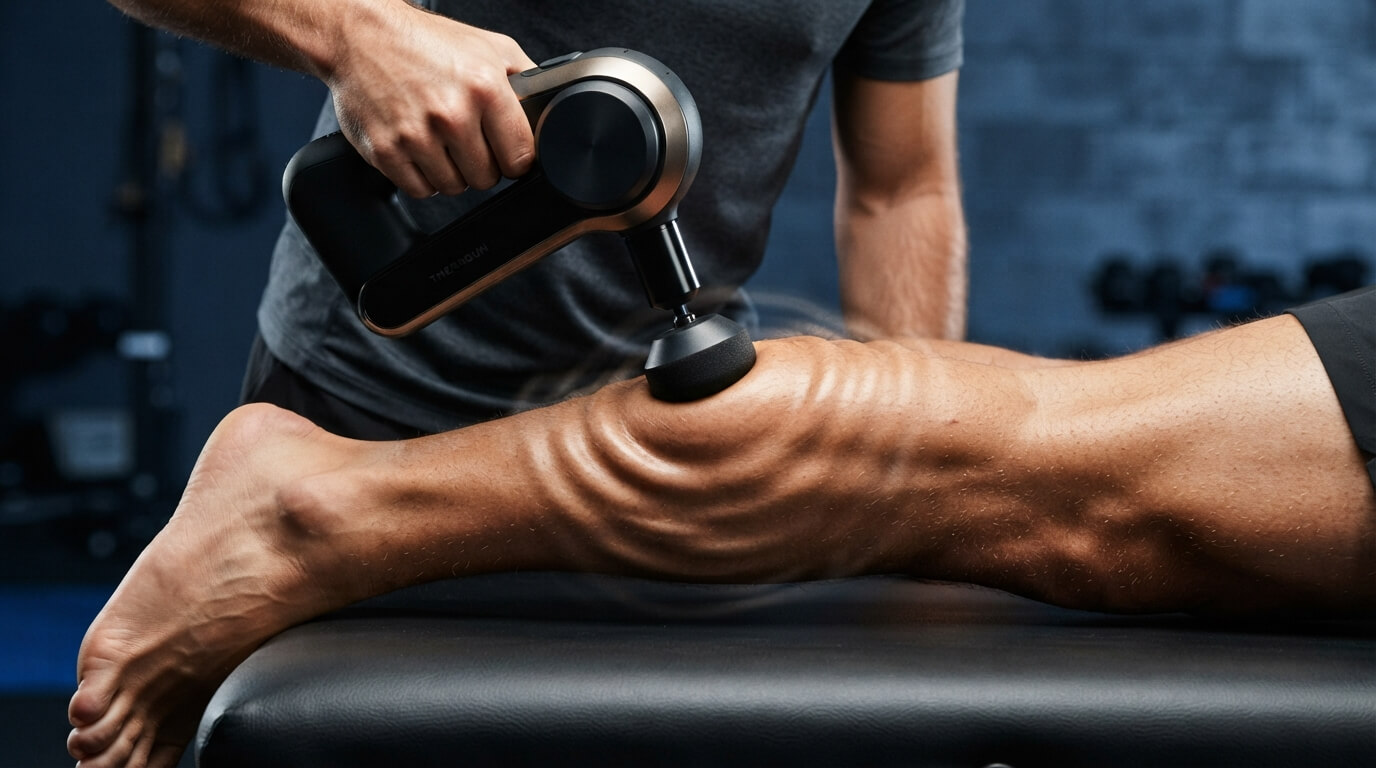
Good percussion technique is easier than the marketing implies and gentler than most beginners assume.
Let the device do the pressing. Float the head on the muscle and add only light pressure. The percussion is the treatment; leaning in with your body weight mostly stalls cheap devices and bruises tissue under strong ones.
Keep it moving. Glide slowly, roughly an inch per second, along the length of the muscle. When you find a tender spot, you can pause briefly, ten to fifteen seconds, then move on. Parking on one spot for minutes is how percussive bruising happens.
Keep sessions short. Research protocols and manufacturer guidance converge on the same range: one to two minutes per muscle group, up to perhaps five for the largest areas. More is not deeper; more is just more mechanical stress on the same tissue.
Time it to purpose. Before training: 30 to 60 seconds per target muscle at moderate speed as part of a warm-up, for mobility and blood flow. After training or on rest days: slower speeds, slightly longer, for soreness management. Before bed: light, high-frequency, low-pressure work can be genuinely relaxing, though it should compete honestly with the cheaper option of simply stretching.
Respect the stop signals. Sharp pain, numbness, or tingling means stop immediately; you are on a nerve or bone, or pressing far too hard. Bruising that appears after sessions means less pressure, shorter durations, or a softer attachment.
Who Should Not Use Percussion, and Where It Does Not Belong
Every legitimate discussion of percussive therapy includes this section, and its absence from a product page is itself information.
Percussive devices should not be used over areas of acute injury, swelling from trauma, suspected muscle strains or tears in their early phase, fractures, or anywhere that has recently been operated on. They do not belong over varicose veins, areas of known or suspected blood clots (deep vein thrombosis is an absolute stop, since mechanical disruption of a clot is dangerous), or areas with reduced sensation, because sensation is the safety system that prevents overtreatment.
People with bleeding disorders or on anticoagulant medication bruise easily and should approach percussion cautiously and with medical guidance. People with pacemakers or other implanted devices should keep percussion away from the implant site and confirm suitability with their clinician. Pregnant users should seek individual medical advice before use. And persistent pain that keeps drawing you back to the same spot week after week is not a maintenance task; it is a symptom that deserves a professional diagnosis rather than an ever-stronger gadget.
None of this makes percussion dangerous for the general population; adverse events in healthy users following sensible technique are rare. It makes percussion a tool with a defined lane, which is exactly what any honest wellness technology is.
Percussion in Context: One Tool Among Several
The recovery landscape is crowded, and percussion overlaps with several neighbors. Against foam rolling and roller sticks, percussion trades time and effort for cost: rolling is slower, requires more body positioning, and is nearly free, while delivering broadly similar short-term mobility effects. Against TENS and other electrical stimulation, the mechanisms differ fundamentally: percussion is mechanical input to tissue and nervous system, while electrotherapy stimulates nerves directly with current, a distinction we unpack in our shiatsu massager versus TENS unit guide. Against heat, the two are complementary rather than competing: heat raises tissue temperature and relaxes; percussion mobilizes and stimulates. Many users get the best subjective results warming an area first, then treating it percussively.
The consistent theme across all of these comparisons: no recovery gadget substitutes for the fundamentals of sleep, protein, hydration, and sensible training progression. Devices modify comfort and mobility around the edges of recovery; they do not perform it.
Percussion by User: What Different People Actually Need
The spec triangle looks different depending on who is holding the device, and matching device class to user is where most buying mistakes happen.
Desk workers treating upper-back tightness, forearms, and hips need modest amplitude, quiet operation above all (this is a device used near family and video calls), and light weight for reaching between the shoulder blades. A 7 to 10 mm device under 55 decibels serves this user better than a professional unit that sounds like power tools. The other half of this user’s solution is not percussive at all; it is the workstation itself, which is why we treat ergonomic support as its own category in our lumbar support and chair cushion guide.
Runners and endurance athletes live in calves, quads, hamstrings, and glutes, which argues for real amplitude (10 mm and up) and enough stall force to work the glutes properly, with battery life mattering for race-weekend travel. Pre-run, short and brisk; post-run, slow and light, avoiding any spot that feels like injury rather than fatigue, since shin pain and deep calf pain are exactly the presentations where hammering away at a possible stress reaction or clot is the wrong move.
Strength athletes are the one group that genuinely benefits from top-tier hardware: dense, large muscle under heavy loading calls for 12 mm-plus amplitude and 40 pound-plus stall force, and this population should be most attentive to the working-versus-resting distinction, using aggressive percussion on rest days and lighter, shorter work around training itself.
Older adults get real value from percussion for stiffness and circulation, with three adjustments: softer attachments and lower speeds as defaults, shorter sessions on thinner tissue, and a stricter version of the medical-caution list, since anticoagulant use, fragile skin, and circulation conditions are all more common. For this user, ease of holding the device (weight, grip angle, button placement) is a primary spec, not an afterthought.
Frequent travelers are the one user class where minis win outright, and the details that matter are case size, USB-C charging, and airline battery compliance, a surprisingly binding constraint we mapped in our travel wellness device guide.
Frequently Asked Questions
Do more expensive massage guns actually work better? Often yes, but for one specific reason: the spec triangle. Price generally buys amplitude, stall force, and quieter motors, all of which change the treatment itself. Price also buys logos, apps, and cases, which do not. Compare the three numbers and the decibel rating, and pay for those.
Are mini massage guns worth it? For portability-first use on smaller muscle groups, yes, with eyes open about the 6 to 8 mm amplitude and modest stall force. For deep work on glutes, hamstrings, and quads, a full-size device is the honest tool.
How often can I use a massage gun? Daily use on healthy tissue at sensible durations (one to two minutes per muscle) is generally fine. Soreness or bruising after sessions is the signal to reduce pressure, duration, or frequency.
Can a massage gun replace stretching or a professional massage? It overlaps with stretching for short-term range of motion and can substitute on busy days. It does not replicate the assessment component of professional hands-on therapy, which is often the most valuable part, especially when pain is persistent.
Why does my muscle feel looser for only a few hours afterward? Because the dominant mechanism is neurological. Percussion changes the nervous system’s tension setting temporarily; it does not restructure tissue. Lasting change in mobility comes from repeated input over weeks, ideally combined with strength work through the new range.
Is the vibration bad for my hands over time? Occupational research on prolonged industrial vibration exposure involves hours of daily exposure over years, far beyond wellness use. Short sessions pose no comparable concern for the user, though people with hand circulation conditions like Raynaud’s phenomenon may find the grip vibration uncomfortable and should favor devices with vibration-dampened handles.
A Buyer’s Checklist and First-Week Protocol
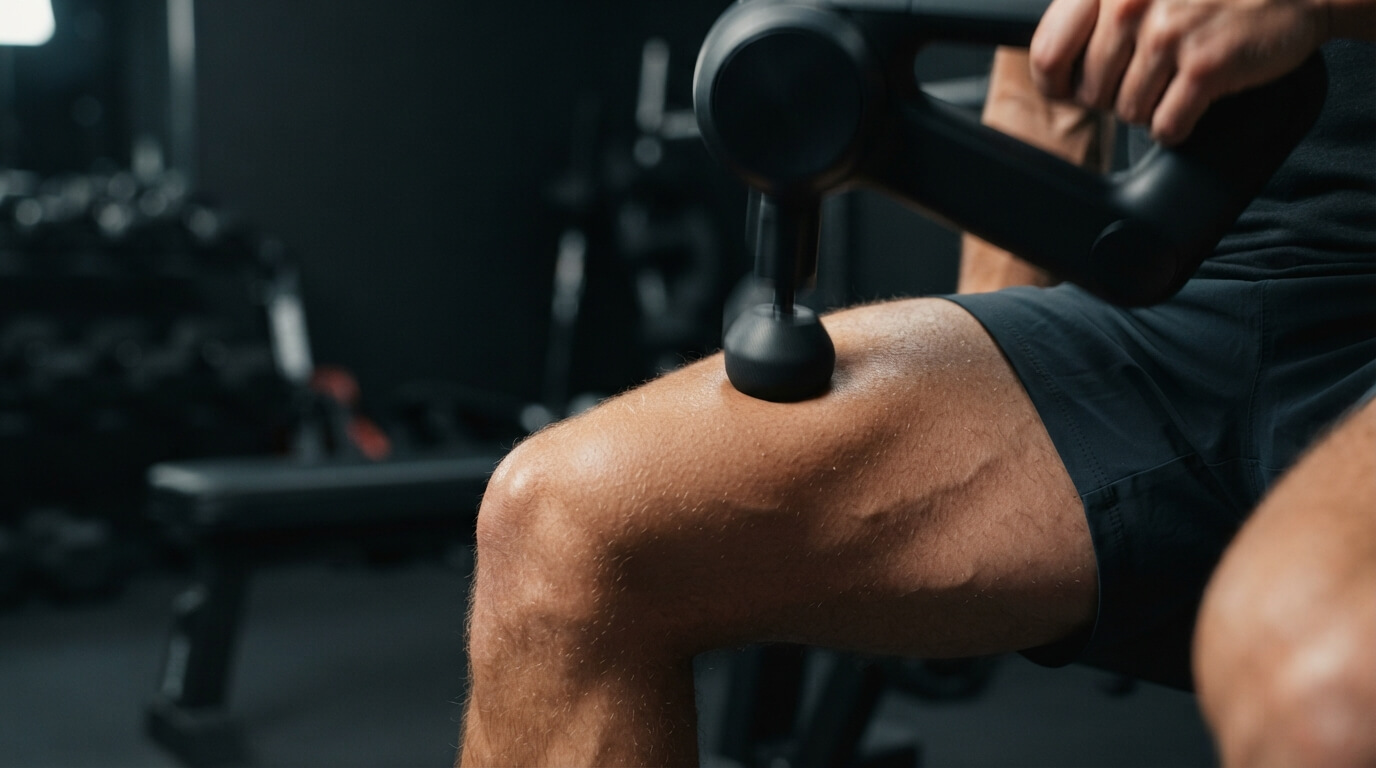
Condensing everything above into the sequence we would run ourselves.
Before buying: find amplitude, stall force, and top-speed decibels in writing, and treat a listing missing any of the three as having answered your question. Check attachment variety for a fork and a flat head at minimum, battery type and charge method, warranty length, and, per the safety section above, whether any of your own medical circumstances put you in talk-to-a-clinician-first territory.
In the first week: start every muscle group at the lowest speed with the big ball head and thirty-second passes, adding intensity only after seeing how tissue responds a day later. Learn your device’s stall point on your own leg so you know what its force ceiling feels like. Map your personal no-go zones (bony prominences, anywhere that produces nerve sensations) once, gently, rather than discovering them at full speed. And set a role for the device, pre-training mobility, post-training comfort, or evening wind-down, because tools with defined jobs get used for years while all-purpose gadgets migrate to drawers.
Disclaimer: This article is for educational purposes only and is not a substitute for professional medical advice, diagnosis, or treatment. Always consult a qualified health provider with questions about a medical condition or before beginning any new therapy.